
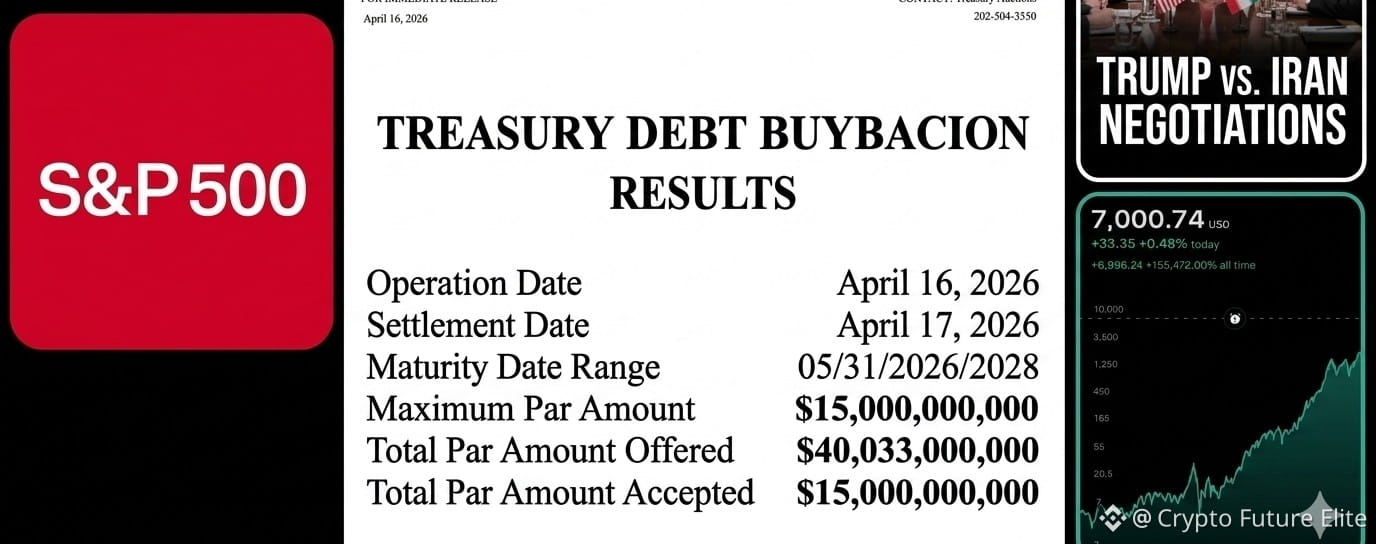
🤔US Treasury just bought back $15 Billion of their own Debt,equaling their largest buyback in history. 💥
At the same time 🇺🇸 Trump said during negotiations with 🇮🇷 IRAN,"IRAN HAS AGREED TO ALMOST EVERYTHING" 🥱
💥Results: The S&P 500 achieved its first record highs since the start of the Iran conflict on Wednesday, surpassing the 7,000 mark.
💡In simple terms: this wasn’t the U.S. “panicking” or secretly defaulting—it’s mostly technical debt management + liquidity support. But the timing is what made people pay attention.
Here’s the brief breakdown 👇
🧠 What actually happened
The U.S. Treasury did a ~$15B buyback of its own bonds (largest on record)
They bought older bonds from the market and will typically replace them with new ones.
👉 Important:
This does NOT reduce total debt — it reshuffles it.
⚙️ Main reasons (the real ones)
1) Improve market liquidity (most important)
Older bonds become illiquid / hard to trade
Treasury buys them back to clean up the market
This keeps the bond market functioning smoothly
👉 Think: removing “junk clutter” so big players can trade easily.
2) Manage interest costs
Replace older high-interest debt with newer, cheaper debt
Over time → reduces borrowing cost
3) Smooth refinancing risk
The U.S. has massive debt maturing soon
Buybacks help spread out repayment pressure instead of facing a sudden wall of maturities
4) Inject liquidity into the system (hidden effect)
When Treasury buys bonds → it puts cash into the financial system
This increases bank reserves / market liquidity
👉 That’s why people compare it to:
“mini QE” (quantitative easing-lite)
⚠️ Why markets are paying attention
Because of context, not just the action:
Bank reserves have been falling
Bond supply is huge
Liquidity has been tightening
👉 So this buyback signals:
“We need smoother liquidity conditions”
Some analysts see it as early easing signals, even if officially it’s not QE
🧩 The simple takeaway
Official reason: technical debt management
Real effect: adds liquidity + stabilizes bond market
👉🏼Market interpretation: possible shift toward easier financial conditions
💡 One-line summary
👉 The U.S. Treasury didn’t reduce debt—it restructured it while quietly injecting liquidity to keep markets stable.
📌Now let’s connect the dots properly—this is where macro meets markets 👇
🔗 The Chain Reaction (Simple Flow)
Treasury Buyback → Liquidity Injection → Lower Yields → Risk Appetite ↑
That one action quietly pushes money into the system.
And where does excess liquidity go?
👉 Risk assets + stores of value
🟠 1) Bitcoin Impact
Short term:
Liquidity ↑ → more speculative capital
Bitcoin reacts fastest to liquidity changes
👉 Why?
No earnings, no cash flow → pure liquidity asset
Highly sensitive to global money supply
What this signals:
Early stage of a liquidity cycle shift
Similar setups seen during:
2020 QE → BTC exploded
2023 liquidity injections → rallies
Key insight:
👉 If buybacks continue = bullish tailwind for BTC
📈 2) Stock Market Impact
Immediate effect:
Buybacks → smoother bond market → yields stabilize or fall
Lower yields = higher stock valuations
👉 Mechanism:
Discount rates ↓ → future earnings worth more
Liquidity ↑ → more flows into equities
Who benefits most:
Tech / growth stocks (rate-sensitive)
Risk-on sectors
But here’s the nuance:
If buybacks are happening because of stress
→ short-term rally, long-term uncertainty
👉 Translation:
Bullish short-term
Watch macro carefully
🟡 3) Gold Impact
Gold reacts differently—it’s more about real rates + trust
Two competing forces:
Bullish:
Liquidity injection → currency debasement fears
Lower real yields → gold becomes attractive
Bearish:
If markets go “risk-on” → money moves to stocks/crypto
Net effect:
👉 Gold rises slower but steadier than Bitcoin
🧩 One-line Summary
👉 This move is like turning the liquidity tap slightly open.
⛔Concerns: 📌The market rebound is largely led by momentum stocks, especially mega-cap technology companies, which continue to drive gains despite oil price concerns.
📌Market breadth is strong but not as broad as previous rallies, indicating some underlying weakness beneath the surface.