
I keep thinking about Pixels in a way that feels a little different from the usual Web3 gaming conversation.
Most people look at Pixels and notice the obvious things first.
There is NFT land. There are pets. There are premium players, free players, and different layers of value moving through the game. That part is easy to see.
But the deeper part... the part that really caught my attention... is not just that Pixels has NFTs.
It is how Pixels uses them.
And honestly, I think that is where the real story begins.
Pixels does not force players into the old, tired model where you must buy expensive NFTs just to matter. That is important. It means the game does not slam the door on new users. A free player can still enter the world, play, explore, build habits, and become part of the ecosystem. That low barrier matters because it keeps the world alive. A game needs people. Energy. Movement. Noise. Without that, even the most beautiful economy starts feeling like an empty market with polished stalls and no crowd.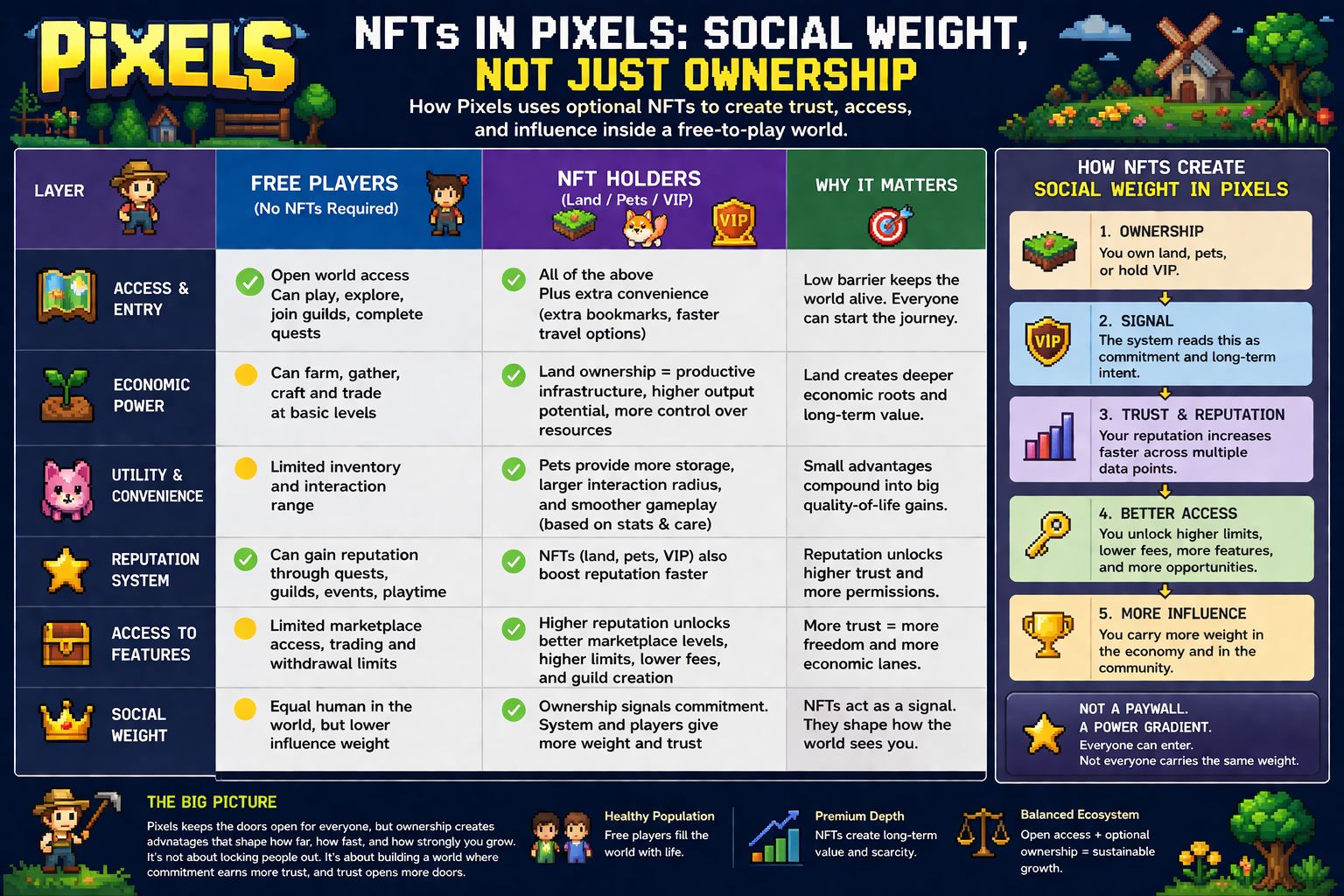
That is why Pixels feels more careful than many earlier NFT games.
It is not saying, “Pay first, then you can belong.”
It is saying something softer. Smarter.
“You can come in for free... but some forms of ownership will change how much weight you carry once you are inside.”
That is a very different idea.
And I think that is the heart of the Pixels NFT model.
When I look at Farm Land in Pixels, I do not just see an NFT. I see a kind of economic anchor. Land is not only about owning a digital square on a map. It is about having a stronger place in the game’s productive layer. It gives a player a more rooted position. More permanence. More gravity. Like owning a shop on the busiest street instead of wandering through the city with a backpack and no fixed base.
That difference matters.
Land says something. Quietly... but clearly.
It signals commitment.
It tells the system, and other players too, that this person is not just passing through. They have skin in the game. They have planted a flag.
Then there are pets.
At first glance, pets may look smaller. More casual. Almost decorative. But in Pixels, they are not just there to look cute. They add utility. They make the playing experience smoother. More storage. Better convenience. Better rhythm. They reduce friction in the background, and sometimes that is where real power hides. Not in flashy rewards. Not in dramatic announcements. But in the small invisible ways that make one player’s loop easier than another’s.
That is what makes this interesting to me.
Pixels is not using NFTs only as assets people hold.
It is using them as tools that shape position.
And position is everything in a game economy.
Because once a game becomes more than a toy... once it becomes a living system... the real question is no longer just who owns what. The real question becomes:
Who moves more easily?
Who gets trusted more?
Who gets better access to opportunity?
Who becomes more valuable to the system over time?
That is where Pixels starts feeling layered.
The game does not appear to treat ownership as the only thing that matters. That would be too blunt. Too old. Too easy. Instead, ownership seems to sit beside other signals like activity, participation, and reputation. And that is a much more modern design choice. It feels closer to how real digital platforms work today. Not everyone is treated equally. Systems watch behavior. They notice commitment. They reward consistency. They create soft hierarchies.
That phrase matters here... soft hierarchies.
Pixels is not building a hard wall between free players and NFT holders. It is building gradients. Slopes. Small rises in the landscape. And over time, those rises matter a lot. A player with land, pets, reputation, and stronger positioning does not just own more. They often move through the ecosystem differently. More smoothly. More confidently. Like someone walking on a paved road while others are still crossing mud.
This is why I do not think the right way to describe Pixels is simply “free-to-play with NFTs.”
That sounds flat. Mechanical. It misses the emotional truth of what is happening.
A better way to say it is this:
Pixels is using NFTs to create social weight inside a free-to-play world.
That weight is subtle. It does not always look aggressive. It does not shout. But it is there. It shapes how the economy breathes.
And in a strange way, that may be exactly why Pixels has felt more durable than many old-school GameFi models.
Earlier NFT games often made one fatal mistake. They turned ownership into a giant locked gate. If you could pay, you entered. If you could not, you stayed outside. That model looked strong for a while, but it was brittle. It created ecosystems that felt more like private clubs than real game worlds. The result was predictable. Once hype cooled, the structure started cracking.
Pixels seems to understand that danger.
So instead of making NFTs the whole house, it makes them the better rooms inside the house.
That is clever.
The free layer keeps the world populated. It brings in motion, curiosity, and new players. The NFT layer creates premium depth. It gives serious players and investors something to own, something to optimize, something to value. So the game does not collapse into pure exclusion. And it does not collapse into total equality either.
It stays somewhere in the middle.
And honestly... that middle ground may be the smartest place to be right now.
Because the market has changed.
People are more skeptical than before. They are tired of empty token promises. Tired of shallow NFT hype. Tired of systems that look exciting for a week and then feel hollow. In that environment, a project like Pixels cannot afford to build around noise alone. It has to build around structure. A system that can welcome casual users while still giving more serious participants a reason to stay.
That is exactly what this NFT model appears to do.
Still, I do think there is a risk.
If ownership keeps gaining too much influence, then optional NFTs can slowly become necessary in practice, even if not in theory. That is the line Pixels has to watch carefully. Because the same soft power that makes the system elegant can also make it quietly unequal. And when that imbalance grows too far, players feel it... even when no one says it out loud.
That is why this topic matters.
Not because NFTs are new. They are not.
Not because free-to-play is new. It is not.
But because Pixels may be combining those two things in a way that feels more realistic, more adaptive, and more aligned with where digital economies are heading.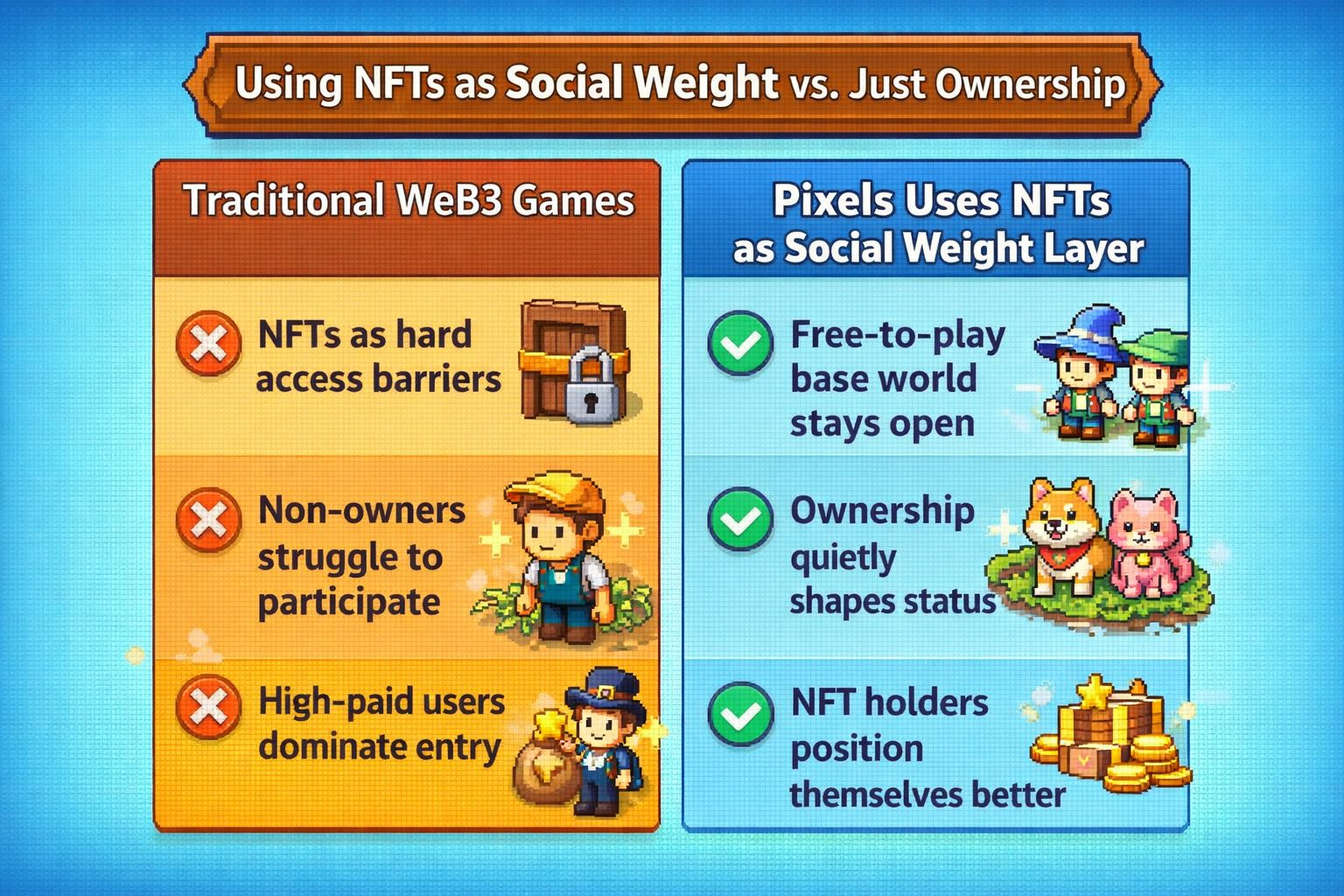
When I step back and look at the whole picture, this is what I see:
Pixels is not really using NFTs to lock people out.
It is using them to shape who carries more weight inside the world.
That is a deeper model. A more mature one.
And maybe that is the real reason Pixels still feels worth watching... because beneath the farming, the land, the pets, and the rewards, it is quietly experimenting with something much bigger:
How to build a game where access stays open... but influence is still scarce.
