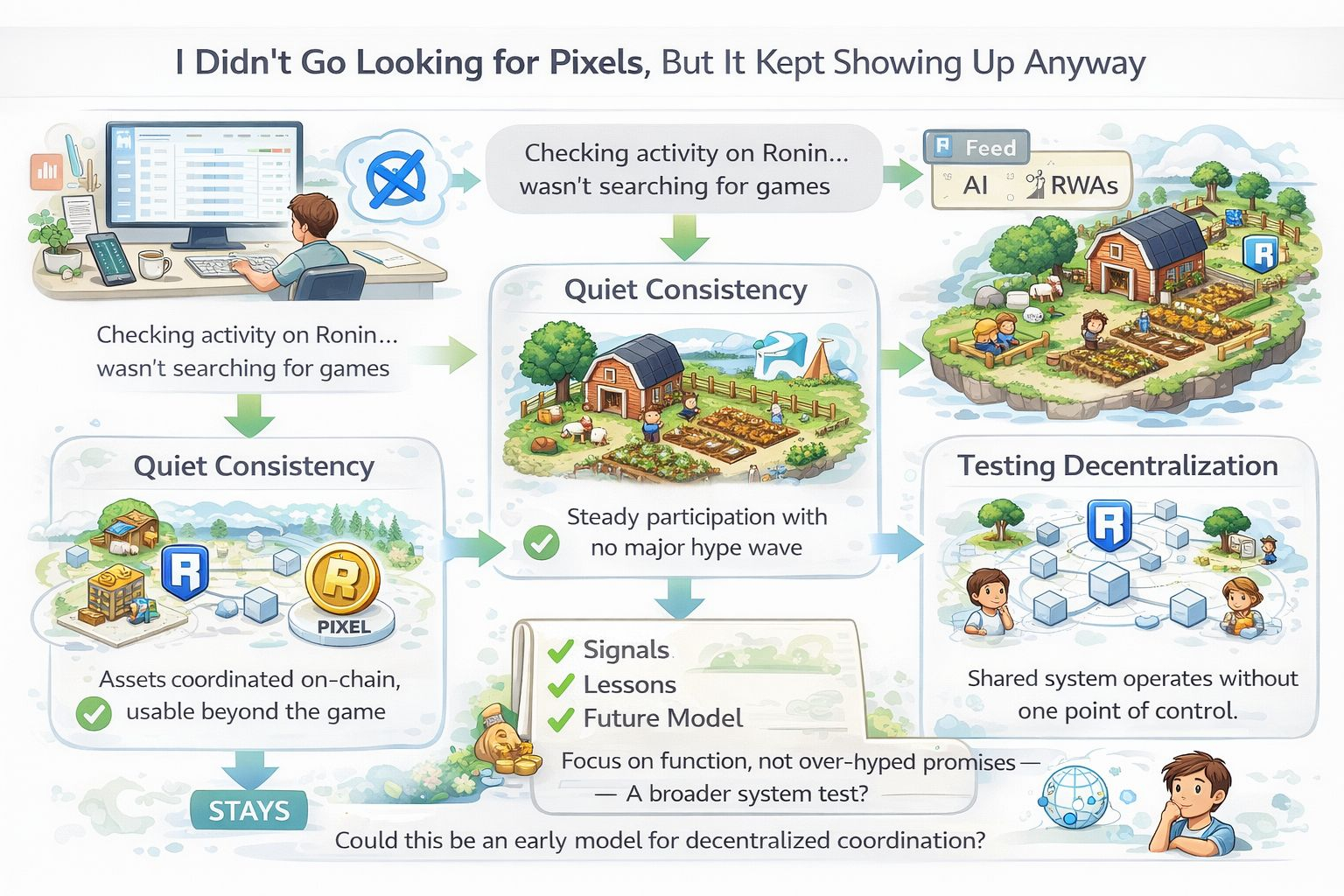
I’ve been spending less time looking at games lately.
Not because they’re irrelevant, but because the market hasn’t really been rewarding them. Liquidity has been picky. It moves fast, chases whatever feels “next” AI one week, restaking the next, then something tied to real-world assets. Games usually come later in the cycle, when people feel a bit richer and a bit more relaxed.
So when I kept seeing Pixels pop up while I was checking activity on Ronin, I didn’t think much of it at first. I wasn’t even searching for games. I was just watching where users were actually spending time. Not headlines, not announcements just raw behavior.
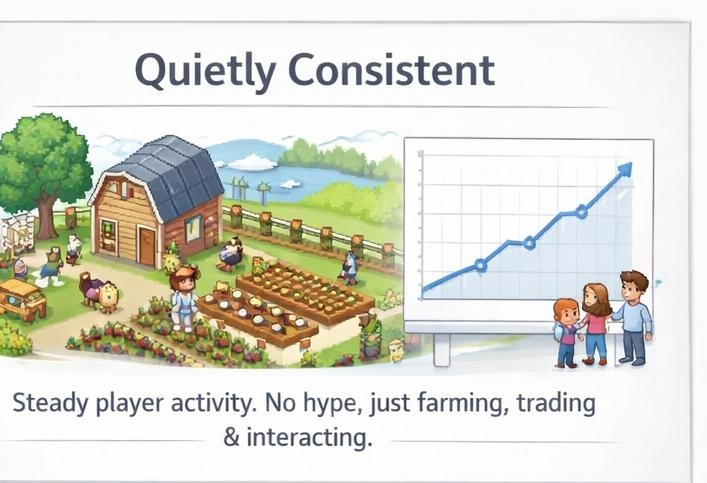
And Pixels was there. Quietly consistent.
No hype wave. No aggressive push. Just people logging in, doing things, coming back.
That’s usually a better signal than anything else, so I opened it.
It didn’t try to impress me. No dramatic intro, no “this changes everything” moment. Just a simple world. Farming, moving around, collecting resources, interacting with other players. It felt almost too basic, like something that shouldn’t be holding attention in a market this competitive.
But I stayed longer than I expected.
And after a while, I realized it wasn’t the gameplay pulling me in it was the structure underneath it.
Most Web3 games I’ve tried feel forced. You can almost feel the token mechanics pushing you around. Everything is optimized for extraction. Either you’re early enough to benefit, or you’re feeding someone else’s exit.
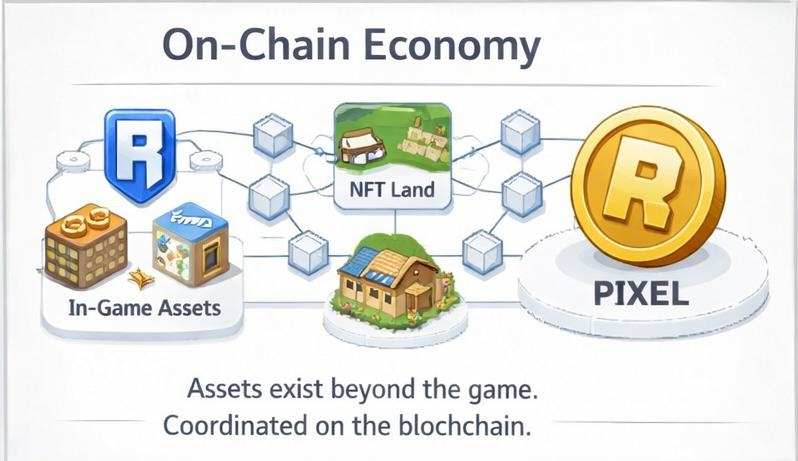
Pixels doesn’t completely escape that, but it softens it.
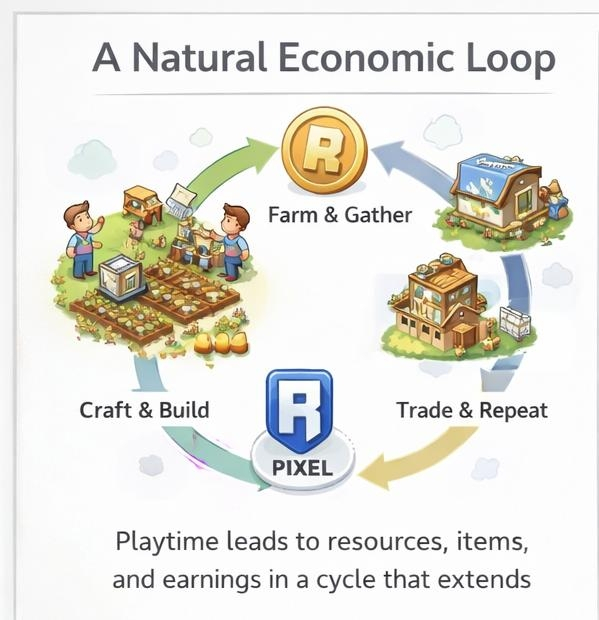
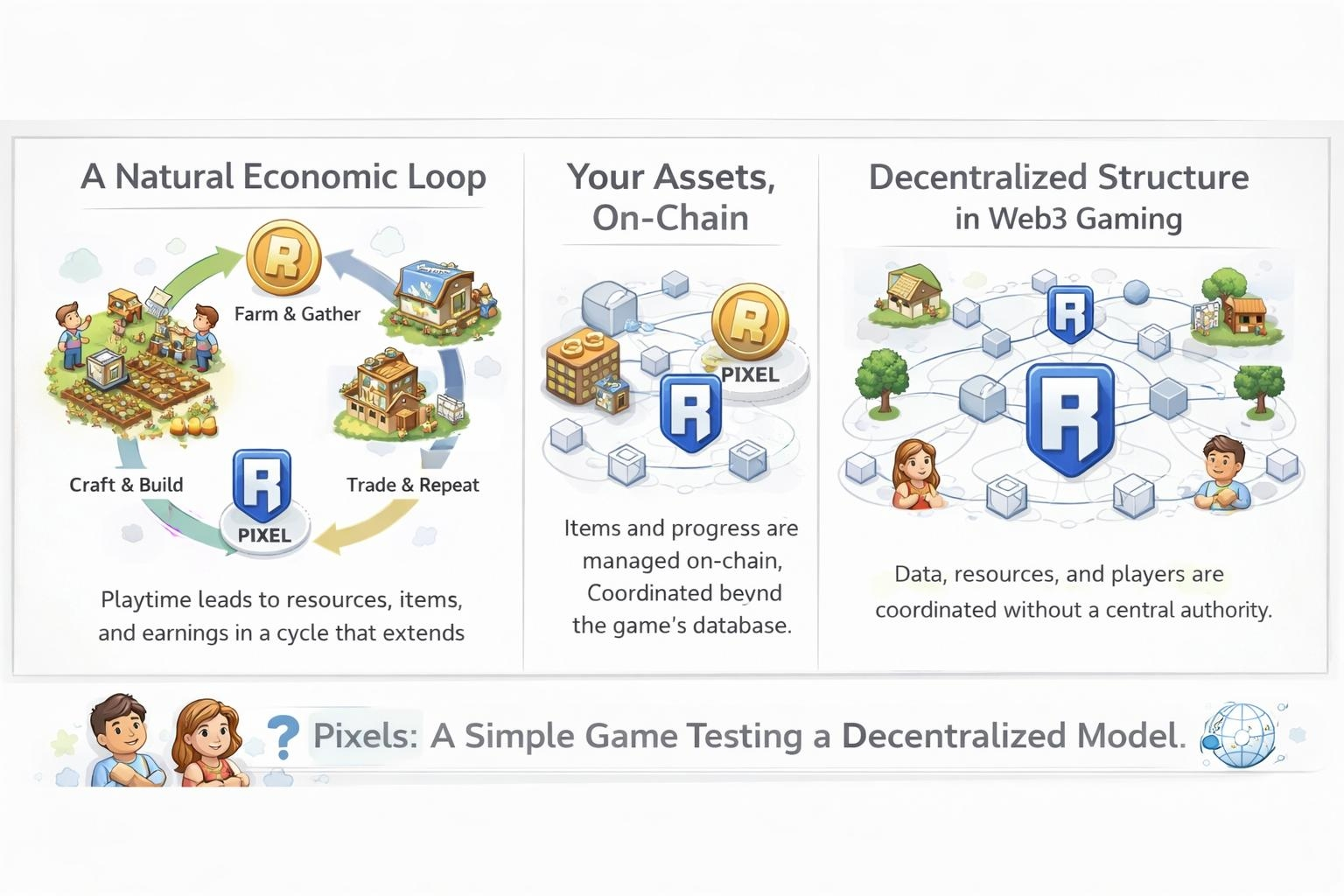
The economy feels more like a loop than a trap. You put time in, you get resources, you build something, you trade, you repeat. And the interesting part is that what you earn isn’t locked inside the game in the usual way. Your assets exist beyond it, coordinated on-chain through Ronin.
It’s a small detail on the surface, but it changes how the system behaves.
Instead of everything being controlled in one place, it’s more distributed. Your data, your progress, your items they’re part of a shared system rather than a private database. That’s the decentralization piece people talk about, but here it’s not being marketed loudly. It just exists in the background.
And maybe that’s why it works.
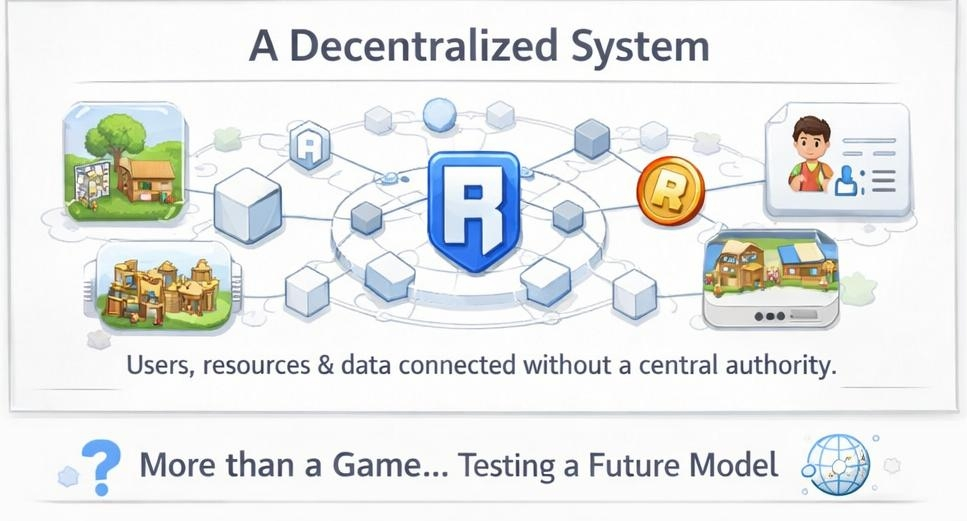
Because right now, the market doesn’t care about big promises. It cares about things that actually function. Things that people use without needing to be convinced every five minutes.
Pixels seems to be leaning into that without making a big deal out of it.
Still, I’m cautious.
I’ve seen enough cycles to know how fragile these systems can be. The balance between fun and financial incentive is tricky. If the economy becomes too dominant, the game starts to feel like work. If the incentives weaken, people leave.
There’s no easy middle ground.
And then there’s the token itself. PIXEL isn’t just sitting on the side it’s tied into how the system runs. That makes it useful, but also vulnerable. Market sentiment shifts fast. If attention moves away from gaming again, it’s not just the price that feels it the whole ecosystem does.
What I can’t ignore, though, is how natural the activity feels.
No sudden spikes that fade just as quickly. No obvious farming behavior dominating everything. Just steady participation. People doing small things, over and over again.
That’s harder to fake than a temporary surge.
It makes me wonder if the real story here isn’t about the game itself, but about what it represents.
Because when you strip it down, Pixels is really about coordination. A system where users, resources, and infrastructure interact without one central point controlling everything. It just happens to be packaged as a game.
And maybe that’s the part most people overlook.
We keep thinking these are isolated experiments games, platforms, small ecosystems competing for attention. But what if they’re early versions of something broader? Ways to test how decentralized systems behave when real people engage with them over time.
Not in theory. In practice.
That thought stuck with me after I logged off.
Because if something this simple can keep people engaged while quietly running on a shared, decentralized structure, then the model itself might be more important than the product we’re seeing.
And if that’s true, then the real question isn’t whether Pixels succeeds as a game.
It’s whether systems like this can hold together once the market stops paying attentionand no one is being rewarded just for showing up.