

Most play-to-earn games did not really become games. They became extraction systems with game graphics wrapped around them.
That is probably the cleanest way to describe what went wrong with the first big wave of crypto gaming. The promise sounded great: own your assets, earn while you play, participate in an open economy. But in practice, a lot of these projects turned into weird digital labor markets where the “fun” part existed mostly to justify the reward loop. People were not playing because they liked the game. They were showing up to farm, dump, and move on.
And once that happens, the whole thing starts eating itself.
Because to be completely honest, the core problem in crypto gaming has never just been bad graphics or weak design. The real issue is that most of these economies are built around short-term extraction. If the main reason people enter the system is to pull value out of it, then the game is not really competing with other games. It is competing with yield farms, airdrops, and every other speculative opportunity on the internet. That is a brutal place to live.
That is why Pixels is interesting.
Not because it has a token. Not because it found product-market fit in Web3. Not because it proves play-to-earn “works.” It is interesting because it seems to understand the actual failure mode better than most of its peers. It is trying to build something that people might still touch even after the financial excitement cools off.
That sounds obvious. It is not.
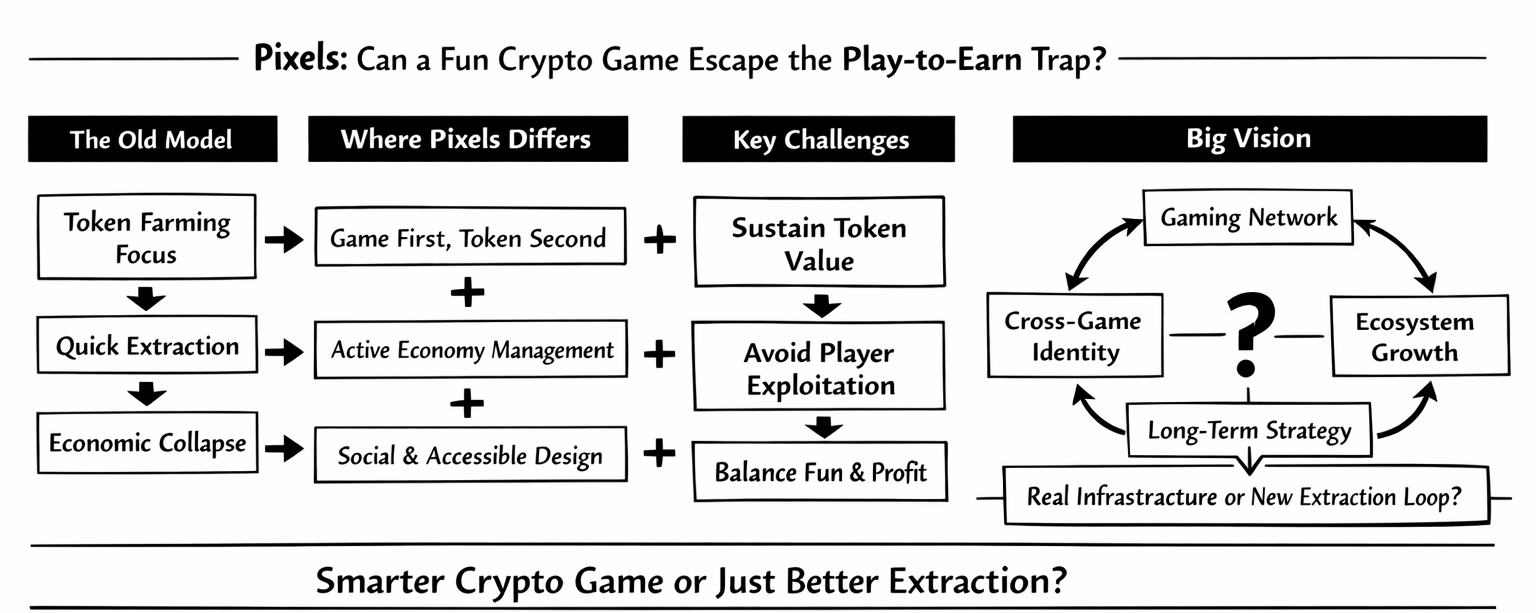
Most crypto games fail in the same predictable ways. The gameplay is shallow, so players optimize instead of engage. Rewards become the only real retention tool, so the user base shifts from players to farmers. Inflation kicks in, token emissions keep people interested for a while, and then selling pressure starts crushing the economy. Once the rewards stop feeling attractive, the illusion breaks. People leave, activity falls, and suddenly the entire “economy” looks like a machine that only worked while fresh capital was entering from the outside.
This is why so much play-to-earn became play-to-extract. The player is not behaving like a player. The player is behaving like a rational mercenary.
And honestly, that behavior is not the problem by itself. People respond to incentives. If you build a system that rewards repetitive farming and short-term token harvesting, that is exactly what users will do. Blaming the users misses the point. Incentive design is the game. If the incentives are wrong, everything downstream gets distorted.
Pixels seems to get that. At least more than most.
The project’s main pitch is not just that it is a crypto game. It is that it is trying to be a game people actually want to spend time in first, and an onchain economy second. That distinction matters. But it also deserves a little skepticism, because saying “game first” is easy. Keeping the economy from corrupting the game is much harder.
The first thing Pixels appears to do differently is put the game before the token, at least in terms of experience design. It has a more social, accessible, low-friction structure than the usual Web3 grind machine. The browser-based format helps. The art style is friendly. The loop is easy to understand. It feels closer to a lightweight social farming game than a financial dashboard with avatars.
That is a real strength.
It lowers the intimidation factor, broadens the audience, and creates a better chance that some users are there because they actually like being there. In crypto gaming, that is already a meaningful improvement. If players enjoy the world without constantly asking what the hourly return is, you have at least created the possibility of healthier retention.
But it sounds good on paper, and the risk is still obvious: once a token sits at the center of the system, the economy has a way of taking over player behavior anyway.
A game can feel light, social, and fun at the surface while still training users to optimize every action around yield. If the most committed players are the ones extracting the most value, then the design quietly shifts in that direction whether the team wants it to or not. Over time, even a pleasant game loop can become a spreadsheet game in disguise. That is the trap. “Game first” is not just about how it looks. It is about whether the system still works when the reward intensity fades.
That remains unproven.
The second thing Pixels is doing differently is using a more data-driven approach to rewards and progression. This is probably one of the smarter parts of the model. Instead of pretending the economy will naturally balance itself, the team seems more willing to tune outputs, track behavior, and actively manage incentives. In theory, that is exactly what crypto games need. A live economy cannot survive on ideology. It needs real-time intervention.
This is where Pixels feels more modern than the earlier generation. The old model was often embarrassingly static: emit token, reward activity, hope demand catches up. Pixels appears more aware that reward systems need to be adjusted based on actual player behavior, not fantasy assumptions about loyalty or market conditions.
That is a strength because it shows they understand that economies are behavioral systems, not just token charts.
But there is another side to that too.
A heavily managed economy can reduce obvious inefficiencies, but it can also create fragility. If the system only works because the team is constantly tuning incentives behind the scenes, then sustainability may be more artificial than it looks. You are not solving the structural tension. You are managing it in real time. That is better than doing nothing, sure, but it still means the economy may depend on a very active operator staying one step ahead of the player base.
And players always adapt faster than people think.
Especially in crypto, once profitable patterns emerge, they spread quickly. Farming communities, botting pressure, multi-account behavior, off-platform coordination — all of this can overwhelm carefully designed systems. So the question is not whether Pixels can optimize its economy for a while. It probably can. The harder question is whether it can keep doing that without making the experience feel overly controlled, overly extractive, or just exhausting to maintain.
That brings us to the third big point: the publishing and distribution flywheel.
This may actually be the most ambitious part of the Pixels thesis. The project is not just trying to build one successful crypto game. It seems to be trying to build a larger gaming network, where Pixels becomes a kind of center of gravity for users, identity, distribution, and maybe future game economies. In other words, it is trying to become infrastructure, not just content.
That is a much bigger idea than “farm token in pixel game.”
If it works, it gives Pixels something most crypto games never achieve: leverage beyond a single gameplay loop. Instead of relying only on one title to keep attention alive, it can potentially extend user acquisition, retention, and monetization across a broader ecosystem. That could matter a lot, because one game can cool off fast, but a network can keep reinventing its reasons to exist.
There is real strategic logic there. Distribution is hard. Attention is expensive. If Pixels can use its existing player base as a base layer for future experiences, it gives the project a better shot at surviving beyond the initial cycle.
But again, the risk is huge.
Building one durable game is already difficult. Building a game network is much harder. You need good content, strong economic design, cross-game identity that actually means something, and enough operational discipline to keep the whole thing coherent. In crypto, projects often start talking like platforms long before they have earned that status. The language gets bigger faster than the product does.
That is where a little skepticism is healthy.
Because the network vision can either be a genuine long-term strategy or a smarter narrative wrapper around the same old problem: needing continuous new activity to support the system. If more games, more users, and more distribution mainly serve to create fresh demand for the token economy, then it may still be another version of the same extraction model — just better packaged, better designed, and more patient in how it pulls value through the system.
And that leads directly to the token.
$PIXEL is where the entire conversation gets uncomfortable, because no matter how nice the design is, token sustainability is still the hardest problem in crypto gaming.
The basic issue is simple. If players earn a token, many of them will sell it. That is not a moral failure. That is the expected behavior. Unless the game creates strong, recurring reasons to hold, spend, or sink that token back into the ecosystem, sell pressure becomes the default state. Then the economy starts requiring either new players, stronger speculation, or more aggressive demand engineering to absorb that pressure.
That is the old problem, and I do not think Pixels fully escapes it.
Maybe it manages it better. Maybe it delays it. Maybe it creates more sinks, more utility, more reasons for users to stay inside the loop. All of that helps. But the real challenge is whether those sinks are organic or forced. If people use the token because it genuinely improves the experience, that is a healthy signal. If they use it because the system keeps nudging them into circular spending just to stabilize the economy, that is less convincing.
This is where crypto gaming often starts to feel financially clever but emotionally empty.
Players can sense when an economy is designed for life inside the world versus designed to defend the chart. And once that trust fades, the whole model gets harder to sustain.
To be completely honest, Pixels may be one of the better attempts at addressing this. It does seem more thoughtful than the first wave of play-to-earn games. It feels less cynical. It feels more aware of user behavior, more grounded in actual game loops, and more serious about distribution and long-term structure.
But that does not automatically mean it has solved the problem.
The real issue is that crypto games keep trying to reconcile two forces that naturally fight each other. Good games want immersion, experimentation, community, and long-term engagement. Tokenized systems invite optimization, extraction, and financial behavior. Sometimes those things can coexist. A lot of the time, one of them ends up hollowing out the other.
Pixels looks like it is trying harder than most to keep that balance intact.
That alone makes it worth paying attention to.
Still, the difference between “smarter model” and “same model with better UX” only becomes clear over time. Can the game hold attention when token rewards matter less? Can the economy survive without leaning too heavily on new entrants? Can the project expand into a real network without becoming bloated or overly financialized? Can it manage token pressure without constantly redesigning incentives every few months?
Those are not small questions. They are basically the whole case.
So my take is mixed.
Conceptually, Pixels is one of the more credible crypto gaming projects because it seems to understand where earlier models broke. It is not just shouting about ownership and rewards. It is trying to think about behavior, retention, and ecosystem design in a more serious way. That matters.
But execution risk is still high. Very high.
Because in crypto gaming, understanding the problem is not the same thing as escaping it.
Pixels may be building something more durable than the usual play-to-earn machine. Or it may just be the cleanest, most playable version of the same extraction logic the sector has been struggling with all along.
Interesting, but time will tell.
