
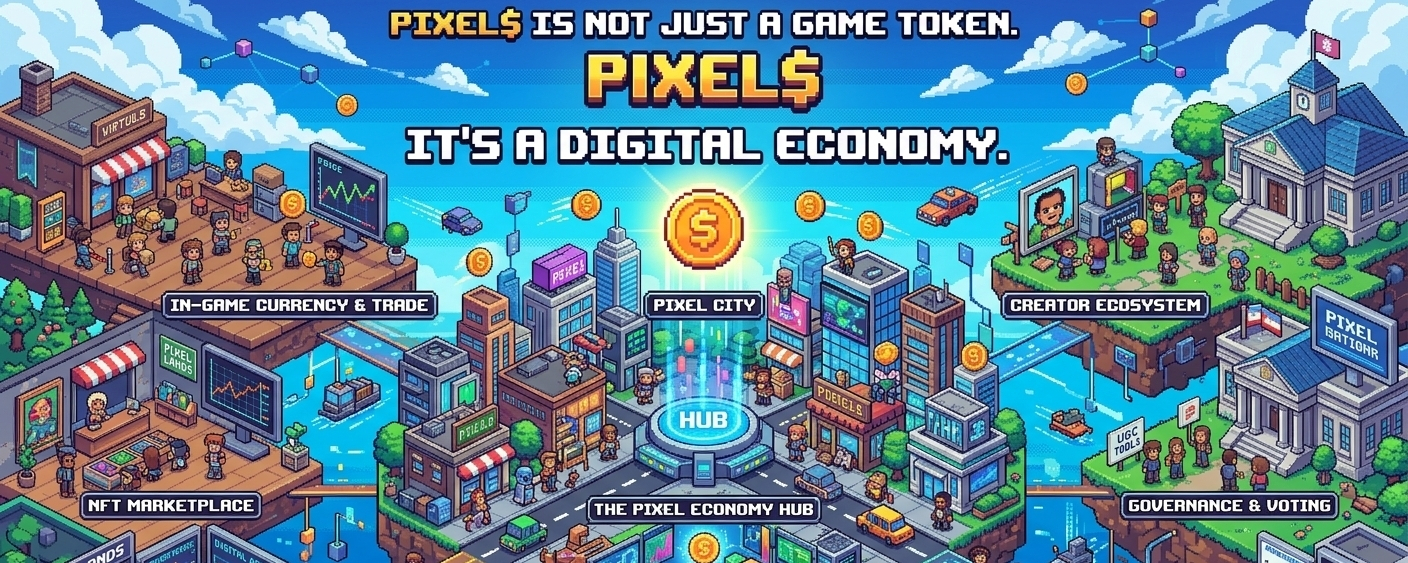
I think most people hear "game token" and think speculation... Buy before the hype, sell during it, move on. That's how the market treats PIXEL, and that's exactly why the market is missing the point.
It's confirmed that PIXEL isn't just the currency of a game. It's the economic layer of a living digital world... Pixels is a farming and social game on Ronin, but what's been built underneath it isn't a reward loop — it's a functioning micro-economy. Players earn, spend, trade, and invest. Land has value. Resources have scarcity. Labor — yes, actual in-game labor — generates output that other players need.
I believe that's not a game. That's an economy that happens to be fun.
The distinction matters because economies have different fundamentals than games... Games die when players get bored. Economies persist as long as there's something worth transacting. Pixels has been building toward the second category quietly, while the market has been pricing it like the first.
PIXEL the token sits at the center of that system. Governance, in-game purchases, land interactions, crafting — it all flows through PIXEL. when the ecosystem grows, demand for PIXEL doesn't just increase, it compounds. More players means more activity means more transactions means more reasons to hold rather than dump.
Nobody's talking about it that way right now. which is usually when it's worth paying attention.
I believe PIXEL isn't the currency of a game... It's the economic layer of a living digital world. Pixels is a farming and social game built on Ronin, but what's underneath it isn't a reward loop dressed up as entertainment — it's a functioning micro-economy. Players earn, spend, trade, and invest. land has value. resources have scarcity. Labor — actual in-game labor — generates output that other players need to progress. That's not a game mechanic. that's supply and demand.
I noticed the distinction matters more than people realize... games die when players get bored. Economies persist as long as there's something worth transacting. Boredom is a product problem. An economy is a structural one. Pixels has been quietly building toward the second category while the market has been pricing it like the first.
Guys Look at the architecture... Ronin isn't a random chain choice — it's purpose-built for gaming with near-zero transaction fees and fast finality. That matters because micro-transactions are the lifeblood of an in-game economy. If every crafting interaction or resource trade costs a dollar in gas, the economy seizes up. On Ronin, it doesn't. The infrastructure was chosen to let economic activity breathe, and that's a deliberate design decision that most token analysts never bother to examine.
Then there's land. land in Pixels isn't cosmetic. It's productive. Landowners can deploy resources, host players, and generate yield from the activity happening on their plot. That creates a property rights layer inside a digital world — owners, tenants, output, rent. These are concepts that predate blockchain by centuries. They work because they reflect how humans actually organize productive activity. Pixels didn't invent that logic. it just encoded it on-chain, where it becomes transparent, tradeable, and composable.
I feel PIXEL the token sits at the center of all of it... Governance, in-game purchases, land interactions, crafting upgrades — the token isn't a reward you dump after a quest. It's the medium of exchange for an economy that runs whether you're playing or not. When the ecosystem grows, demand for PIXEL doesn't just increase linearly. It compounds. More players means more land activity means more crafting means more resource trades means more reasons to hold rather than sell... That compounding dynamic is what separates an economy from a game with a points system.
The criticism you'll hear is that it's still early, that player counts fluctuate, that the broader GameFi narrative has been burned before. All of that is fair. GameFi has a credibility problem it earned honestly... But the projects that survive the credibility crisis will be the ones that built something with real economic gravity — not just high APYs and a whitepaper full of token sinks.
I think Pixels is one of the few that actually built the thing... The economy is real. the land market is real. The labor dynamics are real. PIXEL isn't pricing any of that in right now, which means either the market is right and none of it matters, or the market hasn't looked closely enough.