
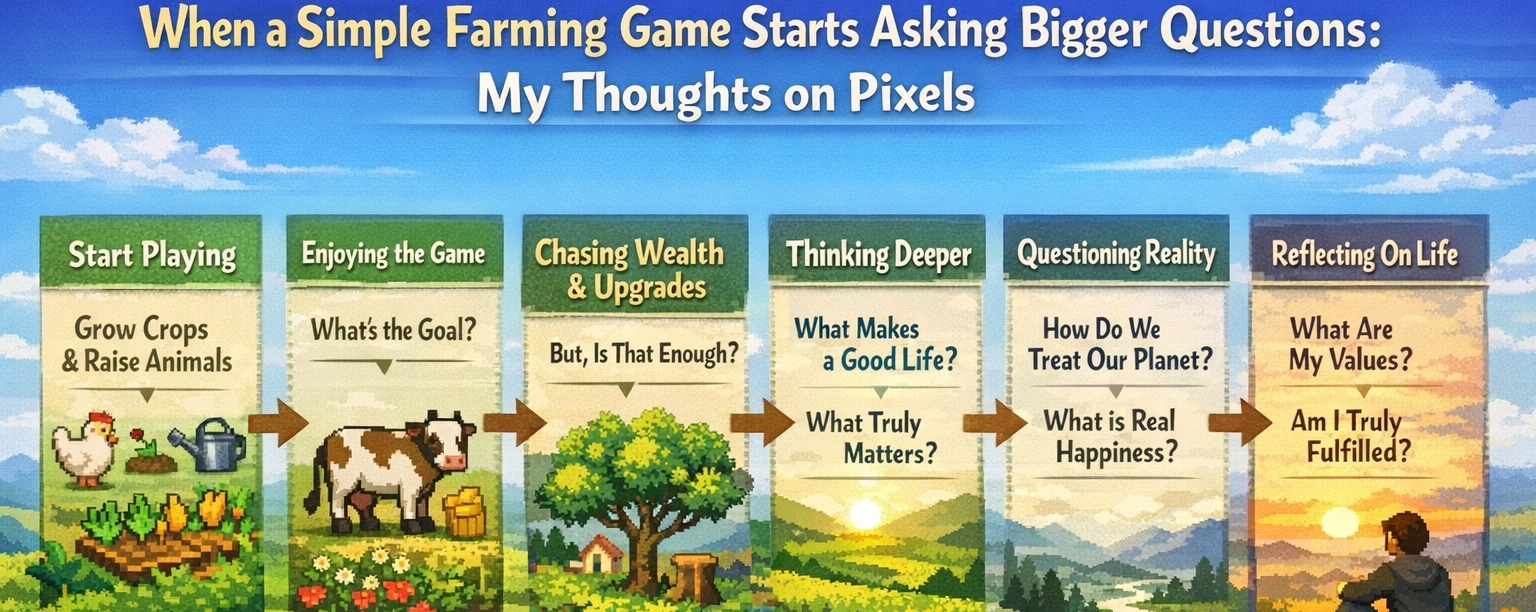
I was sitting with a cup of tea the other night, half paying attention to the rain outside and half scrolling through different Web3 projects, when I stumbled back into Pixels. At first glance it looked almost too simple — little pixelated farms, bright colors, players wandering around collecting resources. It reminded me of the kind of browser games people used to play casually in between everyday life, something light and harmless. But the more I looked at it, the more I felt that strange tension that exists in a lot of blockchain projects: the surface feels playful, but underneath there’s an entire economic system trying to function.
That’s what made Pixels interesting to me. On one level, it presents itself as a social farming game. You plant, harvest, trade, explore, and slowly build out your land. It feels familiar because farming games have always had this quiet rhythm to them — repetitive but satisfying, simple but strangely absorbing. But Pixels isn’t only trying to recreate that loop. It’s layering ownership, governance, and token incentives underneath that routine, asking players to participate in an economy while they play. And when I started thinking about that, I realized Pixels isn’t really just about farming. It’s about whether a game economy can feel natural when real value is attached to it.
That question matters because Web3 games often struggle with balance. If rewards are too strong, players arrive for extraction instead of enjoyment. If rewards are too weak, the blockchain layer starts to feel unnecessary. Pixels seems aware of that problem. It uses a free-to-play model to lower the barrier for entry, while reserving blockchain mechanics for land ownership, token incentives, and governance. That separation feels intentional, almost cautious. It suggests the team understands that if every small interaction required a wallet transaction, the experience would become exhausting. By keeping the casual gameplay familiar and letting the token economy sit quietly in the background, Pixels is trying to build something that feels like a game first and an economy second.
And honestly, that might be one of its most important design choices.
Because trust in blockchain gaming is fragile. People have seen too many systems where the economy became the game. Instead of fun creating value, value was expected to create fun. That rarely lasts. When rewards shrink, attention disappears. What makes Pixels feel different is that it appears to be chasing routine behavior rather than speculation. Farming, crafting, and social interaction create repeatable loops that don’t rely entirely on token price. That doesn’t solve the incentive problem, but it changes the shape of it.
Lately, the project has been leaning further into this idea by expanding the PIXEL token’s role across a broader ecosystem, with staking mechanics and connected experiences in other games. Reports show that over 73 million PIXEL tokens were staked shortly after the staking model launched, suggesting that users are at least willing to lock value into the ecosystem rather than immediately extract it. That matters because it hints at a deeper kind of engagement — one where users may be starting to think of the token as part of a growing network rather than just a short-term reward.
But staking systems are never neutral. They create commitment, yes, but they also create expectation. The moment players stake tokens, they begin evaluating whether the system is worth trusting. Governance, reward structures, treasury decisions — these things stop being background mechanics and start becoming social contracts. That’s where Pixels becomes more than a farming simulator. It becomes a governance experiment, even if most players don’t think of it that way.
And governance in gaming is a strange thing. In theory, decentralized governance sounds empowering. Players gain influence, ecosystems become community-driven, incentives align. But in practice, governance often accumulates around those with the largest holdings, which can reproduce the same power imbalances decentralization claims to avoid. So when Pixels talks about ownership and governance, I find myself wondering what kind of ownership this really creates. Is it creative ownership, where players genuinely shape outcomes? Or is it financial ownership, where influence scales mostly with token accumulation?
That uncertainty doesn’t make the project weak — it makes it real.
Because every meaningful economic system carries these contradictions. Pixels wants participation, but it also needs sustainability. It wants openness, but it needs structure. It wants player ownership, but it also needs coordinated direction. These tensions are unavoidable, and the way a project handles them often reveals more than its roadmap ever could.
One reason I keep watching Pixels is because its recent growth suggests these questions are becoming harder to ignore. The game has reportedly passed 1.1 million players on Ronin, alongside over 2 million lifetime wallets, which means the ecosystem is no longer operating at a tiny experimental scale. Once participation reaches that level, economic design decisions start shaping real behavior in measurable ways. Inflation, reward pacing, onboarding friction, token sinks — these aren’t abstract systems anymore. They begin influencing whether users stay, whether markets stabilize, and whether trust deepens or erodes.
And that scale matters even more because of the network Pixels chose to build on. Ronin was designed specifically for gaming, which gives Pixels infrastructure tailored to low-cost transactions and high user activity. Recent improvements to Ronin’s economic and security model show the broader ecosystem is still evolving, with governance incentives shifting toward builders and new security upgrades aiming to strengthen trust. That’s encouraging, but it also reminds me that Pixels depends on more than its own design. Its economy is partially downstream of Ronin’s reliability, policy decisions, and network health. In that sense, Pixels is modular but not independent.
And maybe that’s where the project becomes most interesting to me: it exposes how layered trust really is in Web3.
A player might trust the game mechanics but not the token model. They might trust the token model but not the network. They might trust the network but not the governance process. Each layer adds possibility, but each layer also adds fragility. Pixels can create a beautiful in-game economy, but if users don’t trust the surrounding infrastructure, that beauty becomes difficult to sustain.
At the same time, there’s something quietly compelling about how modest the game feels despite all this complexity. The act of planting crops and trading resources is small and understandable. It gives the economic layer something human to attach to. That simplicity might be the project’s greatest strength, because users tend to understand systems better when the visible actions are intuitive. If governance and incentives are built around familiar behaviors, adoption becomes less about education and more about habit.
Still, habit alone isn’t enough. Real ecosystems are messy. Players optimize. Communities coordinate. Speculators enter. Rewards distort behavior. A system that looks stable under friendly conditions can behave very differently under pressure. I think that’s the real test waiting for Pixels — not whether it can grow, but whether it can preserve balance when incentives begin pulling users in conflicting directions.
That’s the question I kept returning to as I thought about the project: what happens when the farming stops being symbolic and the economics become emotionally real? What happens when governance decisions upset players, or when token volatility changes how people interact with the game? Can the social layer absorb that pressure, or does the economic layer overwhelm it?
I don’t think there’s an easy answer yet, and maybe that’s why Pixels keeps my attention. It feels less like a finished product and more like a live experiment in whether digital ownership can coexist with casual play without distorting it. There’s something honest about that uncertainty.
The more I look at Pixels, the less I see a simple farming game and the more I see a quiet attempt to solve one of Web3 gaming’s hardest problems: how to create incentives without letting incentives define everything. I find that fascinating, but I also find myself wondering whether that balance can really hold once larger numbers, stronger incentives, and real economic pressure enter the picture.
Personally, that’s where my curiosity sits right now. I like the simplicity of what Pixels is trying to build, and I respect the fact that it seems to be moving toward sustainability rather than spectacle. But I can’t help wondering what kind of behavior this system will create when more people arrive, when rewards fluctuate, and when governance becomes contested. Will the social world remain stronger than the financial one, or will the economy slowly reshape the game around itself? I keep thinking about that, and maybe that unanswered question is the most honest place to leave it.
