
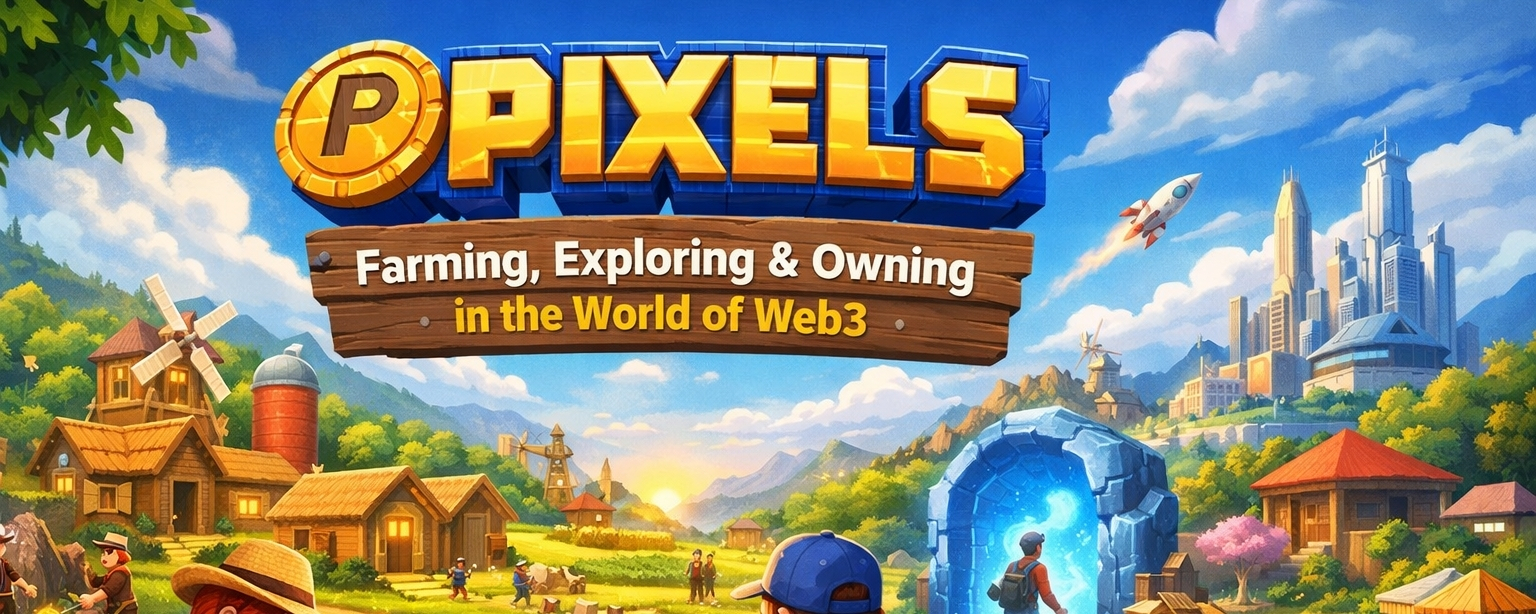
There’s something a bit ironic about Pixels. At a time when most Web3 projects try to impress you with complexity—tokenomics charts, layered mechanics, big promises—Pixels goes in the opposite direction. It looks simple. Almost too simple.
You log in, you farm, you walk around, you collect stuff. At first, it doesn’t scream “next-gen blockchain innovation.” And honestly, that’s probably the point.
Because the real problem Pixels is trying to solve isn’t technology. It’s behavior.
Most people don’t stick around in Web3 games. Not because they don’t understand crypto, but because the games themselves don’t feel like games. They feel like systems. Or worse, like work. Pixels flips that idea on its head by starting with something familiar—farming, exploration, progression—and only then layering in ownership, tokens, and economy.
And weirdly, that approach seems to be working.
When you first enter the Pixels world, it doesn’t overwhelm you. There’s no moment where you feel like you need a guide just to move your character. You plant crops, you harvest them, maybe you wander a bit too far and realize there’s more to the map than you expected. It unfolds slowly, and that pacing matters more than it seems.
Because while you’re doing all this, you’re also participating in a system that’s quietly connected to the blockchain.
That’s where $PIXEL comes in. Not aggressively. Not in a “you must understand this now” way. It just sort of exists in the background until you’re ready to care about it.
And that design choice—keeping the token slightly out of the spotlight at first—is one of the smartest things Pixels does.
Earlier Web3 games made the mistake of putting the token at the center of everything. Every action tied back to earning. Every decision felt financial. It created pressure, and eventually, burnout. Pixels tries to avoid that by introducing an off-chain currency called Coins for everyday gameplay. So when you’re playing, you’re not constantly thinking about market value or token fluctuations.
You’re just… playing.
Only later, once you’ve spent time in the world, do you start to see how the pieces connect. Coins can be bought using $PIXEL. Staking becomes an option. Events start to make more sense. And suddenly, you realize the game isn’t simple—it’s just layered.
The farming system itself deserves more credit than it usually gets. It’s easy to dismiss it as repetitive, but there’s actually a subtle strategy behind it. Deciding what to grow, how to manage your time, how to optimize your output—it builds over time. Not in a complicated way, but in a way that rewards attention.
Exploration adds another dimension. The map isn’t just there to look nice; it’s part of progression. You find new areas, new opportunities, sometimes things you weren’t even looking for. That unpredictability helps break the monotony that farming games can sometimes fall into.
And then there’s the social side of Pixels, which—if we’re being honest—is probably one of the main reasons people stay. It’s not forced, which is important. You’re not required to interact, but the option is always there. Trading, collaborating, just seeing other players moving around—it makes the world feel alive.
That’s something a lot of blockchain games still struggle with. They build economies, but not communities. Pixels seems to understand that the second one matters more.
Now, the move to the Ronin Network wasn’t just a technical upgrade. It changed how the game fits into a bigger picture. Ronin already has a reputation for supporting gaming ecosystems, so Pixels joining it wasn’t random—it was strategic. It gave the game a stronger foundation and, maybe more importantly, access to a wider player base that already understands Web3 gaming at some level.
But even with that, Pixels hasn’t tried to suddenly become something it’s not. It hasn’t overcomplicated its identity. It’s still, at its core, a farming and exploration game.
Just one with deeper consequences.
Staking is where things start to get a bit more serious. If you’ve spent enough time in the game, you eventually start wondering what else you can do with $PIXEL. Staking becomes the obvious next step. And here again, Pixels offers flexibility. You can stake in-game, which ties your rewards to your activity, or you can go the external route, which is more passive.
Neither option is inherently better—it depends on how involved you want to be.
But this is also where people sometimes get it wrong.
One of the most common mistakes is jumping into staking too early, without really understanding the game. It’s tempting, especially if you’re coming from a crypto background where staking feels like second nature. But Pixels isn’t just a financial system. If you skip the gameplay, you miss context. And without context, it’s easy to make decisions that don’t really make sense long-term.
Another mistake is treating Pixels like a short-term earning opportunity. That mindset has hurt a lot of Web3 games in the past. Players rush in, extract value, and leave. But Pixels doesn’t seem designed for that kind of cycle. Its structure encourages staying, exploring, building over time.
It’s slower. And yes, that might frustrate some people.
But it also makes the experience feel more stable.
Looking at Pixels from a broader perspective, it’s hard not to see it as part of a bigger shift in Web3 gaming. The industry is slowly moving away from “play-to-earn” toward something more sustainable—something closer to “play and own.” That distinction might sound small, but it changes everything.
Because when earning is the only reason to play, the system eventually collapses under its own weight. But when ownership, progression, and enjoyment are balanced, you get something that can actually last.
Pixels isn’t perfect. It still has limitations. Some players will find the gameplay loop too simple. Others might wish for more depth, more speed, more immediate rewards. And those are fair criticisms.
But at the same time, Pixels feels… intentional.
It knows what it’s trying to be. And more importantly, it knows what it’s not trying to be.
That clarity gives it an edge.
Looking ahead, the future of Pixels will likely depend on how well it continues to balance its systems. The economy will need constant adjustment. The gameplay will need to evolve without losing its simplicity. And the community will need to keep growing in a way that feels natural, not forced.
If it can manage that, Pixels could end up being more than just another Web3 game. It could become a reference point—a kind of blueprint for how to do this right.
Not by chasing hype.
But by building something people actually want to come back to.
And maybe that’s the real takeaway here. Pixels doesn’t try to convince you it’s revolutionary. It just lets you play, explore, and figure it out at your own pace.
Which, in a space full of noise, might be the most refreshing thing about it.
