
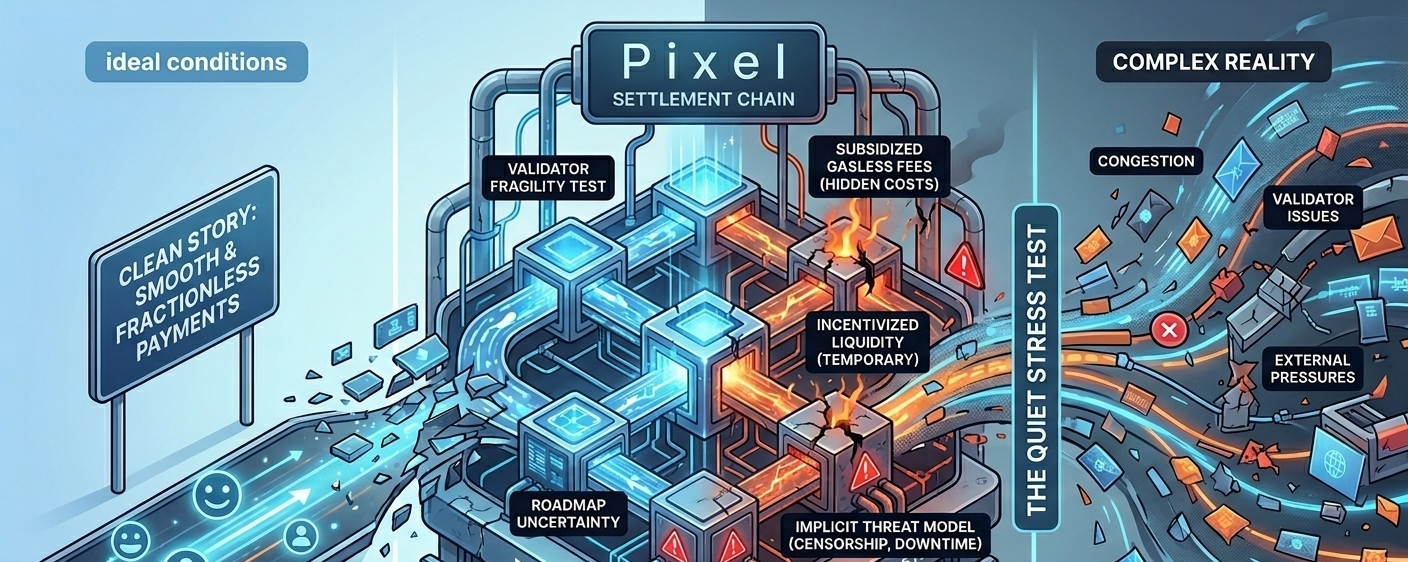
When a Clean Story Meets a Complex Reality
A new blockchain that presents itself as a payments or settlement chain often arrives with a calm and appealing message. It promises smooth transfers, minimal friction, and a system that feels almost invisible to the user. This idea is attractive because it speaks to one of the oldest goals in crypto, making value move as easily as information.
But a clean story does not always reflect a complete system. Payments infrastructure is not judged by how simple it sounds, but by how well it performs when things are uncertain. A system may look efficient in controlled conditions, yet behave very differently when faced with congestion, validator issues, or shifting incentives.
For everyday users, the promise is convenience. For a careful observer, the real question is durability. What happens when the system is no longer supported by ideal conditions. That is where the true design begins to show.
The Quiet Gap in Roadmaps
Most blockchain projects publish roadmaps that appear structured and confident. They describe upcoming features, integrations, and phases of growth. On paper, this creates a sense of steady progress.
The issue is not ambition, it is compression of uncertainty. Payment focused chains depend on many external layers, wallets, bridges, liquidity providers, compliance frameworks, and user interfaces. Each of these introduces risk and delay. When a roadmap treats all of these dependencies as predictable, it starts to feel less like an operational plan and more like a narrative timeline.
A more grounded roadmap would acknowledge friction. It would show where delays are possible. It would separate what is under direct control from what is not. This kind of clarity is rare, yet it is often the difference between a system that adapts and one that struggles when expectations are not met.
What Is the System Actually Defending Against
Every blockchain has an implicit threat model, even if it is never clearly explained. For a settlement chain, this question becomes central. What risks is the system designed to handle.
Is the priority protection against censorship. Is it resistance to downtime. Is it protection against double spending. Is it safety against governance abuse. Or is it simply ease of use for the average participant.
Without a clear answer, reliability becomes a vague claim. A system might perform well in normal conditions, but users are left guessing how it behaves when those conditions break down. Payments infrastructure carries a higher expectation. It is not enough to function, it must remain predictable under stress.
If the design choices, validator structure, fee model, and upgrade process are not clearly linked to a defined threat model, then the system is relying more on assumption than on structure.
Validators and Fragility Under Pressure
Validator design reveals how power is distributed in a blockchain. Some newer chains favor smaller or more coordinated validator sets to achieve speed and efficiency. This can work well in early stages, especially for applications that prioritize user experience.
However, this approach introduces a different type of trust. If validators are limited or closely connected to the project, the system depends more on coordination than on decentralization. That is not automatically a flaw, but it changes the nature of the system.
The key issue is how the network behaves when something goes wrong. If validators go offline, does the network stall. If a subset of validators acts in a coordinated way, can they influence outcomes. If external pressure is applied, how resilient is the system.
A payments chain needs to answer these questions clearly. Users expect consistency, not just speed. A system that performs well only when all parts are functioning perfectly may struggle in real world conditions.
The Token and Its Real Job
Tokens often carry multiple roles within a blockchain. They can be used for fees, staking, governance, and incentives. This flexibility can be useful, but it can also blur the purpose of the token.
If a token is heavily tied to incentives, such as rewards for participation or liquidity provision, then much of the activity around it may be temporary. Participants may engage because they are being compensated, not because they need the service.
Over time, the system needs to demonstrate that the token has a function beyond attracting attention. Does it secure the network in a meaningful way. Does it enable necessary operations. Or does it mainly act as a tool for distributing rewards.
Clarity here is important because long term stability depends on consistent demand, not just initial excitement.
Gasless Transactions and Hidden Costs
One of the most appealing features of modern blockchain design is the idea of gasless transactions. From the user perspective, this removes friction and makes the experience feel more familiar.
But the cost does not disappear. It is shifted. The network still requires resources, and someone must pay for them. This could be the application developer, a relayer system, or a treasury that subsidizes activity.
The important question is sustainability. If transactions are being subsidized, how long can that continue. What happens when the cost is no longer absorbed by the system. Do users remain, or does activity decline once the true cost becomes visible.
Gasless design improves usability, but it also introduces a dependency. Understanding that dependency is key to evaluating whether the system can operate without continuous financial support.
Liquidity Does Not Equal Adoption
Liquidity incentives are a common strategy for new chains. By offering rewards, projects attract capital and create the appearance of activity. This can be useful in the early stages, especially for building markets and enabling transactions.
However, liquidity driven by incentives is often temporary. When rewards decrease, capital may leave. What remains is a clearer picture of actual demand.
Real adoption looks different. It involves users who return because the system provides value, not because it pays them to participate. It involves consistent transaction patterns that persist beyond incentive programs.
A settlement chain that aims to support payments needs this kind of organic usage. Without it, the system risks becoming dependent on continuous incentives to maintain activity.
Governance and the Visibility of Power
Governance is often presented as a future goal, something that becomes more decentralized over time. In practice, early stage projects tend to operate with concentrated decision making. This can help with speed and coordination, but it also introduces risk.
If decisions about upgrades, fees, or validator changes are made by a small group, users are relying on trust rather than on transparent processes. For a payments system, this is a significant consideration.
Operational transparency becomes essential. Users need to understand how decisions are made, who is responsible, and what mechanisms exist for accountability. This includes clear communication during outages, honest reporting of performance, and visible governance procedures.
A system that hides its decision making may still function, but it asks users to accept uncertainty. A system that exposes its structure allows users to evaluate it more clearly.
When the Narrative Fades
Every blockchain benefits from a strong narrative in its early stages. It helps attract attention, build a community, and create momentum. But over time, the narrative becomes less important than the system itself.
A payments or settlement chain must eventually stand on its own behavior. It must show that it can operate without heavy incentives, without perfect conditions, and without constant reinforcement from its original story.
This transition is often where projects are truly tested. Some adapt and mature. Others reveal gaps that were not visible during the initial phase.
A Final Reflection
Skepticism in this space is not about rejecting new ideas. It is about asking whether the structure can support the promise. For a settlement chain, the most convincing signals are practical rather than promotional.
Clear data on validator performance, transparent handling of transaction costs, evidence of sustained usage, and visible governance processes all contribute to a stronger foundation. These are the elements that show whether a system can endure beyond its early narrative.
In the end, the question is simple. Not whether the chain sounds reliable, but whether it remains reliable when conditions are no longer ideal.
