
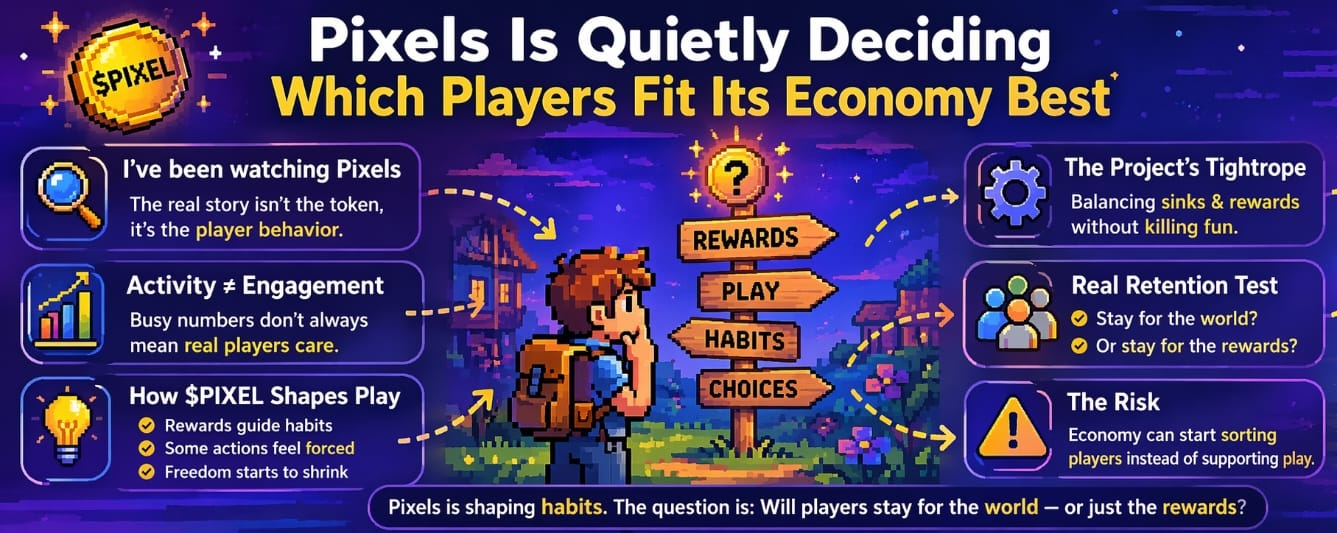
I’ve been watching Pixels for a while, and that is probably why I keep coming back to the same question about the project. The more I look at Pixels, the more I feel the real story is not just about PIXEL as a token, but about what the project is slowly asking players to become. I’ve noticed that with Pixels, the most important changes do not always show up in loud announcements. They show up in the way the project rewards time, shapes habits, and quietly tells players what kind of activity matters most.
That is what makes the project worth paying attention to.
Pixels does not feel like a project struggling to create activity. It feels like a project trying to decide what kind of activity it wants to keep. That is a more interesting problem, but also a harder one. Any project can create bursts of movement if rewards are strong enough. The harder part is building a system where people stay because the project still feels enjoyable, useful, and alive without needing rewards to carry everything.
That is where I think Pixels becomes more complicated.
The project seems to be using $PIXEL less like a simple reward and more like a way to shape behavior. In theory, that makes sense. A project like this needs balance. It needs sinks. It needs some pressure in the system so value is not flowing out too easily. Without that, the project risks becoming a place where players mainly show up to extract and leave. So some economic control is normal. In fact, it is necessary.
But there is always a line.
A project can use rewards to support play, or it can lean on rewards so heavily that they start replacing the reason to play. That is the difference I keep watching in Pixels. When a player starts thinking less about what they want to do and more about what makes the most sense to do, the feeling of the project starts to shift. What looked like freedom starts becoming routine. What felt natural starts feeling managed.
That does not mean the project is broken. It means the pressure is becoming easier to notice.
And that is usually where the deeper truth sits in projects like this. Not in the big moments, but in the small patterns. Which actions start feeling necessary instead of optional. Which loops become too important. Which parts of the project still feel fun on their own, and which parts only hold attention because the rewards are still doing heavy lifting.
This matters because activity on its own does not tell us much. A project can look busy and still feel hollow underneath. Players can keep showing up for reasons that have very little to do with real attachment. They might stay because the system is still paying enough attention back to them. They might stay because leaving feels costly. They might stay because the project still offers just enough reward to make repetition worth it.
But that is not the same as real retention.
Real retention comes when a project gives people reasons to remain even when the economic logic is not the only thing holding them there. It comes when players are building habits around the world itself, not just around the return it offers. That is the part Pixels still has to prove more clearly. Because if the project keeps narrowing behavior toward whatever is most efficient, then even strong activity can start to feel less organic over time.
That is the risk with a project that becomes too clear about what it wants from players.
Once people can see which behavior the system values most, they naturally move toward it. That is normal. But it can also flatten the experience. The project starts feeling smaller because fewer actions feel truly worth doing. Players stop exploring the edges and begin following the center. Over time, the world may still look active, but the activity starts feeling more uniform, more calculated, and less alive.
I think that is the tension inside Pixels right now.
The project looks like it is trying to become more disciplined, more structured, and more intentional about how value moves through the system. That is probably the right instinct. But structure alone is not enough. A project also has to protect the feeling that players are there because they want to be, not just because the economy has trained them to stay.
That is why the smallest details matter most. You can usually tell what is happening in a project by noticing what players quietly stop doing. Which systems lose their charm first. Which routines start feeling like chores. Which rewards feel like support, and which feel like compensation for friction the project created itself. Those details say more than the surface numbers ever do.
For me, Pixels still feels like a project in the middle of figuring out what it wants to reward and what it wants to become. That is why I do not think the question is simply whether $PIXEL is being used more. The bigger question is whether the project is using that system to strengthen real player engagement, or whether it is slowly turning the economy into the main thing that decides who stays active and why.
I do not think the answer is fully clear yet. Pixels still has time to shape this into something healthier and more natural. But right now, the project feels like it is walking a narrow line between supporting play and managing it too tightly. That is why I am still watching. The project is clearly moving, but I am still not fully convinced that all of that movement is coming from something strong underneath.