
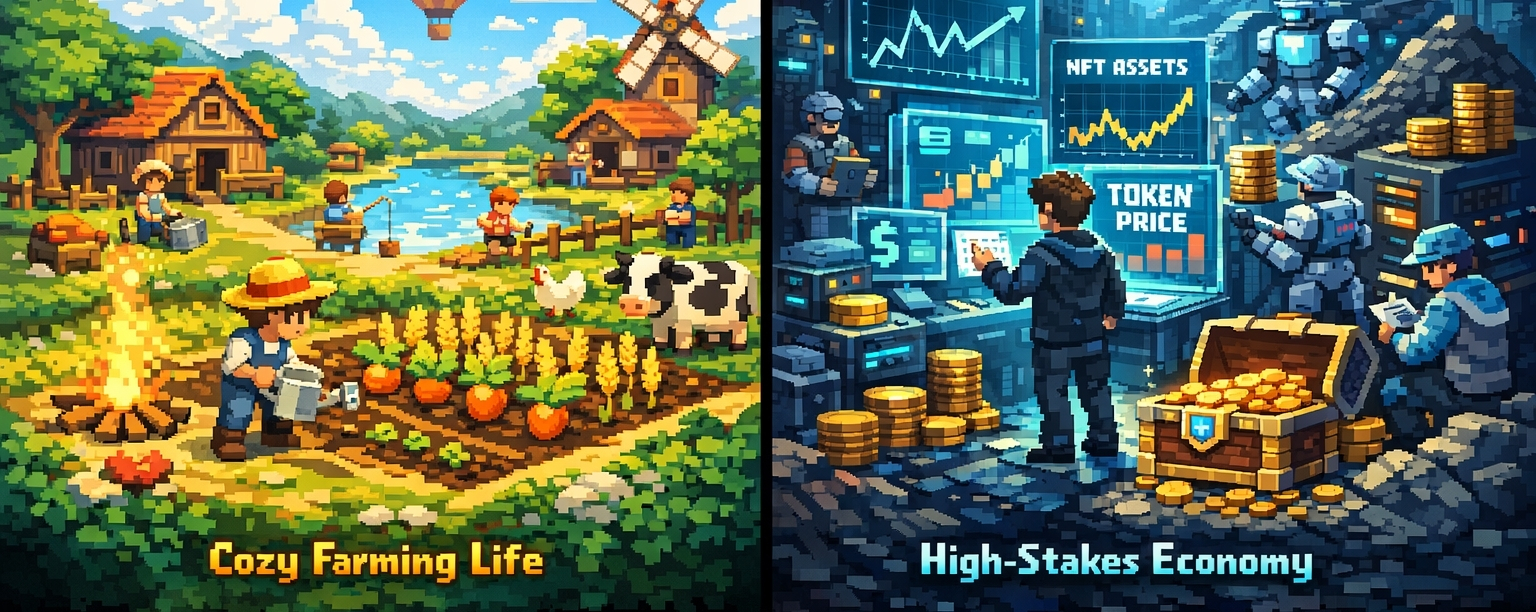
I've been spending some time thinking about Pixels, and the more I look at it, the harder it becomes to describe it in simple terms. At first, it feels like a calm little farming game — the kind where you plant crops, wander around, gather materials, and slowly build your own rhythm inside a colorful world. It feels light, almost comforting. But after sitting with it for a while, I started noticing that beneath that easygoing surface, there’s something much more layered going on. It isn’t just trying to be a farming game. It feels like it’s trying to explore what happens when digital ownership, player freedom, and economic systems are woven directly into the experience of play.
That’s what makes it interesting to me.
Because on the surface, Pixels feels simple. Maybe even intentionally simple. The art style is soft, the mechanics are familiar, and the world feels approachable in a way many blockchain projects don’t. Nothing about it screams complexity at first glance. In fact, that might be one of its smartest choices. Instead of making the technology the center of attention, it lets the world speak first. You enter because it feels like a game, not because it feels like a financial product. And honestly, that already sets it apart from many Web3 projects that lead with tokens and economics before they ever establish a reason to care.
But the longer I think about it, the more I realize that this simplicity is doing a lot of work.
Because while the world feels cozy and casual, the systems underneath are carrying much bigger ideas. In Pixels, your resources, your assets, even parts of your progress can hold value beyond the game itself. That changes the feeling of everything. Planting a crop is no longer just planting a crop. Collecting an item is no longer just part of the gameplay loop. Every small action begins to exist in two spaces at once: one as play, and one as participation in an economy.
And that shift feels subtle, but powerful.
I find myself wondering what happens to a game when the things inside it start carrying real value. On one hand, it creates a stronger sense of meaning. There’s something undeniably appealing about the idea that the time you spend in a game leaves behind something that belongs to you. In traditional games, your effort often stays locked inside systems you don’t control. Here, there’s this sense that your actions matter in a more lasting way. The world feels less temporary.
But at the same time, ownership changes behavior.
The moment players begin to see in-game actions as valuable, the relationship between player and world starts to evolve. What begins as curiosity can slowly become calculation. Instead of asking, “What do I feel like doing today?” players may begin asking, “What gives the best return?” And that’s where the emotional atmosphere of a game can quietly shift. A relaxing farming mechanic can become a routine. Exploration can become optimization. Even community interactions can become influenced by incentives.
That tension keeps standing out to me.
Because Pixels wraps these systems inside a world that feels warm and inviting. It looks like a place designed for comfort, creativity, and social connection. But beneath that warmth is a carefully balanced economy, and economies always shape behavior. No matter how peaceful the setting is, people naturally respond to rewards. They find the fastest path, the most efficient routine, the best strategy. That’s human nature. So I keep wondering how a game like Pixels protects its sense of playfulness when efficiency starts to compete with enjoyment.
That question feels bigger than Pixels itself.
It touches on something at the center of many blockchain games: the balance between freedom and design. Ronin Network gives Pixels the infrastructure to make ownership feel real, and that matters. Cheap transactions, smooth gameplay, and player-owned assets all help create the illusion that the world belongs to its players. But even with decentralized ownership, the experience is still shaped by central decisions. Someone decides how rewards are distributed. Someone adjusts scarcity. Someone controls how the economy grows and how the systems evolve.
So while the assets may be decentralized, the experience itself still depends on human choices behind the scenes.
That’s not necessarily a flaw — every game needs direction — but it reminds me that trust never disappears. In Web3 spaces, there’s often this idea that technology replaces trust, but I don’t think that’s really true. It just moves trust into different places. Players trust the economy to remain stable. They trust the design to remain fair. They trust that the systems won’t slowly tilt in ways that benefit some players more than others. And in a game where value is involved, that trust becomes even more important.
Because when incentives are real, balance becomes emotional.
If rewards feel fair, the world feels alive. If rewards feel uneven, the illusion starts to crack. Suddenly the farming, gathering, and crafting no longer feel like peaceful mechanics — they feel like labor inside an unstable system. And I think that’s where the true challenge for Pixels lies. Not in building the game world itself, but in maintaining the fragile emotional balance between fun and function.
That’s what keeps me curious.
Because Pixels feels like an experiment disguised as a farming game. It looks peaceful, but it’s quietly testing something complex: whether a game can combine ownership, economics, and community without losing the feeling of play. That’s not an easy balance to maintain. The more value enters the system, the more behavior changes. The more incentives matter, the more player motivations diversify. Some people will come to relax, others will come to earn, and both groups will shape the same world in very different ways.
I can’t help wondering what that world looks like over time.
Can it stay welcoming when competition increases? Can the social side remain genuine when assets have value? Can a game preserve creativity when optimization becomes the dominant instinct? These aren’t easy questions, and I don’t think Pixels has fully answered them yet. But maybe that’s exactly what makes it compelling.
Because the most honest thing about Pixels may be that it doesn’t feel “finished” as an idea.
It feels like an ongoing conversation between game design and economic design. Between the desire to create a fun world and the pressure to create a sustainable system. Between the fantasy of ownership and the reality of human incentives. And that tension is where the project feels most alive to me.
The farming mechanics, the open-world exploration, the social interactions — all of these things matter, but what really draws my attention is the uncertainty beneath them. The feeling that this world is testing whether ownership can deepen engagement without turning every action into strategy. Whether transparency can build trust without creating pressure. Whether a game can remain playful while carrying the weight of real economic meaning.
I don’t know the answer to any of that yet.
And honestly, that uncertainty makes Pixels feel more real.
Because instead of presenting itself as a solved vision of the future, it feels like a living system that will reveal its strengths and weaknesses only through the behavior of the people inside it. The real story won’t be written by the design documents or the token model. It will be written slowly, through how players respond, how incentives shape communities, and how the world changes once theory meets reality.
That’s why I keep thinking about it.
Not because Pixels promises a revolution, but because it quietly asks difficult questions. Questions about ownership, motivation, trust, and the future of digital spaces. And maybe the most important question of all is whether a world built on value can still feel like a world — not just a system.
I don’t think we know that yet.
But watching Pixels try to find that balance might be the most interesting part of the journey.
And maybe that’s what makes Pixels so fascinating — not what it is today, but what it might become when real players begin shaping its future. Beneath the calm farms and pixelated charm, there is a deeper experiment unfolding, one where every action, every reward, and every decision quietly tests the balance between freedom and control. It feels like standing at the edge of something peaceful yet unpredictable, where the beauty of the world hides the uncertainty of what lies ahead. The real question is not whether Pixels can attract players, but whether it can preserve its soul once value, ambition, and human behavior collide. Perhaps the most thrilling part is that no one truly knows what this world will become when the systems are pushed beyond their comfort zone. Maybe Pixels will prove that digital ownership can create deeper meaning, or maybe it will reveal just how fragile that dream really is. Either way, the story of Pixels feels like it is only just beginning, and the most important chapter has not yet been written.
