
I’ve been around long enough to remember when “play-to-earn” felt like cheating the system. Free money, infinite upside, spreadsheets disguised as games. And yeah… we all know how that ended. Liquidity dried up, token charts went vertical in the wrong direction, and suddenly everyone discovered they were holding bags in something that was never really a game to begin with.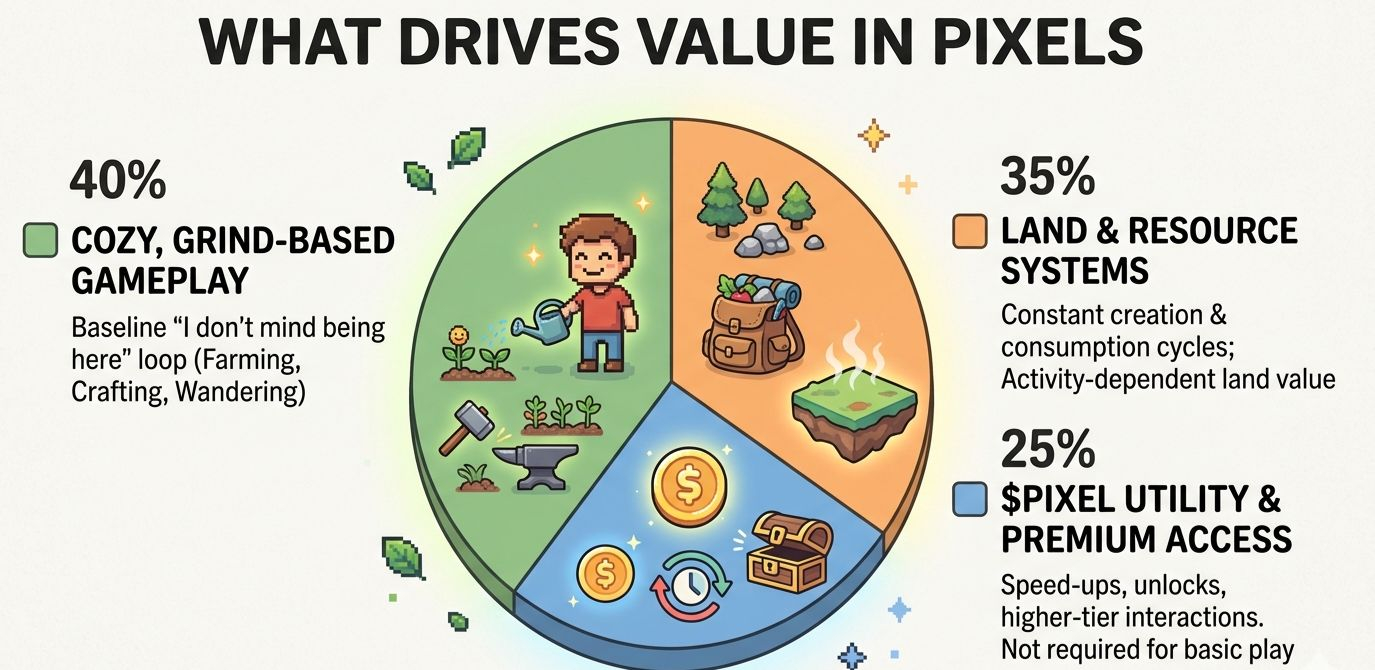
So when I look at Pixels, I don’t start from hype. I start from suspicion.
Because I’ve seen this movie before.
And yet… this one feels a little different.
Not because it’s revolutionary. Honestly, that’s the least interesting thing about it. It’s different because it’s not trying to reinvent the wheel. It’s trying to remember why the wheel worked in the first place.
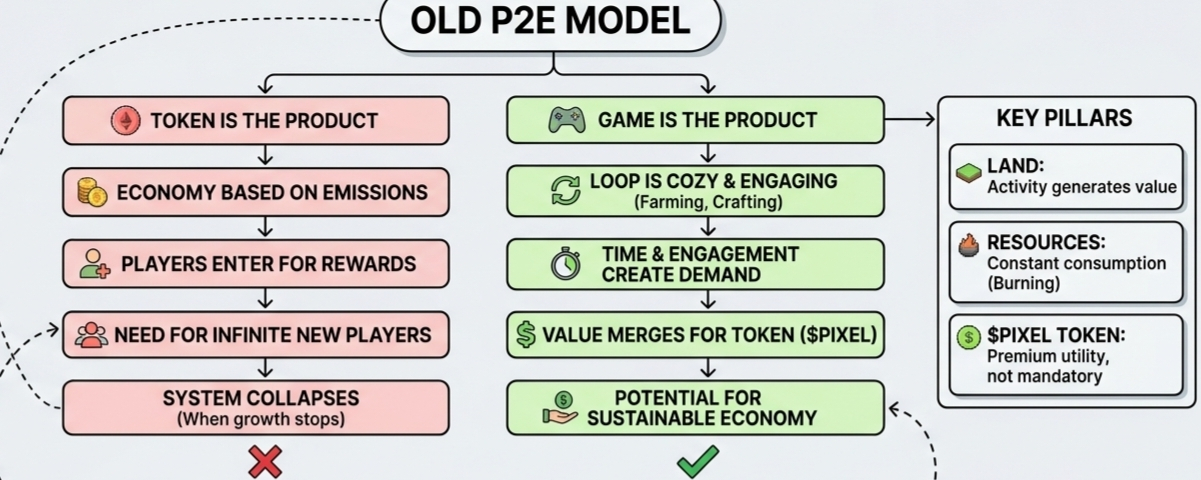
Most P2E economies broke for a very simple reason people keep overcomplicating: they treated the token like the product. Everything revolved around emissions, rewards, APYs dressed up in game UI. The “gameplay” was just a thin excuse to justify the payout loop. Bring in players, print rewards, pray new players show up before the music stops.
That’s not an economy. That’s a treadmill with a cliff at the end.
Pixels, at least from what I’ve seen, flips that on its head. Or at least tries to. The token isn’t the product, it’s a byproduct. And that sounds like a small distinction until you realize it changes everything downstream.
Because now the uncomfortable question becomes: would anyone still play this if you stripped the rewards out?
Most Web3 games never dared to ask that. Pixels kind of does.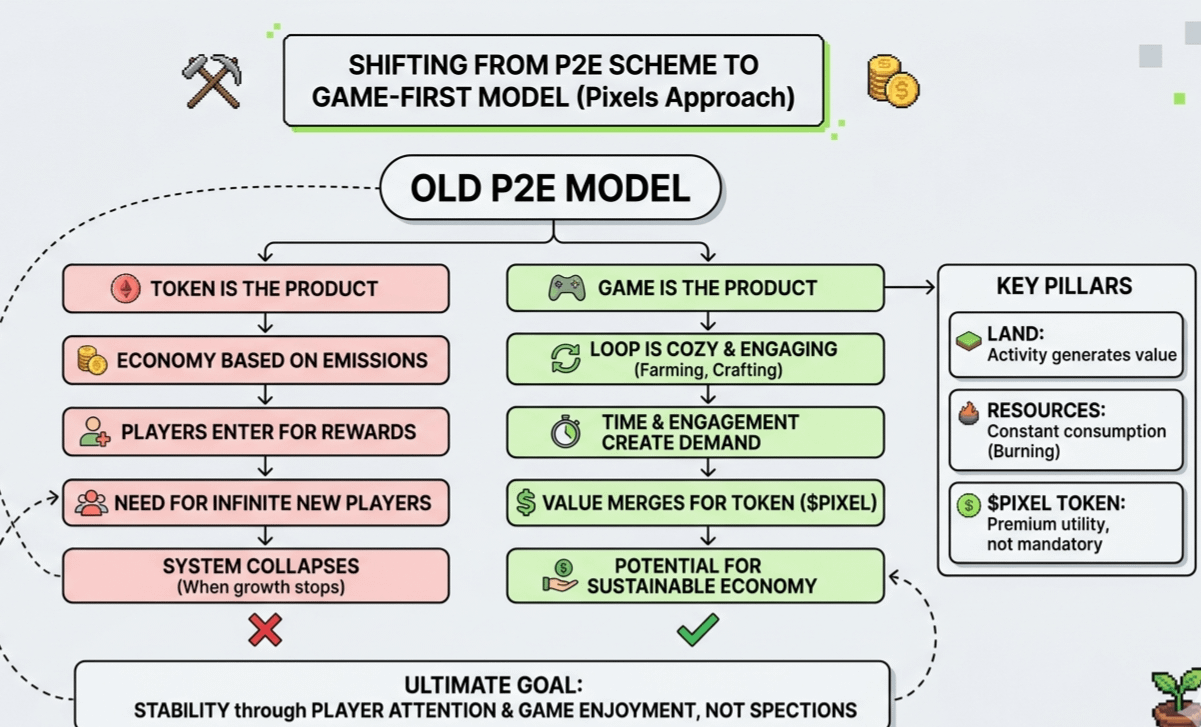
And look, I’m not saying it’s the most addictive game ever made. But it has something a lot of these projects didn’t even attempt to build, a baseline “I don’t mind being here” loop. Farming, crafting, wandering around… it’s simple, a bit grindy, a bit cozy. It’s not screaming for your attention, which ironically makes it easier to stick with.
That’s where the real shift begins.
Instead of asking “how do we pay players more,” the design quietly asks, “why would they stay anyway?” And once you have even a half-decent answer to that, the rest of the economy stops collapsing under its own weight.
Because here’s the part people miss: value doesn’t come from tokens. It never did. Tokens just measure where value is already flowing.
In Pixels, that flow starts with time. Players planting, harvesting, crafting, optimizing their little loops. That creates engagement. Engagement creates demand, for resources, for land, for small advantages. Then the token starts to make sense, because it’s sitting on top of something real instead of trying to bootstrap reality out of thin air.
Older P2E games got that backwards. They started with the token and tried to force everything else to orbit around it. Pixels starts with the orbit and lets the token emerge as gravity.
And yeah, under the hood, you can still see the familiar pieces. Land ownership acting like infrastructure. Resources acting like the bloodstream of the system. The token sitting above it all, coordinating the higher-value stuff. None of this is new. That’s kind of the point.
But here’s where it gets interesting.
Land, for example, isn’t just a flex asset. It actually depends on other players showing up and doing things. No activity, no output. No output, no value. Which means landowners, whether they realize it or not, are tied to the health of the ecosystem. They can’t just extract and disappear. At least, not for long.
That’s a subtle but important pressure. It nudges the system away from pure extraction and a little closer to cooperation. Not perfectly. Let’s not romanticize it. But closer than most.
Then you’ve got resources, the stuff players actually grind for. This is where Pixels feels the most “game-like.” You’re not hoarding them because they might 10x. You’re using them. Converting them. Burning them through progression loops. That constant cycle, creation, consumption, repeat, does more for stability than any clever token emission schedule ever could.
And $PIXEL itself? It’s there, but it’s not suffocating everything else. It acts more like a premium layer, speeding things up, unlocking certain paths, giving access to higher-tier interactions. Crucially, it’s not required just to exist in the game.
That decision matters more than people think.
Because the moment a token becomes mandatory for basic play, you introduce friction. And friction is death for retention. We’ve seen it over and over again, players don’t stick around to fight your economy.
Pixels seems to understand that. Or at least it’s trying to.
Now, does this mean it’s “solved” GameFi? No. Let’s not get carried away.
The real risk here isn’t tokenomics. It never was.
It’s the same risk every game faces: people might just… not care.
You can design the cleanest loops, balance every sink and source, make the token behave perfectly and if the game slips into “flavor of the month” territory, the whole thing still fades out. Quietly. No dramatic crash, just a slow bleed of attention until only the most stubborn players are left.
We’ve all watched that happen.
But if Pixels manages to hold attention, even at a modest level, then this model has a real shot. Not explosive, unsustainable growth. Something slower. Stickier. A system where value circulates instead of constantly leaking out to early farmers and late bag-holders.
And honestly? That’s way less exciting on paper. No insane APYs. No overnight riches.
But it’s also the first time in a while I’ve looked at a crypto game and thought, “yeah… this might actually function like a game first.”
At the end of the day, Pixels isn’t trying to prove that players can earn more.
It’s trying to prove something much harder, that if the game is good enough, they won’t need to.
