
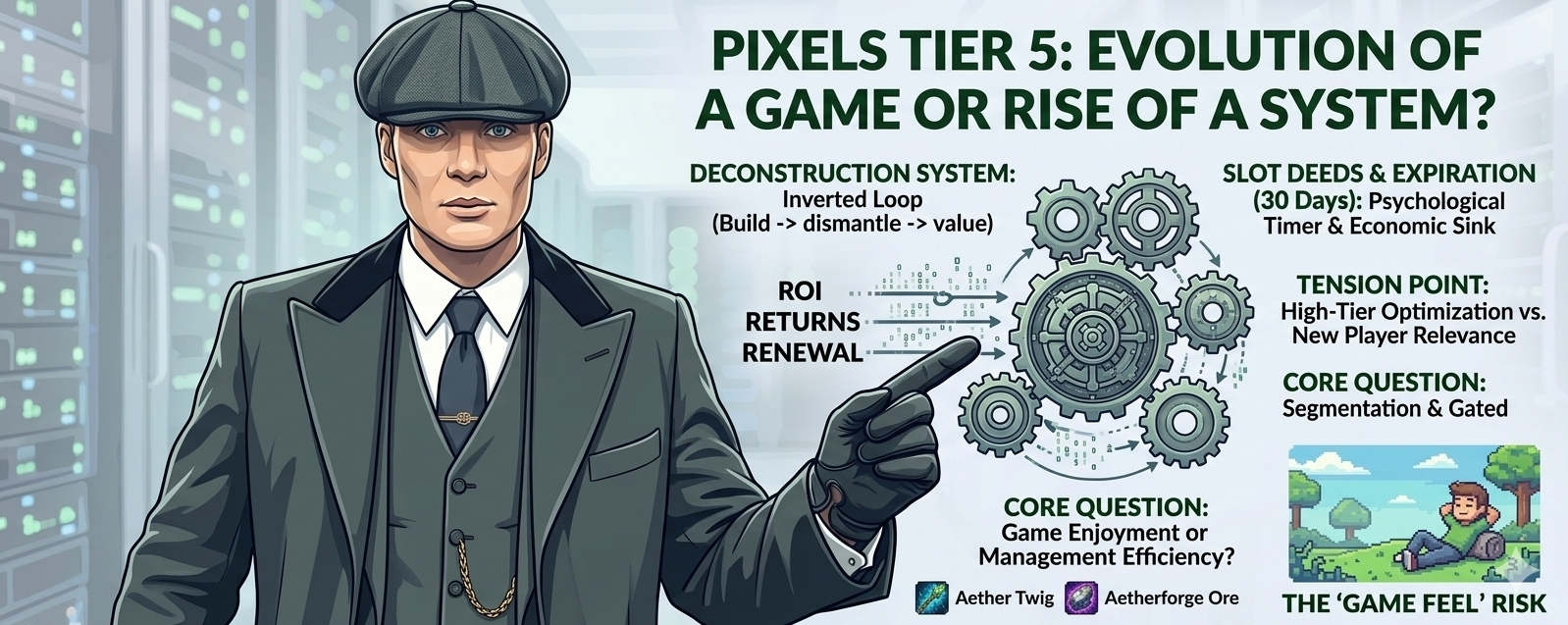
There’s one thought that keeps coming back to me… when a game keeps adding more layers, more systems, more economic depth—does it actually become stronger, or does it slowly begin to feel heavier under its own design?
Honestly…
My first reaction to the @Pixels Tier 5 update wasn’t simple. At surface level, it looked familiar—new tier, new resources, new crafting paths… 🤔 nothing unexpected. But once you go deeper, it’s clear this isn’t just added content. It’s the introduction of a new behavioral layer across the entire system—and that’s where things start to shift.
For instance, T5 industries are restricted to NFT land. That instantly creates segmentation—not every player is operating on the same level anymore. On top of that, a slot deed is required, and it expires after 30 days. There’s a quiet pressure built into this. Nothing is forcing you directly, but the system subtly signals—if you want to maintain progress, you need to stay active.
That’s important, because now commitment itself becomes part of the reward loop.
Then comes the deconstruction system… probably the most thought-provoking change here. Earlier, the loop was straightforward—build, upgrade, accumulate. Now, it’s inverted—break, dismantle, and extract value again. Creation and destruction are no longer separate—they’re part of the same economic cycle.
But that raises a deeper question…
If progression requires destruction, can players still feel attached to what they build? Because now, your creations are temporary by design. That’s not a traditional gameplay loop—it leans more toward efficiency and optimization thinking. There’s a real possibility that over time, gameplay starts to feel more like managing a system than playing a game.
At the same time, there’s a strong upside.
This design doesn’t artificially create scarcity—it circulates it. Materials like Aether Twig and Aetherforge Ore only come from deconstruction. That means supply is controlled, but still dynamic. From an economic perspective, that’s a smart and sustainable approach.
Still, the same core question remains…
Will players experience this as a game—or as a system?
Take the fishing update as another example…
Five tiers, durability scaling, tool-based access—it’s clean, structured, and logically designed. Progression is visible and predictable. But that’s also the point—it feels very controlled. There’s less randomness, more certainty.
The forestry XP buff adds to this shift. 500 XP per log in T5 is a massive jump. It clearly pushes players toward higher-tier optimization and scaling strategies.
But here’s where tension builds…
When high-tier rewards increase this sharply, lower-tier gameplay risks losing relevance. So what happens to new players? Will they enjoy the early experience—or just rush through it to reach the “real” game?
Another strong design element is slot expiration. If you don’t renew within 30 days, your industry stops functioning. On one side, it works as an economic sink—removing value from circulation. On the other, it introduces a psychological timer.
Are you playing because you want to… or because the system expects you to?
It’s a subtle difference, but it can shape long-term player behavior in a big way.
Looking at the update as a whole, it leaves a mixed impression.
On one hand, it’s very clear—the design team isn’t just adding features. They’re actively shaping the economy. Resource flow, item lifecycle, and player behavior are all interconnected. This level of intentional design is rare in most play-to-earn environments.
But with that depth comes risk.
The risk of losing the “game feel.”
When players begin thinking in terms of:
What’s my ROI here?
Should I dismantle this for better returns?
What happens if I skip renewal?
Then the line between enjoyment and optimization starts to blur.
And not every player is here to optimize.
Some players just want to exist in the world… explore… relax… experience.
It’s still uncertain how well @Pixels Tier 5 will protect that space.
In the end, this update feels directionally strong, but emotionally unfinished. System-wise, it’s impressive. Economically, it’s carefully designed. But from a player experience perspective—it’s still evolving.
Maybe time will balance it…
Maybe players will shape it in their own way…
Or maybe the system itself will become so dominant that the game quietly takes a backseat.
That’s where things stand right now…
And honestly—that’s what makes it interesting. 🤔👀
