
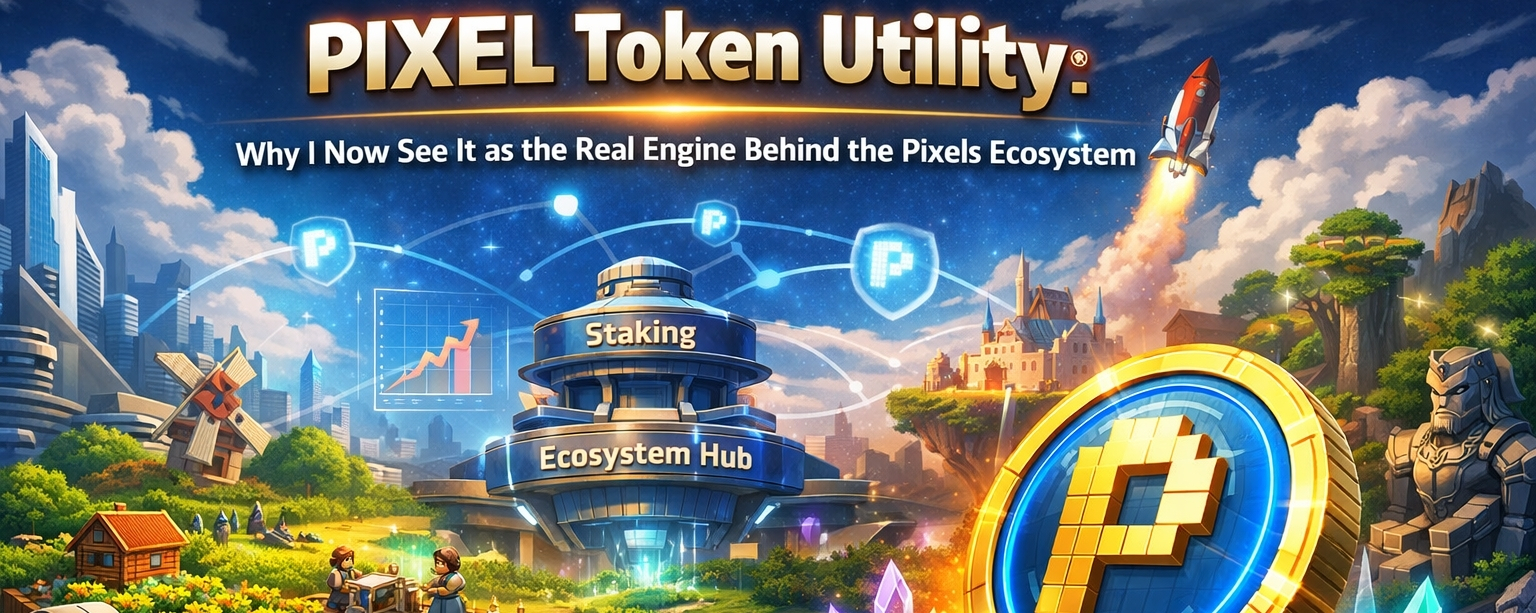

I will be honest, I used to look at PIXEL like it was just another game token.
The kind of token people collect inside a game, talk about for a while, and then sell the moment the excitement starts fading.
But after spending more time looking closely at how Pixels is built, I do not see it that way anymore.
PIXEL feels much bigger than a basic in-game asset.
To me, it is becoming the core value layer behind the entire Pixels ecosystem.
What changed my mind most was the way the team handled the economy. A lot of blockchain gaming projects try to make one token do everything at once. It becomes the reward token, the payment token, the speculative asset, and the thing expected to support the entire in-game economy.
Most of the time, that kind of structure eventually breaks because there is too much pressure on a single asset. Pixels seems to have taken a smarter route. Instead of forcing PIXEL into every small part of gameplay, they separated normal in-game activity from the premium token layer. That made immediate sense to me because it gave PIXEL a much clearer role.
That matters because when a token is used for everything, it usually ends up meaning very little. In the case of PIXEL, the utility feels more deliberate. It is connected to premium features, useful upgrades, and forms of progression that players actually care about. Things like speeding up build times, getting energy boosts, unlocking cosmetics, using special items, accessing recipes, pets, and land-related features all feel like logical token sinks.
That is very different from a token that only exists to be earned and sold. That distinction is important to me. PIXEL is not only something that enters the system through rewards.
It is also something that leaves the system through spending in ways that feel meaningful.
And honestly, I think that is one of the healthiest signs in any gaming token model.
If people only want a token because they believe someone else will buy it later at a higher price, that is weak demand. That kind of demand disappears quickly when sentiment changes.
But if players want the token because it saves time, gives access to better features, or improves the way they play, that is much more real. It creates stronger reasons to hold and use the token beyond speculation. For me, that already makes PIXEL stand out from many blockchain gaming tokens that never grow past the cycle of rewarding users and then facing constant selling pressure.
The other reason I believe PIXEL is more than just an in-game asset is staking. This is where the project starts feeling less like a single-game economy and more like a wider ecosystem. When I looked into the staking model, what stood out to me was that it was not being treated as simple passive yield. It seemed tied to the broader game network and how value flows through it. That changes the role of the token completely. At that point, PIXEL is not just something I would use for upgrades or boosts inside one game. It becomes something connected to how support is directed across the ecosystem and how the network itself grows over time.
That part is especially interesting to me because it adds another layer of purpose. Instead of existing only at the player level, PIXEL starts to matter at the ecosystem level too. That is a major difference. It means the token has utility not only in spending, but also in participation, alignment, and long-term growth. In simple terms, it is not just about what I can buy with PIXEL.
It is also about what role the token plays in shaping the future of the project.
I also think the team understands one of the biggest problems with gaming tokens, which is speed of exit. Most gaming tokens struggle because rewards reach users and are sold almost immediately. There is no real reason for value to remain inside the system. Pixels seems to be trying to solve that by creating stronger reasons for users to keep value circulating within the ecosystem instead of rushing directly to the market. From my point of view, that reflects better token design. I am not saying it is perfect, because no token model is perfect, but it does feel more thoughtful than the usual approach. Any project that wants to survive long term has to think about how value moves, not just how excitement is created.
What makes PIXEL even more interesting is that it is no longer only about Pixels as one standalone game. Once a token starts having use across a wider network, its identity changes. It stops feeling like a local game currency and starts looking more like ecosystem infrastructure. That is a huge difference. A token tied to only one game usually rises and falls with that single game. A token that can be useful across multiple experiences has more room to grow and more ways to remain relevant.
That said, I do not want to exaggerate the case. PIXEL still has to prove itself over time. Real utility only matters if players stay active, continue spending, and genuinely find value in the ecosystem. No token structure can protect a weak product forever. I think that is the honest truth with every gaming token. But if I am judging PIXEL based on structure, direction, and actual use, then yes, I believe it has already moved beyond the label of being just an in-game asset.
The way I see it now, PIXEL is doing several jobs at once. It works as a premium currency, a spending token, a staking asset, and a broader ecosystem tool.
That is why I take it more seriously than I did at first. It is not just sitting inside a game economy as a reward token. It is becoming part of how the whole Pixels network is designed to function. And for me, that is exactly why PIXEL feels like much more than just an in-game asset.