
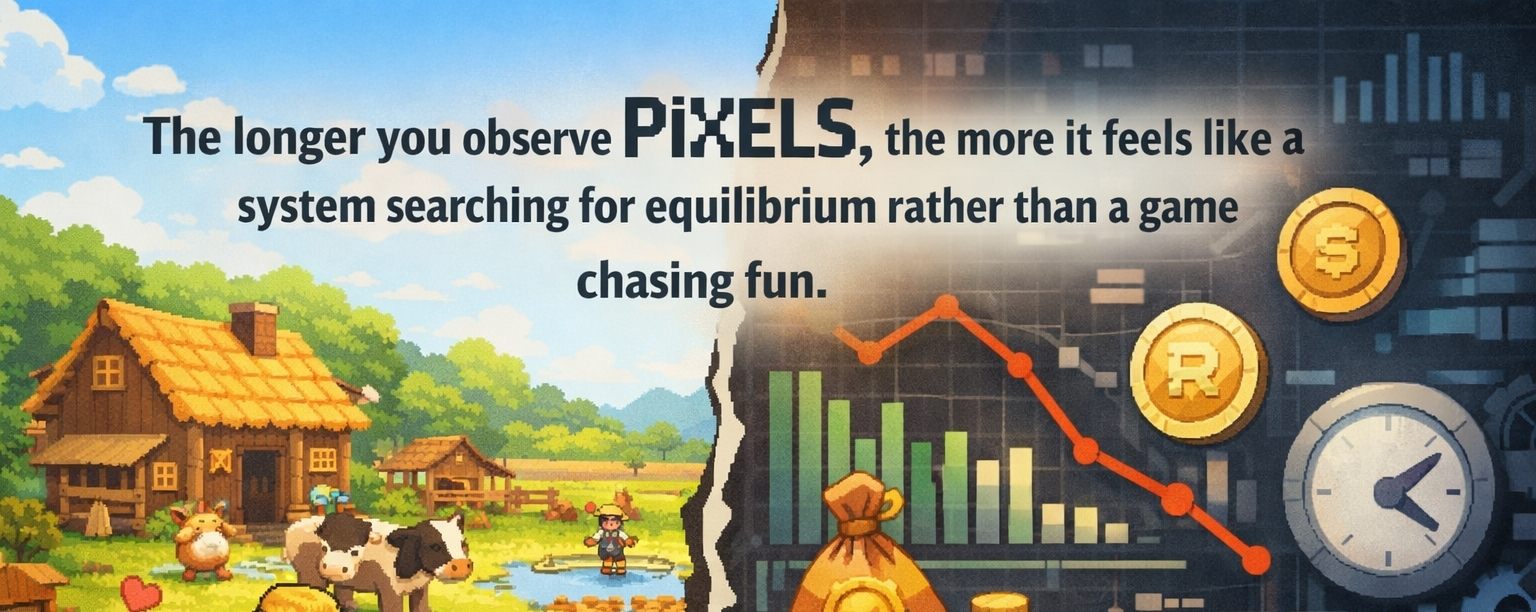

I’m watching Pixels and it doesn’t feel like I’m just looking at a game… it feels more like I’m tracking a system trying to settle into something stable, and I’m not convinced it ever fully does because the more time you spend inside it, the more it quietly shifts from something that feels like casual play into something that behaves like a loop chasing efficiency, and that shift isn’t obvious at first… it just creeps in as you start noticing what actually gets rewarded.
At the start, it’s easy to read it as a simple farming loop… plant, harvest, craft, explore… nothing complicated. But once you layer in ownership and tradable assets, the meaning of those actions changes without the game really saying it out loud. Farming stops being just progression and starts becoming output. Time becomes measurable in yield. And players, naturally, adjust to that. Not because they’re told to, but because the system leans that way. The fact that it runs on the Ronin Network makes everything smoother—cheap transactions, fast interactions—but that doesn’t remove the pressure, it just makes it easier to act on it… so the system reaches that “optimized” behavior faster than you expect.
Where it actually works… is early on. When things are still a bit messy. When not everything is optimized yet and players are still figuring things out. There’s room for inefficiency, and that makes it feel more like a game. But that doesn’t last. As more players come in and information spreads, patterns tighten. People figure out the best routes, the best crops, the best loops… and suddenly the same open world starts feeling predictable. It’s still labeled as casual and social, but underneath, it starts acting more like a coordinated system where everyone is chasing similar outcomes.
What’s interesting is that it doesn’t really break when things slow down… it just tightens. If new players stop coming in at the same pace, nothing dramatic happens. You don’t see a crash. You just feel things getting… thinner. Rewards feel smaller. Time feels heavier. And people don’t necessarily leave all at once… they just become more selective, more calculated. That kind of change is hard to point at because it’s gradual, but it shifts the whole experience.
The infrastructure choice matters more than it looks. Building on Ronin is clearly about control and performance… keeping costs low, keeping things smooth. And it works for that. But it also means the whole system is somewhat contained. Its growth, its liquidity, its energy… all tied to that same environment. If that ecosystem expands, everything feels fine. If it slows, the limits start to show… not immediately, but over time.
There’s also this quiet imbalance between players. Early users or highly active ones figure things out first, lock in advantages, and move ahead faster. Later players step into a version of the system that’s already been optimized… where margins are tighter and opportunities aren’t as obvious. The game doesn’t stop them from joining, but it doesn’t really level that gap either. It just… exists.
And then there’s the part I keep coming back to… if you take away the expectation of earning—if rewards flatten, if assets stop feeling like they might grow in value—what’s left? The game still functions, technically. The loops are still there. But they don’t feel the same. Because once value becomes part of the system, it quietly changes how everything is judged. People stop asking “is this fun” and start asking “is this worth it.”
I don’t think the system fails… it just keeps adjusting. It redistributes pressure, compresses incentives, finds a new balance every time something shifts. And maybe that’s the design. Or maybe that’s just where it ends up for now. Either way, it keeps moving… and I’m still watching it, not fully convinced, but not able to ignore where it’s going.