
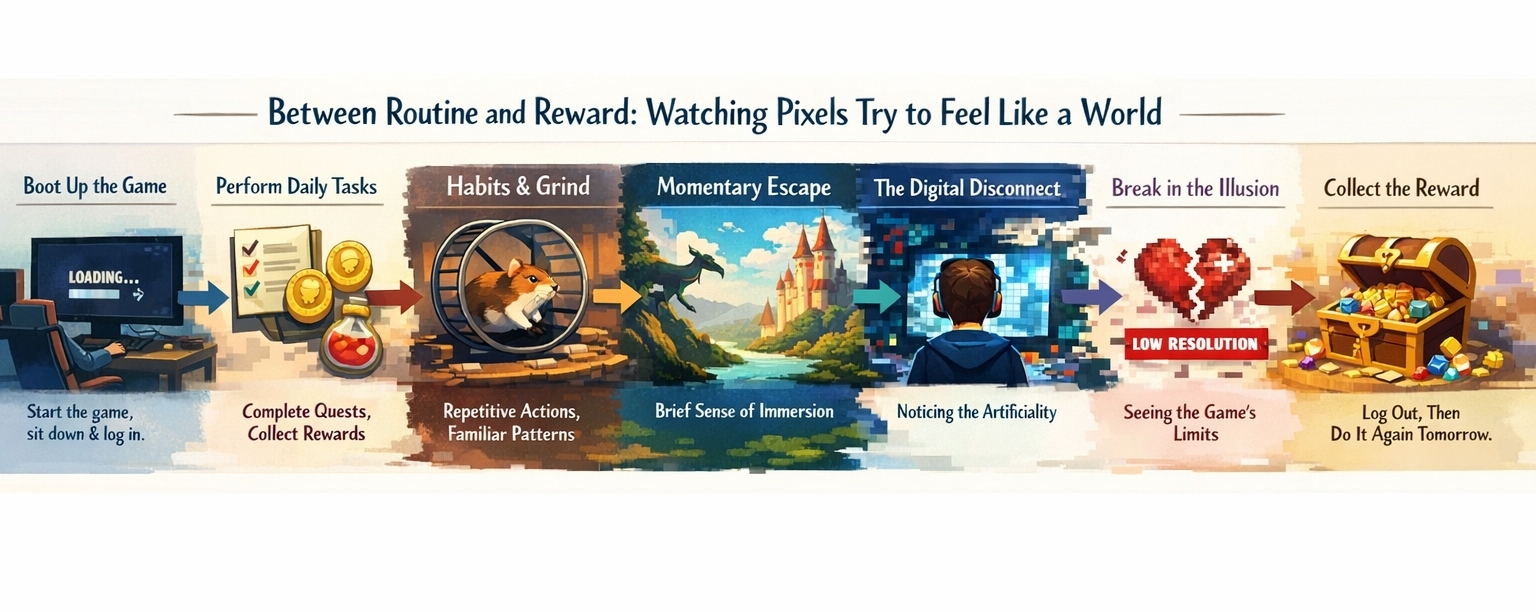
Some days I catch myself doing the same small things without thinking. Making tea, opening the same apps, checking the same charts — not because I expect something new, but because it’s become routine. There’s a kind of quiet comfort in repetition, even when you know nothing has really changed.
That’s the feeling I keep coming back to when I think about Pixels.
At its core, it’s a simple idea. A social farming game running on Ronin, where players grow crops, gather resources, and build out their little corners of a shared world. It doesn’t rush you. It doesn’t demand constant attention. If anything, it leans into a slower rhythm — something closer to habit than excitement. And in a space that usually thrives on urgency, that stands out a bit.
But I’ve been around long enough to know that familiar ideas often come back wearing new clothes. We’ve seen virtual worlds before. We’ve seen economies tied to gameplay before. We’ve seen promises of ownership, creativity, and community more times than I can count. Pixels isn’t inventing something entirely new — it’s rearranging pieces that have existed for a while.
Still, there’s something slightly different in how it presents itself. It feels less aggressive, less transactional on the surface. You can spend time in it without immediately thinking about profit, at least in the beginning. And that’s not nothing. That’s actually where most Web3 games struggle — they forget to feel like games.
But that’s also where my hesitation starts to creep in.
Because no matter how calm the surface looks, the system underneath still revolves around a token. And once a token becomes central, behavior starts to shift. Slowly, almost invisibly. Players begin optimizing instead of exploring. Time starts being measured differently. The world becomes something to work through, not just exist in.
I’ve seen this pattern play out across multiple cycles. Early on, there’s curiosity. Then comes momentum. Then, inevitably, pressure. New users arrive with different expectations. The balance between “playing” and “earning” starts to tilt. And once that balance breaks, it’s hard to recover.
Pixels right now feels like it’s somewhere in the middle of that arc.
It’s no longer early, where everything feels experimental and forgiving. But it hasn’t fully settled either. There are signs of growth — more players, more features, more attention — but also signs that it’s still figuring itself out. The economy, the engagement loops, the long-term retention… none of it feels fully resolved.
What I find interesting is why people stay.
It’s not always about the token. In fact, for a lot of players, it seems secondary after a while. What keeps them around is the routine. Logging in, tending crops, interacting with others, making small progress day by day. It becomes something familiar — almost like checking in on a space that feels partially theirs.
And that’s where Pixels gets close to something real.
Because the moment a game starts to feel like a place instead of a system, everything changes. People don’t just use it — they return to it. Not for rewards, but for continuity.
The problem is, Web3 rarely leaves that feeling alone.
There’s always a layer of extraction sitting just beneath the surface. Even if it’s subtle, it’s there. And over time, it has a way of reshaping the experience. What starts as a world slowly turns into a machine. Not intentionally, but structurally.
I don’t think Pixels has escaped that tension. I’m not sure it can.
What it has done is slow things down enough to make the tension less obvious. Less immediate. And maybe that’s why it feels different, even if the underlying questions are the same.
I keep going back and forth on it.
Part of me thinks this softer approach could actually give it more staying power. Another part of me wonders if it’s just delaying the same outcome we’ve seen before — where the economy eventually outweighs the experience.
For now, it sits somewhere in between those two possibilities.
And maybe that’s what makes it worth paying attention to.
I’m still watching.
Maybe it becomes a world people truly belong to… or maybe it slowly turns into just another system people pass through — I’m not sure which yet.
