
Honestly, I didn’t expect to feel this specific way looking into how Pixels is handling its external partnerships and brand integrations. It isn't skepticism, and it isn't alarm. It’s more like that realization you get when a blockchain game—one that easily could have stayed comfortably inside the crypto bubble—makes a deliberate pivot toward the broader gaming market. You suddenly start to see the massive endgame they’re actually building toward.
Let’s be real about a pattern in blockchain gaming that puts a massive ceiling on growth, a ceiling the space just kind of accepts. The standard model builds exclusively for crypto natives. Token mechanics revolve around wallets, narratives focus entirely on yield and asset appreciation, and communities are pulled from existing Web3 circles rather than the millions of gamers who have never even held a crypto asset. But Pixels is making very deliberate moves toward the mainstream market. They are shipping real product updates like non-crypto brand partnerships, frictionless integrations that don't force you to understand blockchain tech upfront, and an onboarding experience that lowers the technical barrier without sacrificing the underlying ownership layer.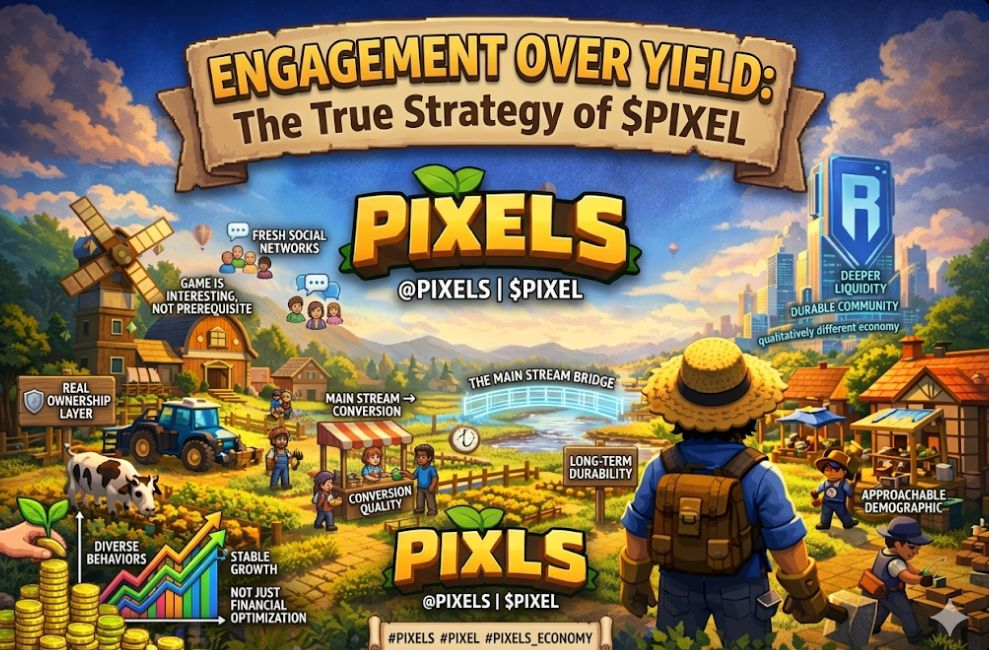
The casual aesthetic isn't an accident. It’s a deliberate design choice to make the game approachable to a massive demographic that most web3 games completely alienate. This strategy isn't just about padding user numbers; it’s about unlocking a totally different kind of player economy when your user base isn't limited to people who already know how to navigate a decentralized wallet. But mainstream marketing isn't the hardest part of web3 gaming. The hard part is building the bridge. And this is where Pixels deserves way more credit than it gets in crypto-native conversations. If you look at the games that actually achieved massive scale at their peak, they grew by reaching non-crypto communities who came because the game was interesting, discovering the ownership layer as a feature rather than a prerequisite.
Pixels is aiming for that exact same growth pattern, but the timing is infinitely better. The infrastructure is more mature, the chain is optimized for gaming, and the broader market is way more aware of blockchain tech than it was during previous cycles. Here’s the really compelling part: a mainstream player who joins for fun and then discovers the web3 economy is a fundamentally different participant than someone who entered just to farm yield. They make decisions on what to buy and build based on what makes the game enjoyable. Their economic behavior is driven by engagement, not just financial optimization. This makes the player base far more stable, diverse, and much less correlated with short-term token price action.
There’s also a dimension people often ignore—mainstream players bring entirely fresh social networks. When a crypto-native talks about a game, their friends are probably already in web3 or actively avoiding it. When a mainstream gamer tells their friends about Pixels, that’s genuinely new blood for the ecosystem. Ultimately, the decision to pursue mainstream accessibility over a pure Web3 echo chamber shows serious ambition. A blockchain game with mainstream numbers isn't just a bigger web3 game; it’s a qualitatively different economy with deeper liquidity and a community attached to the game itself, not just the financial incentives. Teams that pull this off build something durable, while those that stay purely crypto-native just build things that cycle with the market. The real test now is how well each partnership converts casual visitors into long-term economy participants, because in this space, conversion quality is what turns a marketing win into an economic powerhouse.
