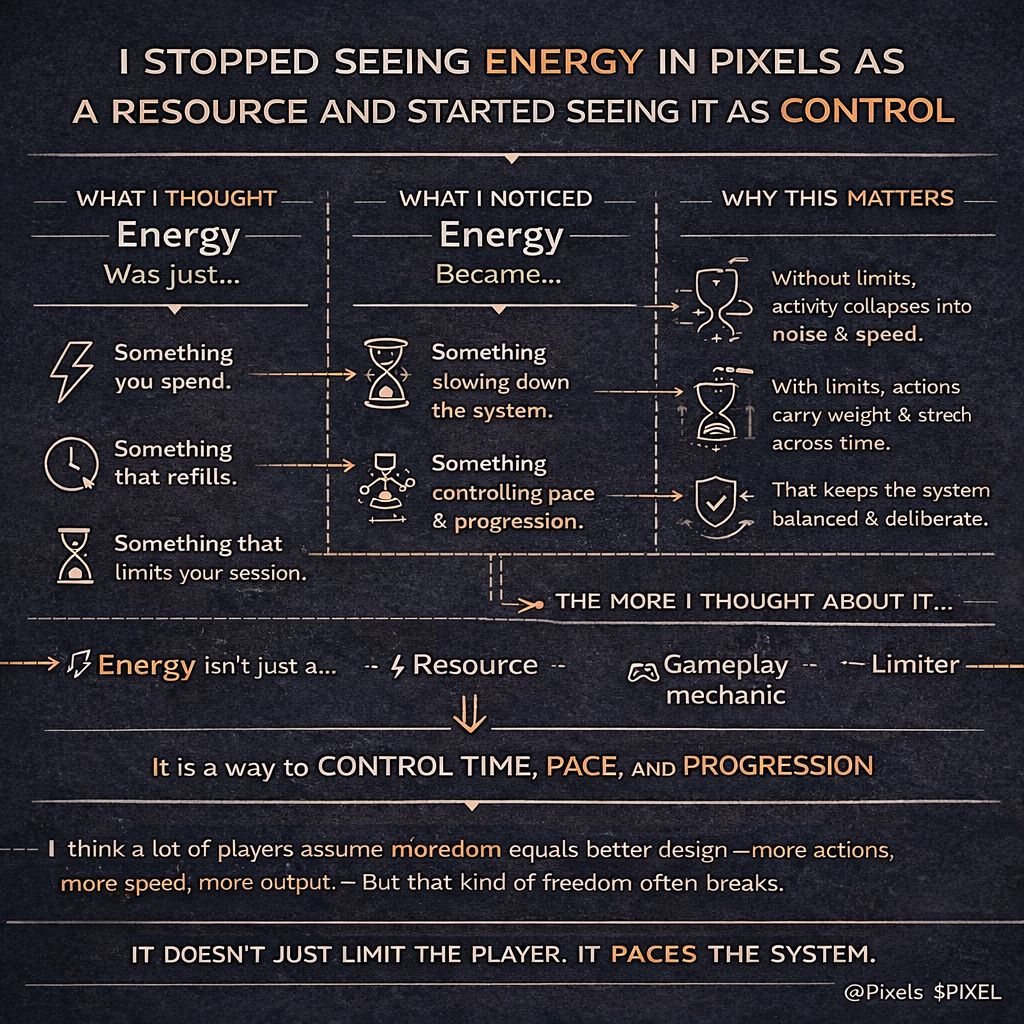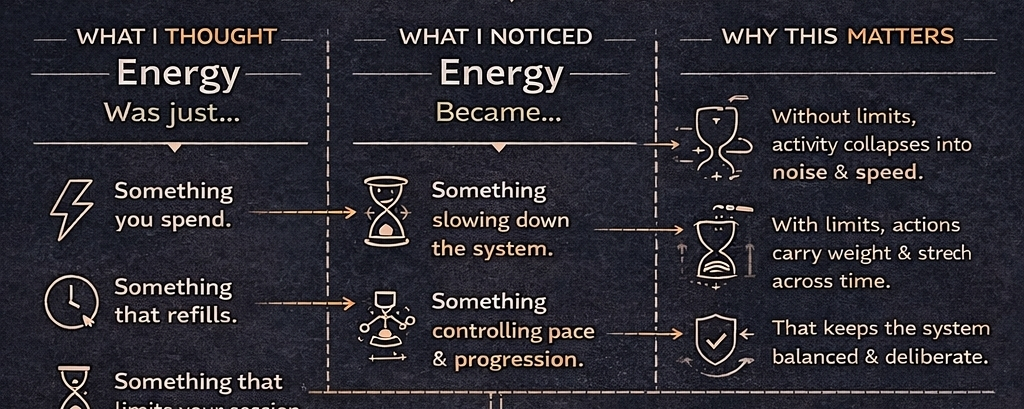
I used to think energy in @Pixels was just another resource—something you spend, something that refills over time, and something that simply limits how long you can play in a session. It felt like a standard mechanic, almost too basic to think deeply about. Like most players, I treated it as a surface-level constraint: when it runs out, you stop; when it refills, you continue.
But the more time I spent inside the system, the more that explanation started feeling incomplete.
Energy wasn’t just sitting there doing nothing. It was quietly shaping how everything moves.
And that is where my perspective started shifting.
Because in most games, energy is framed as friction—a barrier between the player and more activity. It interrupts flow, slows you down, and is usually seen as something negative.
But I think that is the wrong way to read it here.
In Pixels, energy doesn’t just limit the player. It starts pacing the system itself.
And once I saw that, it changed how everything connected.
Because without pacing, progression naturally collapses toward speed. The most active players dominate, the fastest grinders compress value into short bursts, and over time the system starts rewarding intensity over decision-making. At first, that kind of freedom feels exciting. It looks open, flexible, even fair.
But if you follow it long enough, it usually leads to imbalance.
That is exactly where weaker systems break.
They remove friction to feel more engaging. They allow unlimited grinding to keep players active. Everything becomes faster, more accessible, and easier to scale.
But the long-term effect is predictable. The economy distorts, progression feels uneven, and the system starts depending too much on who can push harder rather than who understands it better.
And this is where Pixels started reading differently to me.
Because instead of removing limits, it uses energy to control how fast actions turn into outcomes. Every action carries a cost tied to time, and that cost cannot be bypassed instantly.
Which means activity cannot collapse into one aggressive session.
It has to stretch.
And that stretching is not random. It is structural.
What stands out to me is that energy is not just controlling what you can do—it is controlling when and how efficiently you can do it.
That small shift changes everything.
Because now energy is not just a mechanic. It becomes a layer that decides the rhythm of the entire system. It shapes how effort converts into value, how much impact a single session can have, and how evenly opportunity is distributed over time.
And that difference matters more than it looks.
Because once pacing is controlled, actions start carrying weight. Without limits, actions become repetition. They become noise.
With limits, actions become decisions.
You start thinking before acting. You start optimizing instead of spamming. You start playing the system instead of just pushing through it.
And that is where things start getting interesting.
I think a lot of players assume more freedom equals better design—more actions, more speed, more output. But that kind of freedom often breaks systems in the long run.
Pixels doesn’t follow that path.
It keeps the system open, but not uncontrolled.
Energy sits right in the middle of that balance. It slows things down just enough to maintain structure, while still letting players feel active and involved.
And honestly, that balance is not easy to get right.
Too much restriction, and players leave.
Too much freedom, and the system breaks.
Pixels manages to stay in between.
And the more I think about it, the more energy starts feeling less like a gameplay feature and more like discipline built into the system itself. It makes sure value doesn’t concentrate too fast. It keeps progression from being compressed. It quietly protects the ecosystem without making it obvious.
That is the part that stayed with me.
I don’t think energy becomes interesting when it runs out.
I think it becomes interesting when you realize it is controlling the pace of everything behind the scenes.
Not just your session.
Not just your actions.
But the entire system.
For me, that is where Pixels started making more sense.
Not when energy looked like a limitation.
When it started looking like control.