
I didn’t open Pixels today expecting to question how much of my gameplay is actually mine. I just logged in like I usually do morning coffee, quick farm check, a few actions on Ronin. But somewhere between planting and upgrading, I paused. Not because I was stuck. Because it felt… guided. Like the system already had a soft idea of what I’d do next.
I’ve been in crypto long enough to recognize patterns. Early 2023, when Pixels migrated to the Ronin network, it exploded past roughly 180,000 daily active users at its peak. That wasn’t just hype. It was timing, low fees, and a simple loop that worked. Fast forward to April 2026, and the game is still here. That alone matters. Most play-to-earn projects didn’t survive their own token emissions. Pixels didn’t just survive it adapted.
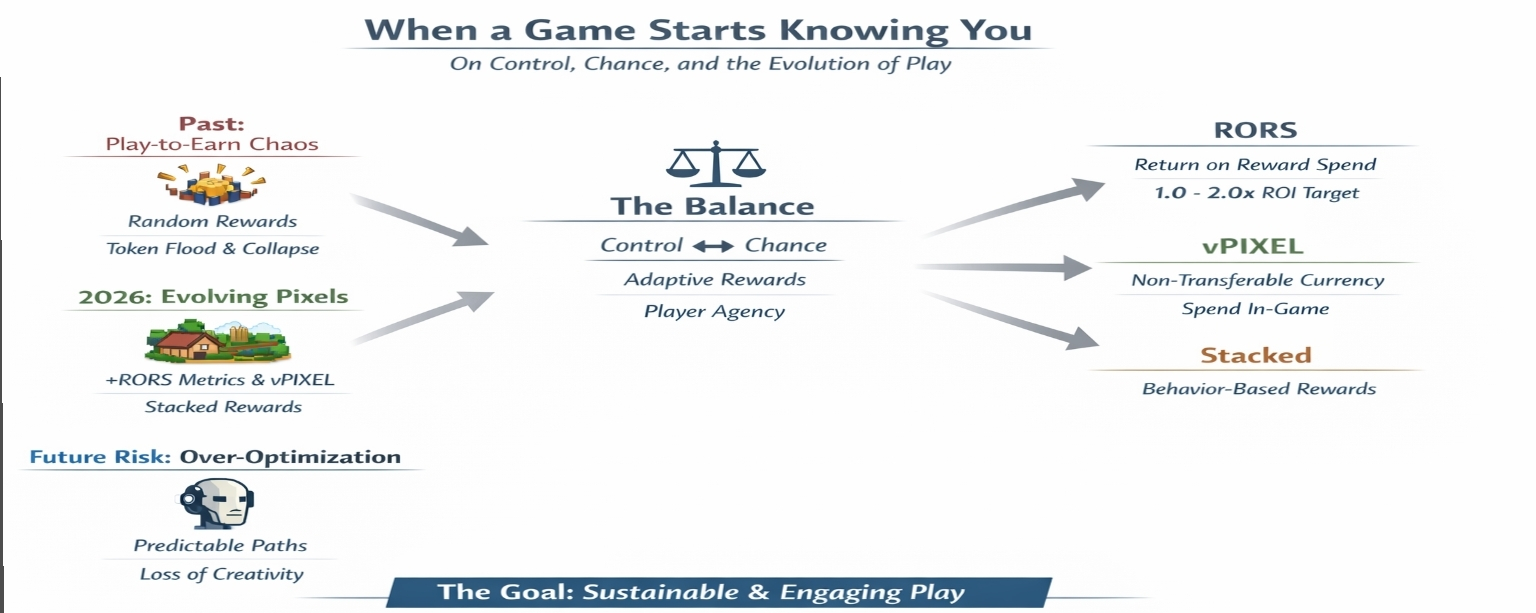
What caught my attention recently is how quietly the system has shifted. Back then, rewards felt random, almost generous. Now, they feel… calculated. And I don’t mean that negatively. I mean it literally. The introduction of RORS Return on Reward Spend changed how I see every action. Simple idea: for every dollar in PIXEL rewards distributed, how much value returns into the ecosystem. Not price speculation. Actual economic flow.
From what the team has shared in recent updates and whitepaper insights, RORS has often stayed above 1.0, sometimes pushing closer to 2–3x in certain cycles. But this isn’t a fixed number. It moves. It depends on player behavior how much we spend on land, crafting, marketplace trades, and progression sinks. That’s the part many overlook. Rewards are no longer just emissions. They’re tied to participation quality.
Then came vPIXEL in early 2026. At first glance, it looks like a simple adjustment. A non-transferable version of PIXEL. You earn it, you spend it in-game, but you can’t dump it on the market. No sell pressure. No farmer tax on withdrawal either, unlike the 20–50% range we’ve seen on regular PIXEL flows. I tested it myself. Earned some, spent it immediately on tools and upgrades. Smooth experience. No friction.
But the real shift isn’t technical. It’s psychological. vPIXEL subtly changes intent. You stop thinking about extracting value and start thinking about reinvesting it. It’s still your reward, but the system nudges how you use it. Not forced. Just… guided.
Late March 2026 introduced another layer Stacked. This is where things get interesting. It’s not just a rewards app. It feels more like a behavior engine. Instead of rewarding raw grind, it seems to weigh how you play. Engagement depth. Consistency. Interaction. Maybe even experimentation. It’s not fully transparent yet, but the pattern is there. Rewards are becoming personalized.
As a trader, I find this fascinating. Because this is no longer just game design. This is algorithmic incentive design. The system observes, adjusts, and redistributes. In traditional games, rules are fixed. Here, they evolve in real time based on player data.
So I started asking myself… where does that leave randomness? The messy part of gaming. The part where you try something pointless just because you feel like it. The part that creates stories, not efficiency.
Pixels seems to be walking a very thin line. On one side, there’s chaos the old play-to-earn model where tokens flood the market and everything collapses. I’ve held those bags before. Not fun. On the other side, there’s over-optimization where every action is predicted, incentivized, and refined until gameplay becomes a loop of best choices.
And that’s the real risk here. Not failure. Over-success.
If the system becomes too accurate, too efficient, it might start compressing player behavior into predictable paths. Exploration fades. Creativity narrows. You’re still playing, yes… but within an invisible framework that’s constantly steering you.
At the same time, I can’t ignore the progress. Ronin’s infrastructure has matured. Transactions are cheap and fast. Pixels continues to push updates through Chapter 2. The economy hasn’t collapsed. That alone sets it apart from most Web3 games launched between 2021 and 2024. There’s a real attempt here to build sustainability, not just hype cycles.
Revenue isn’t coming from thin air either. Land ownership, marketplace fees, crafting sinks, guild interactions these are real economic loops feeding back into the system. That’s what supports RORS. That’s what keeps the reward engine alive.
So where do I stand?
Honestly… I’m still experimenting.
I stake some PIXEL. I track my sessions. I watch how rewards change when I play differently. Some days it feels natural. Other days, I notice the system responding a bit too precisely. That’s when I pause.
Because the deeper question isn’t about tokens or yields anymore. It’s about agency.
When a game starts understanding you at scale… does it enhance your experience, or reshape it?
Maybe the answer isn’t binary. Maybe this is the new layer of Web3 gaming. Not full control. Not full freedom. Something in between. A space where systems guide, but don’t dictate. Where data informs, but doesn’t replace discovery.
Or at least… that’s the balance worth aiming for.
Because in the end, the best games and the best economies aren’t perfectly optimized systems. They’re slightly imperfect ones. Just enough unpredictability to keep us human.
