
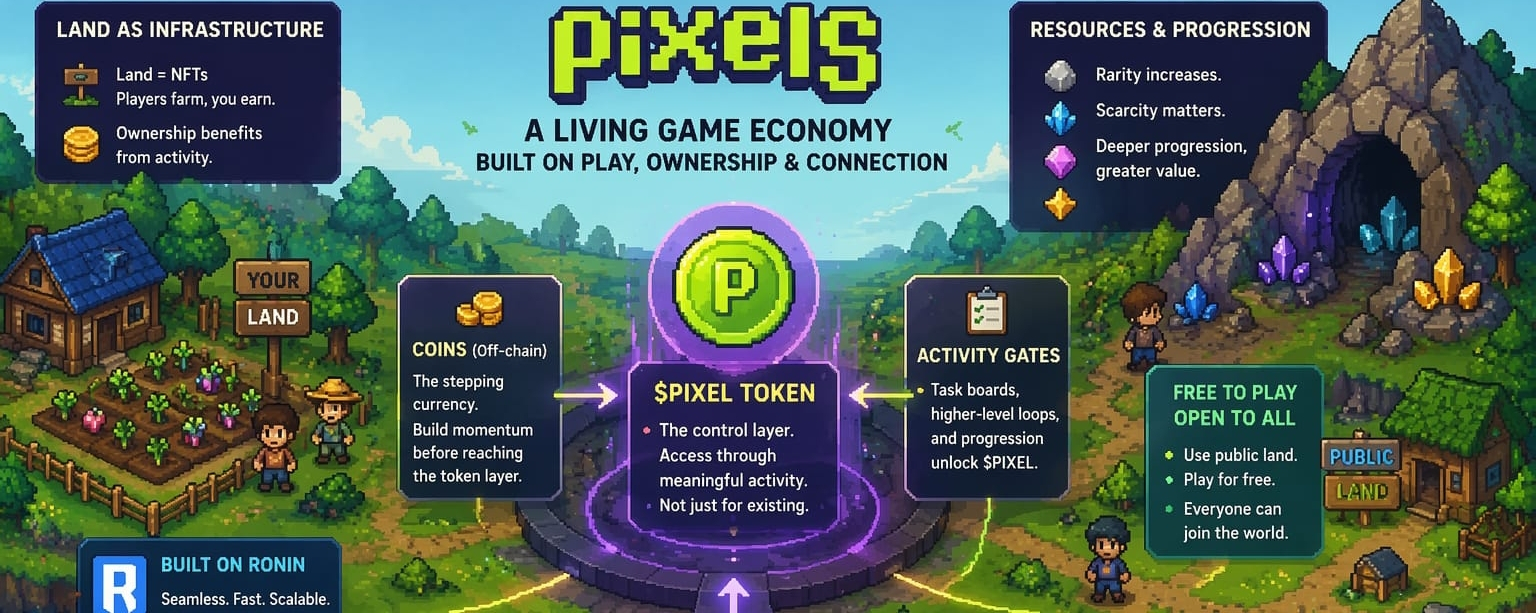
Pixels doesn’t try to impress you by announcing itself as “the future.” It behaves more like something you gradually understand. At first, it looks like a quiet farming world—plant crops, gather wood, cook food, walk around. But the longer you stay, the more it becomes clear that every simple action is wired into a system where time, ownership, and coordination are constantly being measured and redirected.
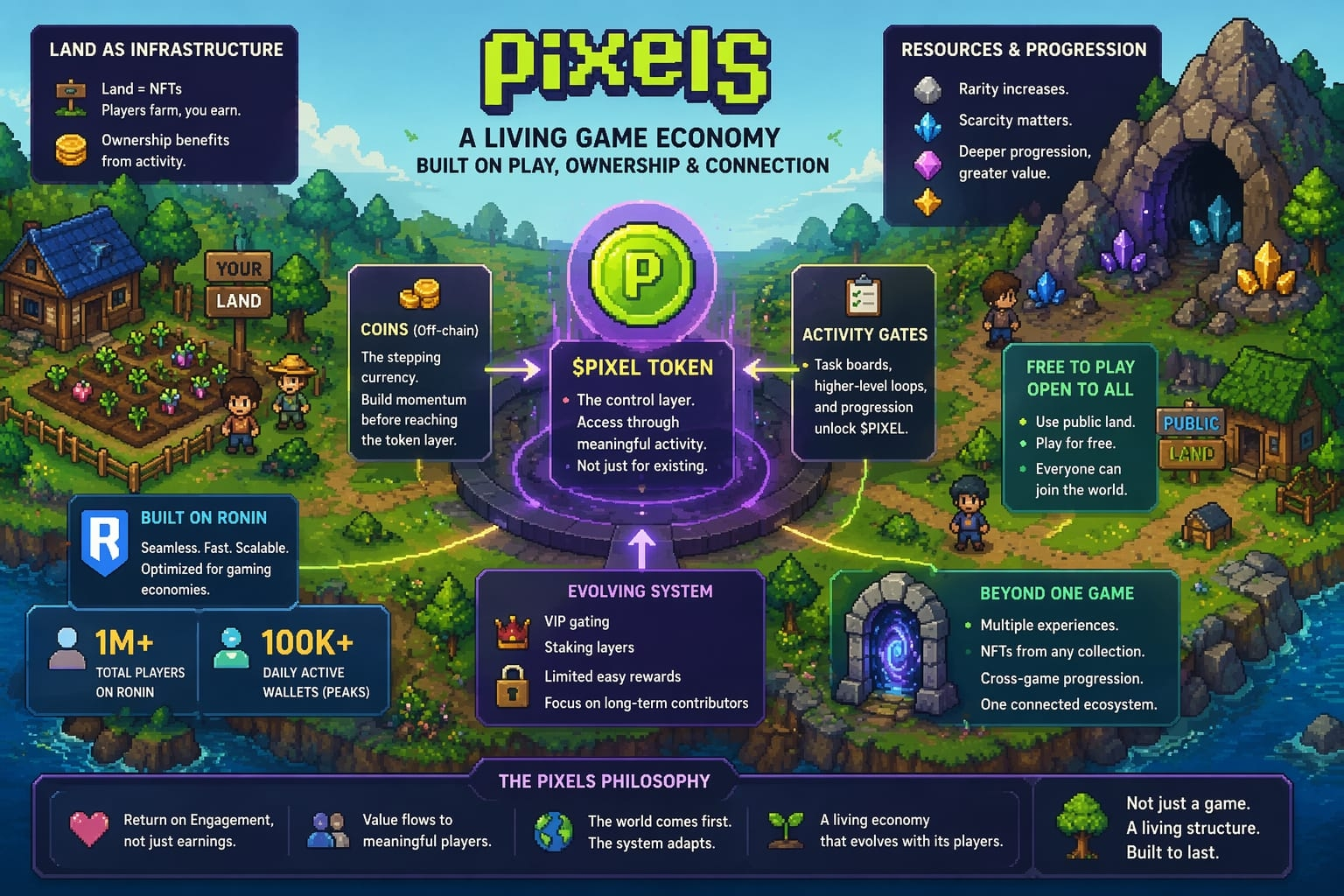
The structure underneath is not random. It’s built on a loop of land, resources, and token flow that keeps feeding back into itself. Land exists as NFTs, but not in a passive way—it acts like infrastructure. If players farm on your land, you benefit from that activity, meaning ownership is tied to participation rather than just holding an asset. Resources move through layers of rarity and scarcity, becoming harder to obtain as progression increases, which prevents the economy from flattening into abundance too quickly.
What makes this more interesting is that Pixels doesn’t lock players into ownership to participate. Anyone can start for free, use public land, and still move through the system. That decision sounds small, but it changes the entire economic tone—it keeps the world open while still rewarding deeper involvement.
The token, $PIXEL, sits in the middle of everything, but it doesn’t behave like a traditional reward token. It’s closer to a control mechanism. You don’t just earn it for existing—you access it through specific activities, especially those tied to progression systems like task boards and higher-level gameplay loops. Coins, the off-chain currency, act as a stepping layer, allowing players to build momentum before touching the token itself.
That separation between “progress currency” and “value currency” is deliberate. It slows down extraction and pushes players to engage with the system instead of rushing through it. The design quietly shifts the mindset from “how fast can I earn” to “how efficiently can I operate inside the world.”
Growth numbers show that this approach has worked—at least in terms of attention. Pixels has crossed over a million players on Ronin and reached hundreds of thousands of daily active wallets at different points, with retention becoming a central focus rather than just raw onboarding.
The move to Ronin wasn’t just technical scaling; it placed Pixels inside an ecosystem already optimized for gaming economies, where transactions feel invisible and onboarding friction is reduced.
But the more telling part isn’t growth—it’s how the team has reacted to pressure. The token went through volatility, including a sharp drop from earlier highs, which forced a rethink of how value flows through the system.
Instead of trying to revive hype, the project started tightening its internal mechanics: limiting easy reward paths, introducing systems like VIP gating and staking layers, and focusing more on players who contribute consistently rather than those who appear briefly for rewards.
That shift is subtle but important. It turns the economy from something that distributes value into something that filters it.
Recent development direction suggests Pixels is no longer trying to be just one game. It’s moving toward becoming a shared environment where multiple experiences plug into the same token and reward structure. The idea of integrating external games, NFTs from different collections, and cross-experience progression shows that Pixels is positioning itself more like a network than a single product.
At the same time, the team has openly acknowledged that the system is still unfinished. Tokenomics, gameplay loops, and reward structures are still being adjusted based on live data and player behavior rather than fixed assumptions.
That willingness to keep reshaping the system suggests Pixels isn’t trying to lock in a perfect model—it’s trying to evolve one.
There’s also a deeper idea emerging in how they think about sustainability. Instead of maximizing earnings, they’re experimenting with something closer to “return on engagement,” where rewards are tied to how meaningful your activity is within the system.
That changes the psychology of the game. It’s no longer about extracting value as quickly as possible—it’s about positioning yourself inside a network where value circulates.
The risk, of course, hasn’t disappeared. Balancing a live economy where players, tokens, and assets all interact is extremely fragile. If rewards become too easy, the system inflates. If they become too strict, players disengage. Pixels is still walking that line, and it hasn’t fully solved it yet.
But what makes it worth watching is that it’s not pretending the problem doesn’t exist. It’s actively redesigning around it.
If most Web3 games treated tokens as the main product, Pixels is slowly reversing that relationship. The world comes first, the system comes second, and the token is forced to adapt around both. If that inversion holds, Pixels won’t just be another farming game with crypto attached—it will be one of the first cases where a game economy feels less like a reward machine and more like a living structure that only works if people actually want to stay inside it.