
When I first stumbled across Pixels, I honestly thought it was just another cozy farming game.
You know the type—bright colors, simple mechanics, a peaceful world where you plant crops, collect resources, and slowly build your own little routine. It felt light, almost comforting, like one of those games you open when you want to relax for a while and escape into something slower. At first, that was all I saw: a charming little digital world built around farming and exploration.
But the more I sat with it, the more I realized Pixels wasn’t as simple as it looked.
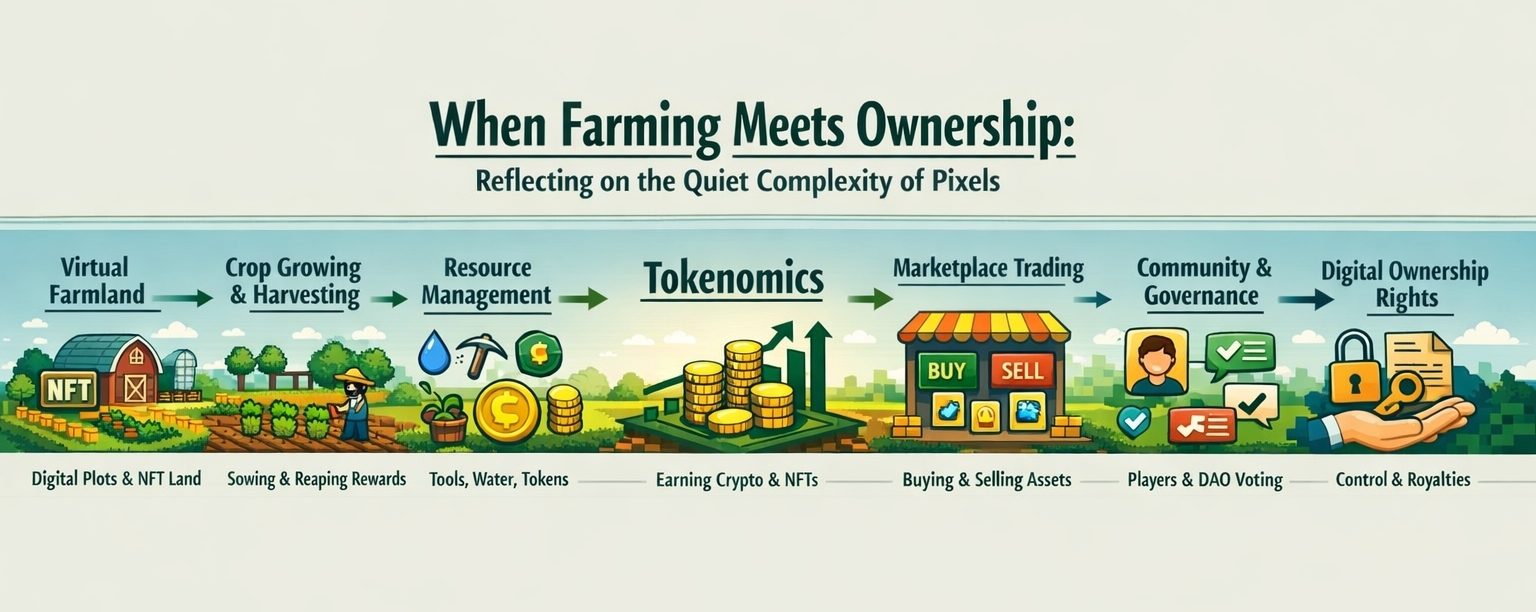
Underneath that easygoing atmosphere, there’s a whole different layer quietly shaping the experience. Behind the crops, the land, the crafting, and the wandering, there’s an economic structure running in the background—a system built on ownership, tokens, and blockchain logic. And that changes the feeling of everything.
That’s what kept pulling my attention back. Pixels presents itself like a casual social game, but beneath the surface it’s asking players to interact with ideas that are much bigger than farming. It’s asking what happens when the relaxing routines of gameplay are mixed with systems of ownership and digital value. And honestly, that creates a tension I find really fascinating.
Because farming games are usually built around simple emotional rewards. You plant something, wait, harvest it, and feel a quiet sense of progress. The value comes from the rhythm. It’s repetitive, but in a calming way. There’s satisfaction in the routine itself. You aren’t usually thinking about ownership or scarcity or market value—you’re just playing.
Pixels changes that.
When the crops you grow, the resources you collect, or the land you interact with are connected to blockchain systems, they start to carry a different meaning. Suddenly, your actions are no longer just part of a closed game loop. They exist inside a structure where digital items have ownership attached to them. That subtle shift makes the whole world feel different.
At first, that sounds empowering. The idea that what you earn in a game actually belongs to you feels like a meaningful change. In traditional games, players spend hours building progress that ultimately stays under the control of the platform. In Pixels, the promise is different. It suggests that your time has a kind of lasting value.
And yet, the moment I started thinking about that promise, I also started wondering what it changes.
Because once ownership enters the picture, play is no longer just play.
Planting a crop is still planting a crop—but it also becomes an action with economic implications. Gathering resources is still part of the gameplay loop—but now it might also be part of a value loop. And that changes the emotional atmosphere in ways that are easy to overlook.
The peaceful farming mechanics are still there, but now they exist alongside incentives.
And incentives always shape behavior.
That’s where Pixels becomes more than just a farming game to me. It becomes an experiment in motivation. It asks whether people can engage with a world casually when every action might hold measurable value.
In theory, players may come for the fun—the exploration, the creativity, the social environment. But once rewards become tangible, behavior naturally shifts. People begin optimizing. They search for the most efficient routines. They calculate what actions produce the best returns. The game might still look cozy on the surface, but underneath, player behavior can become strategic.
That doesn’t mean the design is flawed—it just means systems influence culture.
And I think that’s one of the most interesting things about Pixels. It highlights the quiet difference between a world designed for enjoyment and a world shaped by incentives. Those two ideas can absolutely coexist, but not without affecting each other.
The more I think about it, the more I wonder how sustainable that balance really is.
Can a game remain relaxing when every action has economic weight?
Can a world built for creativity preserve that creativity once optimization takes over?
Can social interaction stay genuine when resources and rewards are part of the same environment?
These questions don’t have simple answers, but Pixels makes them impossible to ignore.
Even the technical side of the project starts to feel less technical when viewed through that lens. Being built on the Ronin Network might sound like a backend detail—faster transactions, lower costs, smoother systems—but infrastructure shapes experience more than people realize.
If transactions are cheap and easy, then value moves faster.
If value moves faster, players adapt faster.
If players adapt faster, the culture of the game changes faster.
That means the blockchain layer isn’t just supporting the world—it’s actively influencing the rhythm of that world. The smoother the economic systems become, the more naturally the economy integrates into everyday gameplay.
That’s powerful, but it also raises another question: does making value flow more smoothly make the game world feel more alive, or does it make it feel more transactional?
I keep coming back to that idea because trust in games has always been emotional before it was technical.
Web3 projects often talk about transparency, ownership, and verifiability. Those are important ideas, but players don’t experience trust as a technical feature. They experience it emotionally. They trust a game when it feels fair. They trust it when progress feels meaningful. They trust it when the rules feel stable.
Pixels may offer technical ownership, but emotional trust still depends on human experience.
And human experience is messy.
Players don’t all enter with the same goals. Some want to explore. Some want to socialize. Some want to earn. Some want to speculate. The moment all those motivations meet in one ecosystem, the ideal of a balanced player economy becomes much harder to maintain.
That’s where the human side of Pixels becomes more interesting than the technology itself.
Because the real challenge isn’t whether the blockchain works—it’s whether the community dynamics work.
Will the economy reward meaningful participation, or mostly reward efficiency?
Will ownership create deeper engagement, or stronger inequality?
Will players build a living world together, or simply optimize the systems for extraction?
These are the kinds of questions that make Pixels feel alive to me. It isn’t just presenting finished answers—it’s exposing an evolving relationship between design and behavior.
And honestly, that uncertainty is what makes the project compelling.
I don’t see Pixels as some polished blueprint for the future of gaming. I see it as an open question.
A question about whether ownership improves immersion or changes the spirit of play.
A question about whether value can enhance community without quietly reshaping it.
A question about whether digital worlds can remain playful once economics are embedded into their foundations.
The more I reflect on Pixels, the less interested I become in whether it “succeeds” in the usual sense. What matters more is what it reveals.
It reveals how fragile the balance is between fun and incentive.
It reveals how quickly systems influence player behavior.
It reveals that ownership can create both freedom and pressure at the same time.
And maybe most importantly, it reveals that the future of digital worlds may depend less on technology and more on how people respond to the systems that technology creates.
That’s why I keep thinking about Pixels.
Not because it promises something revolutionary, but because it quietly asks something difficult:
What happens when a game stops being just a game?
What happens when relaxing play becomes valuable labor?
What happens when ownership enters spaces once defined only by imagination?
I don’t think Pixels answers those questions yet.
But maybe that’s exactly why it matters.
Because right now, it feels less like a finished destination and more like a living experiment—one where every planted crop, every trade, every interaction is part of a bigger attempt to understand what ownership really means inside a digital world.
And I can’t help wondering where that leads.
If players begin to treat virtual worlds as places of value, will those worlds become more meaningful—or will they slowly lose the innocence that made them enjoyable in the first place?
Maybe Pixels is trying to find the answer.
Or maybe the answer will only appear once the system meets real human behavior.
And that, to me, is the most interesting part of all.
And somewhere in that quiet digital farmland, a bigger question begins to grow.
What starts as a simple game slowly turns into a test of human desire, value, and control.
Every seed planted feels like more than progress—it feels like a glimpse into the future of ownership itself.
The world of Pixels may look peaceful, but beneath it, powerful systems are shaping every decision.
What happens when play becomes value, and value begins to shape the meaning of play?
Maybe Pixels is not just building a game—it is revealing how fragile the balance between freedom and incentive really is.
And when that balance is finally tested by real people, the most unexpected harvest may not be crops—but truth.
