

I’ve been noticing something small about Pixels that keeps pulling me back into a bigger question.
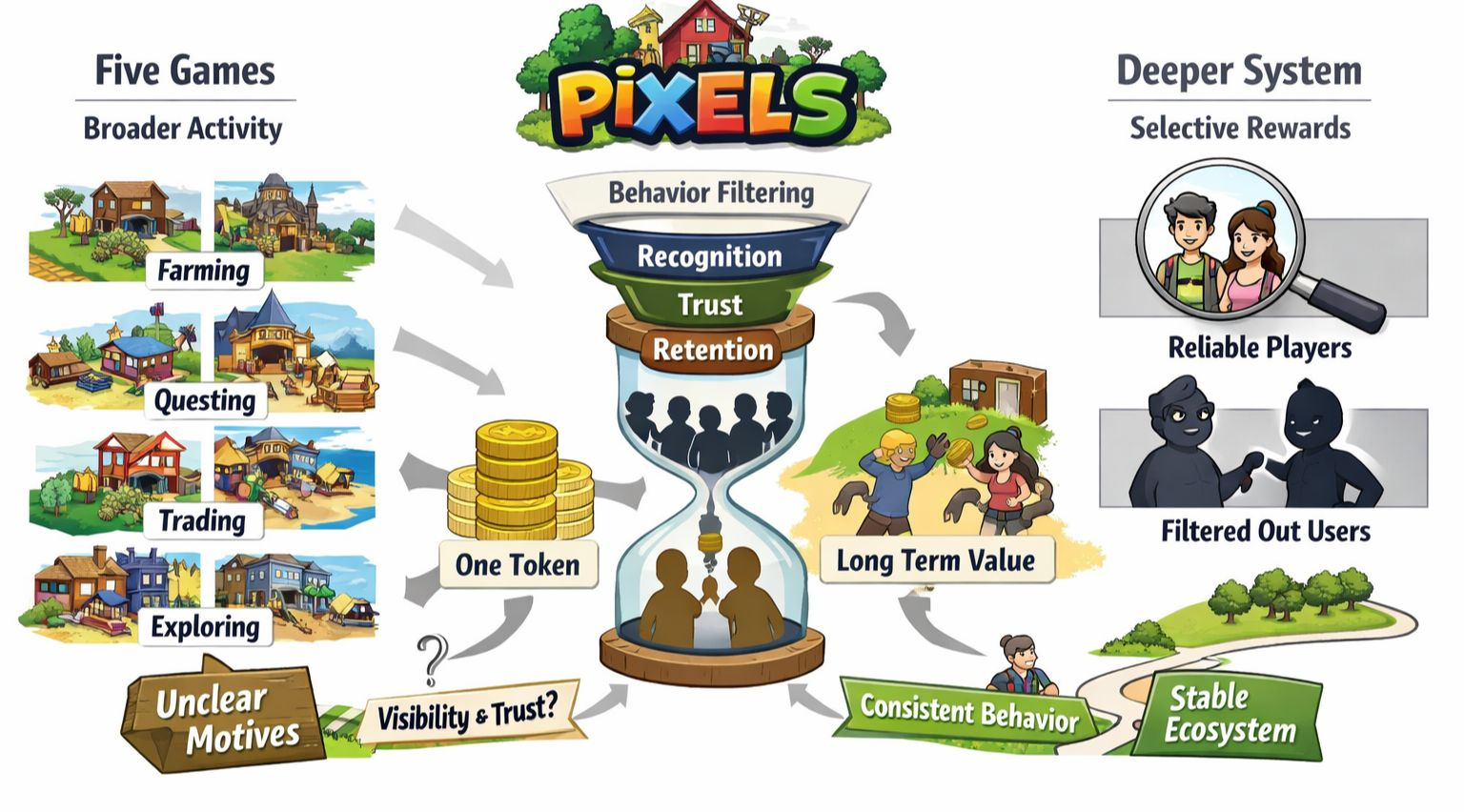
On the surface, Pixels expanding to five games sounds like a clear sign of growth. More games, more activity, more places for the token to exist. But the more I think about the project itself, the less I see this as just a story about expansion. It feels more like Pixels is trying to build a wider system, and that makes me wonder what exactly is being scaled along with it.
That’s where my attention stays.
A lot of people will naturally look at this through the usual lens. More games should mean more users. More users should mean more demand. More demand should be good for the token. That is the simple version. But projects like Pixels are never only about the visible layer. Underneath the games, there is always another structure forming. A structure made of behavior, habits, rewards, and repeated actions.
And that is why the lack of a public token emission model across all five games stands out.
Because for a project like Pixels, token emission is not just a technical detail. It shapes the environment. It influences how people play, why they return, what kind of activity gets encouraged, and which behaviors quietly become more valuable over time. Once one token starts stretching across several games, it stops being only about supply. It starts becoming part of how the project teaches users what matters.
That is the part I think people overlook.
Pixels is not only expanding content. It is expanding the number of places where user behavior can be observed, rewarded, and repeated. One player may grind every day. Another may trade well. Another may move quickly toward whatever produces the highest short-term reward. Another may simply be consistent and easy to predict. From a distance, all of them can look active. But for the project, those are not the same kind of users.
And sooner or later, every project has to decide which kind of activity is worth keeping.
That decision does not always happen in a loud or obvious way. Usually it happens quietly. Through reward design. Through friction. Through what keeps paying and what slowly stops mattering. Players are not always told how to behave, but they learn. They notice which actions feel safe, which patterns keep working, and which type of participation seems to fit the system best.
So when I look at Pixels, I do not just see five games.
I see a project that may be building a stronger ability to recognize useful behavior across a broader network. That matters because the real strength of a project is not always in how much activity it creates. Sometimes it is in how well it learns which activity is reliable, repeatable, and worth supporting again.
That creates a very different way of thinking about value.
If Pixels can connect five games through one token, that may increase utility on paper. But the deeper advantage may be that the project becomes better at understanding its users across multiple environments. It gets more chances to see who returns, who adapts, who extracts, who contributes, and who fits the kind of ecosystem it wants to sustain long term.
To me, that is where the real project story becomes more interesting than the headline.
Because if Pixels is becoming better at identifying the kinds of players it can trust across several games, then the token may not fully represent the deepest layer of value being built. The token may sit close to that layer, benefit from it, and depend on it. But that does not automatically mean it captures all of it.
That is an uncomfortable thought, but I think it is an honest one.
A project can have a visible economy and still be driven by a less visible system underneath. In Pixels’ case, that deeper system may be about recognition, consistency, retention, and behavioral legibility more than people realize. The token moves on the surface, but the project may be learning something more important below it: which users make the ecosystem easier to maintain.
And if that is true, then public modeling matters even more.
Not because every user needs perfect transparency. But because when a project expands this much, people should be able to see how the project believes value is being created and distributed. Without that, users mostly see outcomes without seeing the logic behind them. They can watch the token, but they cannot fully see what kind of behavior the system is actually rewarding across the whole network.
That is why I cannot look at Pixels’ five-game expansion as just a bullish growth signal.
It may be growth. It may also be a deeper shift in how the project filters, rewards, and reuses participation. And if that layer is becoming more important than ever, then the biggest question is not just whether the token will scale with Pixels.
It is whether openness inside the project stays real once the system starts valuing the players it can read clearly enough to trust, reward, and stop questioning.