
At first glance, a “rewarded LiveOps engine” sounds like another product pitch. But the more I looked at it, the more it felt like a quiet correction to a system that never truly worked.
Because the real issue in games—especially anything close to play-to-earn—was never rewards themselves. It was distribution. Who gets rewarded, when they get it, and why.
Most systems treated rewards like an open faucet—always running, barely controlled. The outcome was predictable. A small percentage of players captured the majority of value, often bots or highly optimized farmers, while everyone else slowly disengaged. When 20% of players take 80% of rewards, that’s not randomness. It’s structural failure.
Stacked reframes this entirely by making rewards intentional.
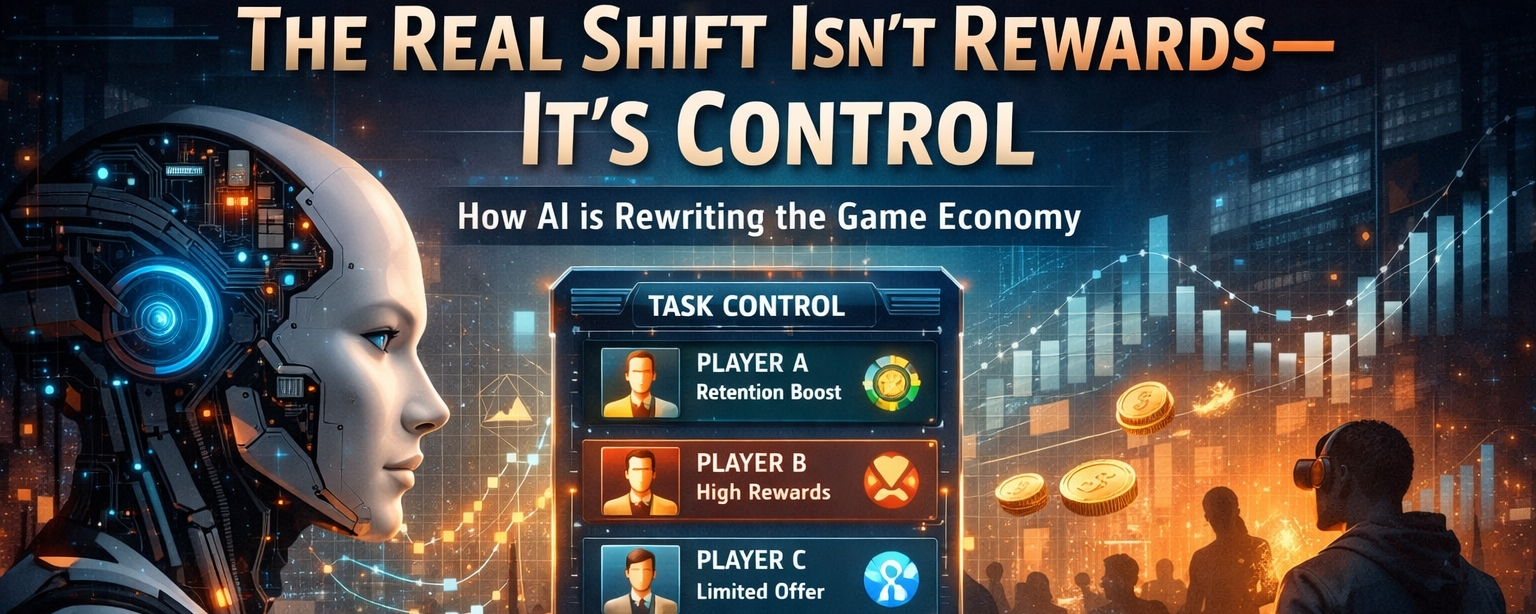
On the surface, it looks simple: players complete tasks and earn rewards across games. But underneath, there’s a layer making continuous decisions. An AI system isn’t just generating tasks—it’s deciding who sees them and when they appear.
That timing is everything.
If a player is about to leave, a reward stops being a bonus—it becomes a retention lever. If a player is already deeply engaged, over-rewarding them can reduce long-term value. So instead of broadcasting incentives across the entire player base, the system narrows its focus: the right player, at the right moment.
It sounds simple. In practice, it means constant behavioral adjustment.
Early implementations of systems like this show retention lifts in the range of 15–30% when rewards are targeted instead of uniform. That range matters. At 15%, you stabilize a game. At 30%, you reshape its growth curve. The difference often comes down to how accurately the system understands player intent.
That’s where the idea of an “AI game economist” becomes real.
Traditionally, game economists design reward loops, monitor inflation, tweak drop rates, and react to imbalances. But that process is slow—updates might happen weekly, sometimes monthly—while player behavior shifts daily.
Stacked compresses that loop into real time.
If a task is being over-farmed, exposure can be reduced quietly. If a new feature struggles to gain traction, rewards can be attached to guide exploration. What looks like a static task board is actually a dynamic surface, constantly reshaped underneath.
This leads to a second-order effect: scale.
Hearing about 200+ unique offers per day sounds excessive—until you compare it to manual design limits. A typical team might produce 10–20 meaningful tasks in that timeframe before repetition creeps in. Automation raises that ceiling—not just in quantity, but in variation.
Still, volume isn’t the real advantage. Relevance is.
A system generating hundreds of tasks only works if each one feels tailored to the player experiencing it. Otherwise, it becomes noise—and players are very good at ignoring noise.
Then comes the economic layer.
Real-money rewards introduce a different kind of pressure. In-game inflation is manageable. Real-world value leakage is not. If rewards are too generous, the system collapses. Too conservative, and players lose interest. This balance has broken most play-to-earn models.
Stacked approaches this differently by tying rewards to measurable outcomes—retention, revenue, and lifetime value.
Rewards stop being expenses. They become investments.
If a $1 reward generates $3 in expected lifetime value, it makes sense. If it doesn’t, the system adjusts—quietly and continuously.
But this introduces a subtle risk.
When everything is optimized for measurable outcomes, there’s a tendency to favor short-term gains over long-term experience. Players may stay longer and spend more, but something harder to quantify—the texture of the game—can begin to flatten.
Efficiency increases. Meaning doesn’t always follow.
This is why the Pixels team is worth paying attention to.
They’ve already experienced the full cycle: hype, rapid growth, and correction. At its peak, Pixels reached over a million daily active users—a milestone that also exposed how quickly misaligned incentives can destabilize a system.
Building Stacked on top of that history suggests this isn’t theoretical. It’s learned.
At the same time, the broader industry is shifting.
Traditional studios are cautiously revisiting player incentives, while Web3-native projects are moving away from open farming toward more controlled systems. Token models are tightening. Reward pools are becoming conditional. There’s a quiet convergence happening.
Stacked sits directly in the middle of it.
If it works, it doesn’t just improve play-to-earn—it reshapes how incentives function in games altogether.
Because once rewards can be measured with precision, they stop being guesses. They become tools.
And tools tend to spread.
Still, one question remains.
How much control is too much?
At what point does a system guiding player behavior start to feel engineered rather than earned? If every action is subtly influenced, does the experience lose something human—or does it simply become more responsive?
For now, players seem comfortable—as long as rewards feel fair and progression feels natural.
But that balance is fragile.
Push too far, and the system becomes visible. And once players start seeing the system, they don’t just play the game anymore—they start playing the system.
If this direction holds, the future of game economies won’t be defined by how much they give away—but by how precisely they give it.
And that shift is quieter—and more powerful—than it looks.
The real change isn’t rewards.
It’s control.