
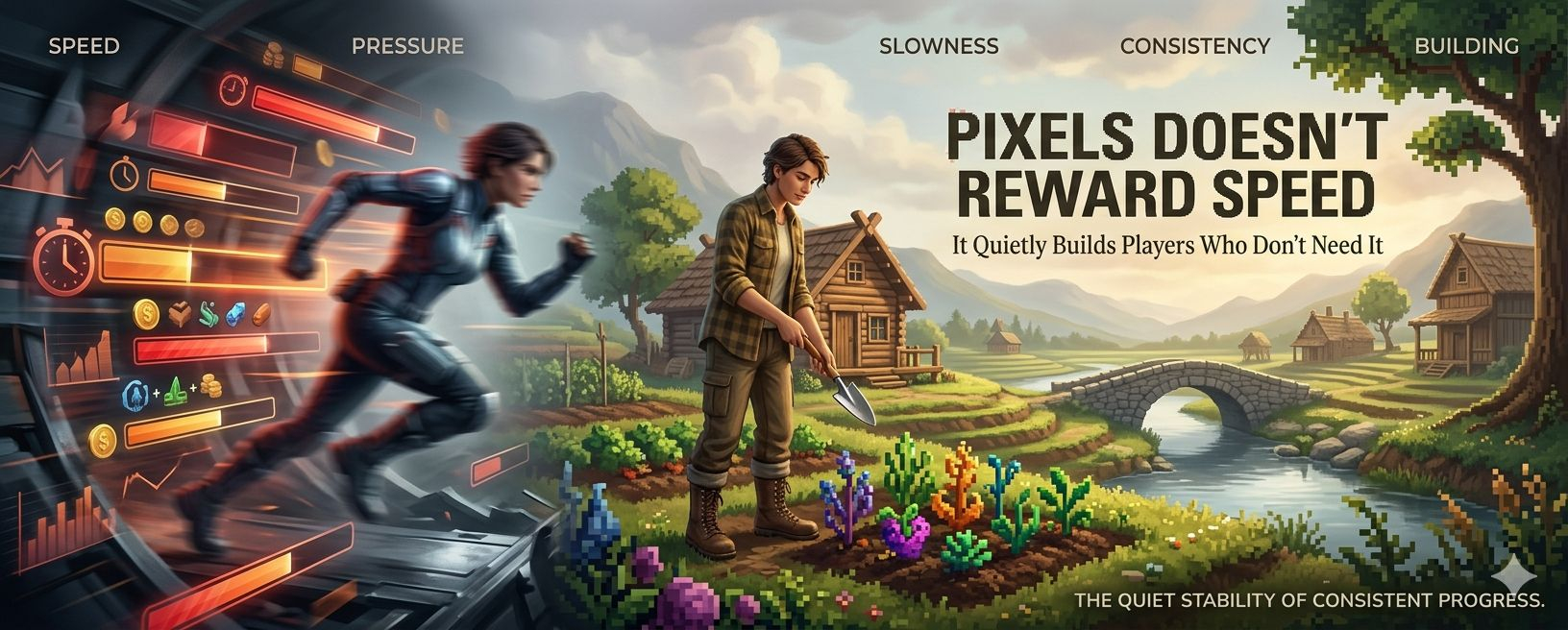
I didn’t realize how much I was used to speed until Pixels took it away.
In most Web3 games, everything moves fast. You log in, collect, optimize, reinvest, repeat. The loop is designed to keep you active, constantly doing something, constantly moving forward. Progress feels immediate, almost aggressive. And after a while, you stop questioning it speed becomes the expectation.
Pixels breaks that expectation without announcing it.
The first few sessions felt slower than I was comfortable with. I kept looking for a way to accelerate things, to push progress forward like I normally would. But the system didn’t really respond to that mindset. There was no obvious shortcut, no fast track that suddenly changed everything.
So instead of speeding up, I slowed down.
And that shift felt strange at first. Logging in without a clear goal, doing small actions without expecting instant results it almost felt like I was playing inefficiently. But over time, that feeling started to change. I wasn’t falling behind. I wasn’t missing out. I was just moving at the pace the system was built for.
That’s when it started to click.
Pixels isn’t designed to reward speed. It’s designed to remove the need for it.
In most systems, speed creates pressure. You feel like you have to keep up, optimize every move, and stay ahead of others. That pressure keeps engagement high, but it also burns it out quickly. You’re not playing because you enjoy the process you’re playing because slowing down feels like losing.
Pixels removes that pressure almost entirely.
Without the constant push to go faster, your behavior starts to shift. You stop trying to maximize every action and start paying attention to how those actions connect over time. Small progress begins to feel enough. Consistency starts to matter more than intensity.
And that changes what “progress” actually means.
It’s no longer about how quickly you can reach the next milestone. It’s about how naturally you can stay within the system without forcing it. That’s a much quieter form of engagement, but it’s also much more stable.
Still, this approach comes with a trade-off.
A system that doesn’t reward speed can feel slow to those who are used to constant momentum. Without strong spikes of progress, some players might feel like nothing significant is happening. And in a space where attention is limited, that perception can become a real challenge.
Because when progress isn’t obvious, it needs to be felt.
That’s where the design has to carry more weight. The world, the rhythm, the small interactions all of it has to create a sense that time spent isn’t wasted, even if it’s not accelerating. If that feeling weakens, players won’t leave because they’re frustrated.
They’ll leave because they’re unconvinced.
The economic layer makes this balance even more fragile. Even if speed isn’t directly rewarded, incentives still exist beneath the surface. If those incentives start to favor faster progress, the system risks drifting back toward the same patterns it’s trying to avoid. If they’re too limited, engagement can quietly fade.
There’s no fixed solution here. Only ongoing adjustment.
At the same time, the broader environment has changed. Fast growth and quick rewards aren’t enough to hold attention anymore. Users have seen that cycle too many times. What matters now is whether an experience can sustain itself without relying on constant acceleration.
Pixels feels like it’s being built with that understanding.
Even the social layer reflects this slower design. Interactions don’t feel rushed or forced. They happen naturally, without the system demanding them. That creates a more relaxed environment, but it also means the game relies on players choosing to engage rather than being pushed into it.
And that choice is everything.
If I look at Pixels as a whole, it doesn’t feel like it’s trying to compete on speed at all. It’s not trying to be faster, louder, or more intense than everything else.
It’s trying to be more sustainable.
Because in the long run, speed is easy to build.
What’s difficult is creating a system where players don’t feel the need to rush at all.
And if Pixels gets that right, it won’t just change how people play.
It will change what they expect from the system itself.