

When evaluating any digital asset ecosystem, the underlying architecture always matters more than the frontend. Most Web3 games fail not because they lack fun, but because their internal economies inevitably collapse. To understand why Pixels is currently dominating the charts, we must look past the retro farming mechanics and analyze its core financial engine through the framework of "sinks and faucets."
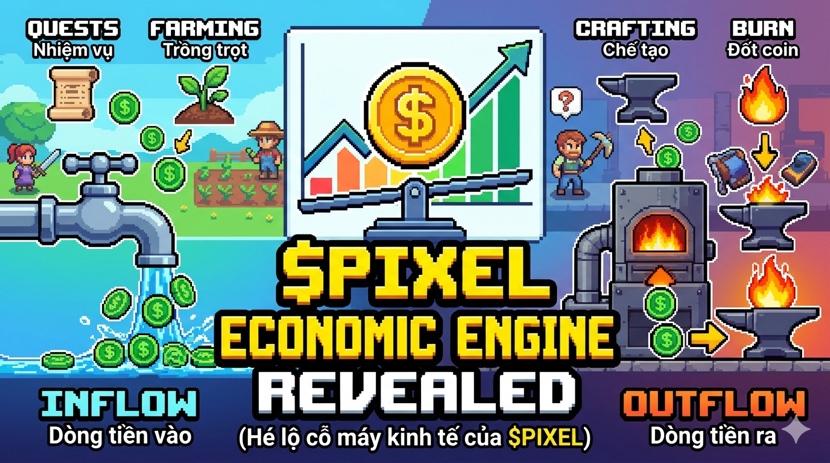
In tokenomics, faucets are the mechanisms that inject liquidity into the economy—quests paying out PIXEL, crops yielding sellable goods, and daily rewards. Sinks are where value is absorbed and removed from circulation—crafting fees, land taxes, and token burns. A healthy digital economy requires both. Too many faucets result in hyperinflation; too many sinks drain the player base.
What sets Pixels apart is that its development team clearly understands this delicate balance. While competitors simply staple cosmetic sinks onto inflationary faucets as an afterthought, Pixels weaves them directly into the core gameplay loop. However, maintaining this equilibrium is not a "set-and-forget" parameter. It requires active, algorithmic management, especially when navigating massive fluctuations in Daily Active Users (DAU).
Following its Token Generation Event (TGE), Pixels experienced the inevitable exodus of short-term speculative capital. Fewer players mean fewer faucet outputs, but also fewer sink inputs. To manage this volatility, the team utilizes seasonal events and limited-time content as temporary sinks. This is a brilliant piece of economic design—it creates urgency and pulls resources out of circulation during high-engagement periods without permanently altering the base economy.
Yet, the most fascinating—and slightly concerning—aspect of Pixels is its land economy. By allowing landowners to earn a cut from landless players farming on their plots, the game has established a two-tiered system mirroring traditional capital and labor divides. Your economic experience in Pixels depends heavily on which side of the property line you stand. It perfectly simulates real-world economic models, which is either an impressive achievement or a cautionary tale, depending on your perspective.
Eventually, the conversation around Pixels must turn to its governance roadmap. Like all Web3 projects, Pixels promises meaningful community decentralization over economy parameters and resource balancing. On paper, this is the ultimate goal. In practice, however, most governance systems provide the illusion of control, with core teams retaining silent veto power to protect the treasury. While I remain cautiously optimistic, the fact that the Pixels team is having this conversation publicly is a commendable starting point.

Ultimately, Pixels is navigating the fundamental tension of every Play-to-Earn ecosystem: extractors who are there strictly to earn need faucets to outpace sinks, while genuine gamers need sinks to give their progression meaning. No project has perfectly solved this yet. But with calculated pivots—like the migration to Ronin to reduce transaction friction—Pixels is proving that it has the agility and the economic intelligence to try harder than most.