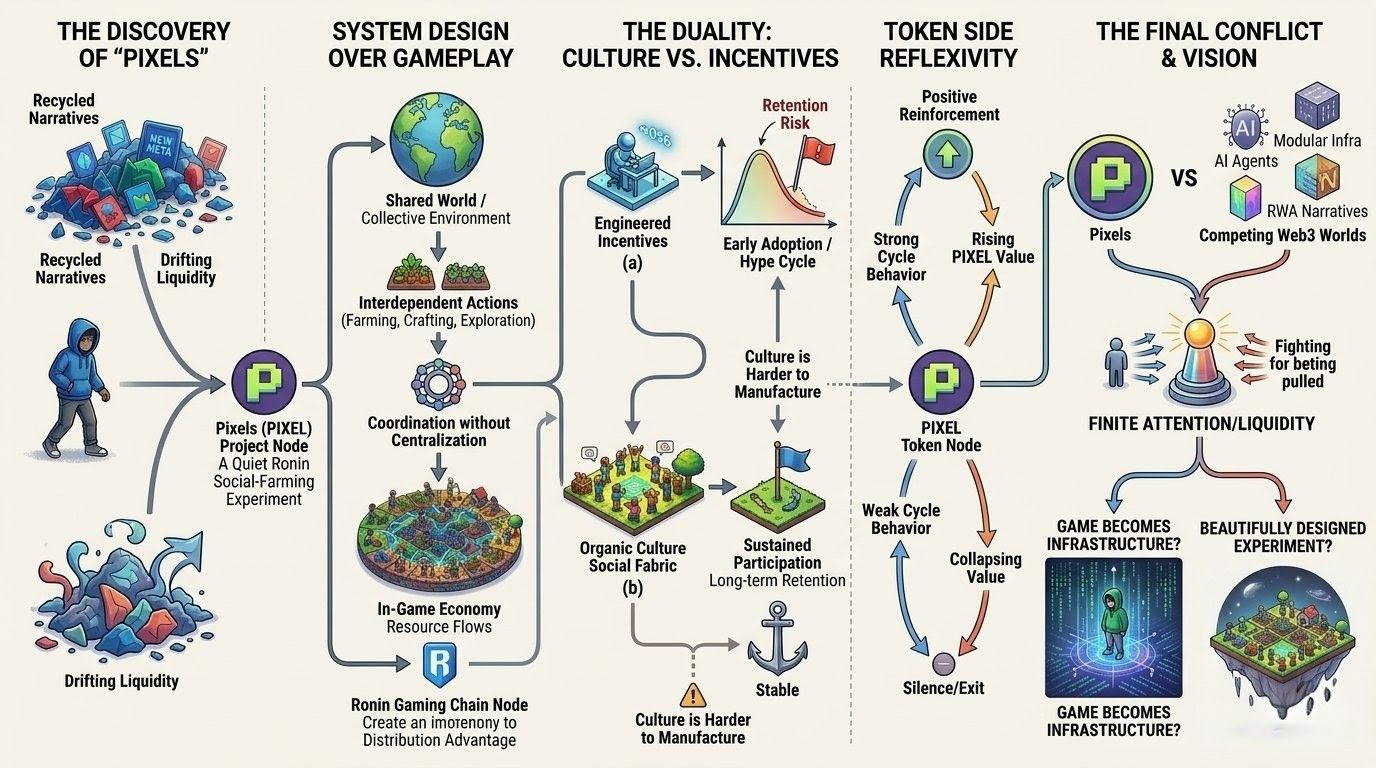
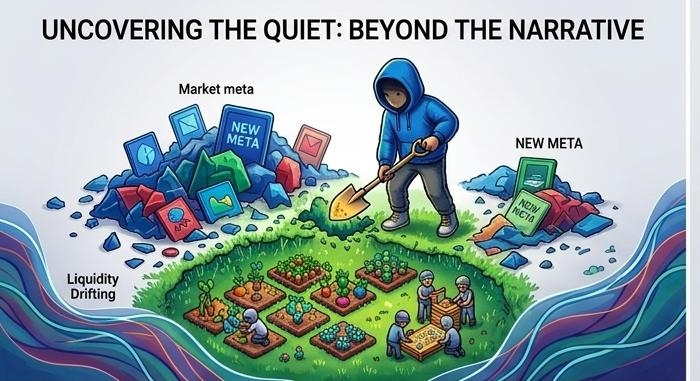
I didn’t go looking for Pixels (PIXEL) that day. I was actually trying to make sense of where liquidity was drifting after another quiet rotation week in the market. You can feel it before you can explain it when narratives stop hitting the same way, when capital starts hesitating at the edges, when “new meta” posts begin to feel like recycled language instead of discovery.
That’s usually when I end up digging into projects that don’t scream for attention.
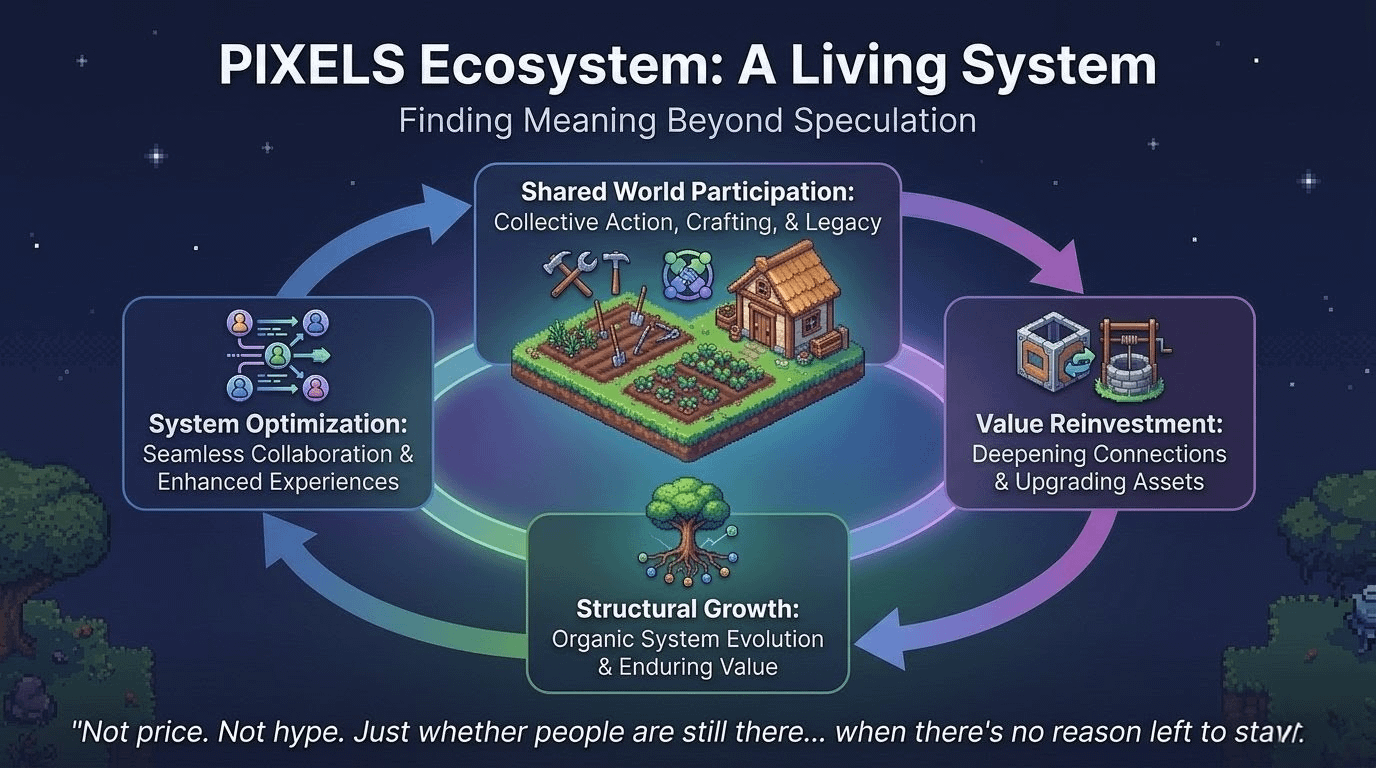
Pixels came up in that in-between space. Not in a “this will change everything” way, but more like something already quietly running while most people are looking elsewhere. A social casual game on Ronin, farming and exploration, creation layered into an open world. On paper, it sounds familiar. Almost too familiar.
But I’ve learned that in this market, familiarity is often where the real differentiation hides or collapses.
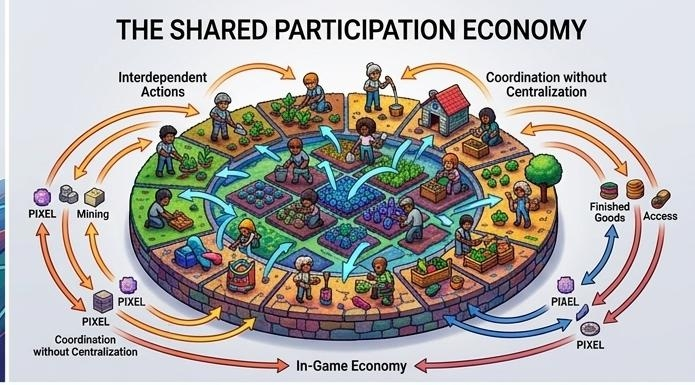
What caught my attention wasn’t the gameplay description. It was the framing around shared participation. A world where farming, crafting, and exploration aren’t isolated loops, but interdependent actions feeding into a collective environment. That sounds abstract until you translate it into how crypto systems actually survive: coordination without centralized control.
And that’s where my thinking shifted a bit.
Because right now, every narrative competing for liquidity is trying to solve some version of the same underlying problem. How do you make users not just consume, but stay? Not just speculate, but participate? We’ve seen it through DeFi composability, through restaking security layers, through modular chains promising separation of concerns, even through AI agents trying to simulate activity. Different interfaces, same question.
Pixels is trying to answer it through a game economy.
At its core, it’s not complicated. You enter a shared world. You farm resources. You explore spaces. You create things that others interact with. But the important part isn’t the activity itself. It’s how those actions are embedded into a network where outcomes are not fully isolated. What you do affects someone else’s environment, and vice versa.
That’s where it starts feeling more like a system design experiment than a game.
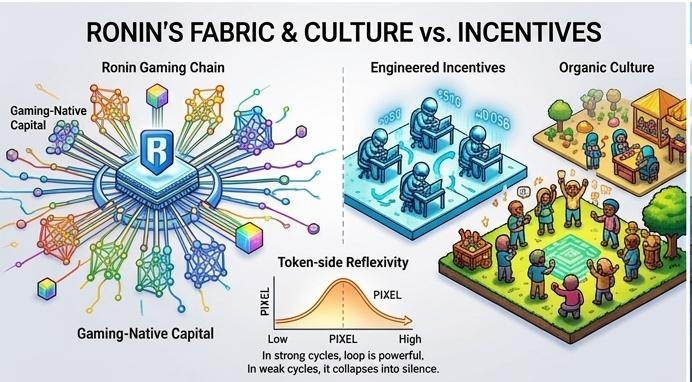
On Ronin, that matters more than people think. Gaming chains have been through cycles of hype and exhaustion. Axie already proved that attention can be bootstrapped, but sustaining it is a different problem entirely. Most successors tried to fix incentives first. Pixels seems more focused on rebuilding the social and economic fabric that sits underneath those incentives.
Still, I’m not fully convinced that design alone solves retention.
In my experience watching these ecosystems, early adoption often looks organic even when it’s partially engineered. Incentives bring people in, but culture keeps them there. And culture is harder to manufacture. I don’t yet know if Pixels has crossed that line or if it’s still leaning on early liquidity-driven participation disguised as engagement.
There’s also the token side, which always complicates things. PIXEL isn’t just a reward layer; it’s meant to tie participation into the economy itself. That usually introduces reflexivity when token value influences behavior, and behavior feeds back into token value. In strong cycles, that loop feels powerful. In weak cycles, it collapses into silence very quickly.
What I keep asking myself is whether the in-game economy can survive without constant external attention. Because in this market, attention is liquidity. And liquidity is oxygen.
The strengths are clear enough if you’ve watched enough cycles. Ronin gives it a distribution advantage in gaming-native capital. The design is simple enough that onboarding friction is low. And there’s something psychologically sticky about farming and creation loops when they’re socially embedded not as isolated grind mechanics, but as visible contributions to a shared space
But the risks are just as visible if you’ve been around long enough.
If player growth slows, does the economy still feel alive? If incentives taper, does participation remain meaningful or just mechanical? And perhaps more importantly, does decentralization of contribution actually lead to decentralization of control, or does it just spread dependence across more invisible pressure points?
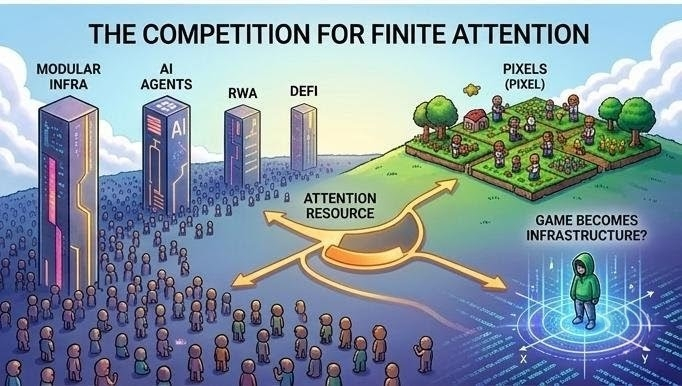
The contrarian thought I keep circling back to is this: maybe Pixels isn’t really competing with other games at all. Maybe it’s competing with the entire idea of attention itself in crypto. Because every ecosystem right now whether it’s AI tokens, modular infra, or RWA narratives is ultimately fighting for the same finite resource: where people choose to care.
And care, in this market, is temporary.
So I find myself less interested in whether Pixels succeeds in the traditional sense, and more interested in what it reveals about the direction we’re heading. A world where “playing” becomes indistinguishable from “participating in an economy,” and where digital spaces slowly turn into coordination layers for behavior rather than entertainment products.
Still, I’m left with a quiet uncertainty.
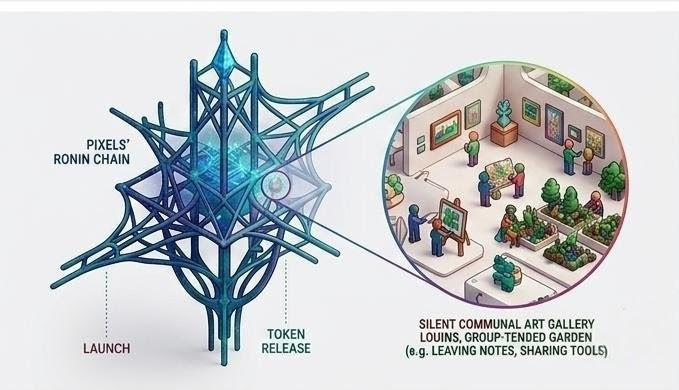
If everything becomes a shared system of contribution, incentives, and coordination, at what point does it stop feeling like a game at all and start feeling like something closer to infrastructure we just happen to live inside?
And maybe the harder question is this: if attention rotates as fast as liquidity does, can any of these worlds ever become stable enough to feel real or are they all just beautifully designed experiments waiting for the next narrative cycle to move on?