
A Pastoral Fantasy That Sells More Than It Admits
Let’s be clear from the outset. Pixels is not just a game. It is a financial system dressed up as one.
The soft colors, the farming mechanics, the “social casual” label—none of that is accidental. It lowers defenses. It invites in players who would never knowingly step into a speculative market. That is the point.
Because this only works if people don’t fully see what they’re entering.
Casual games do not require you to think about token prices. They do not punish you for bad timing. Pixels does both. Quietly, but decisively.
This isn’t entertainment with an economy attached. It’s an economy pretending to be entertainment.
Ronin’s Second Act — Same Script, Better Lighting
We are told this is a comeback story. Ronin, the network behind Pixels, has learned from the excesses of Axie Infinity. The implication is growth, maturity, restraint.
That sounds reassuring. It shouldn’t.
The underlying structure remains intact. Token-led demand. Asset speculation. Growth-dependent economics. These are not superficial features. They are the engine.
Axie didn’t collapse because of poor messaging. It collapsed because the model required constant expansion to survive. That hasn’t been solved. It has been rebranded.
Failure, in this space, is rarely terminal. It is instructional. The lesson isn’t “stop.” It’s “say it differently next time.”
“Social Casual” — The Language of Evasion
The industry has learned one thing very well: change the vocabulary before you change the model.
“Play-to-earn” became an embarrassment. Too many people lost money. So now we get “social casual.” Softer. Safer. Less explicit.
But the incentives are still there, driving behaviour just as forcefully.
Players still buy assets. They still position themselves early. They still care about extraction, even if no one uses that word anymore. The economic layer has not disappeared. It has simply become less honest about itself.
When a system stops describing what it does in plain terms, it is not evolving. It is retreating.
The Token Problem That Doesn’t Go Away
Every Web3 project insists its token has utility. Pixels is no exception. The claim is familiar. The logic is weak.
The token’s value depends on activity. Activity depends on users. Users arrive because they believe the token will hold or rise in value.
That is not utility. That is circular demand.
Break the chain at any point—slower growth, falling prices, declining engagement—and the entire structure begins to unwind. There is no external anchor holding it in place.
It is self-referential. And systems like that do not stabilise. They oscillate, then they fail.
Artificial Scarcity in an Infinite World
Then there is land. Always land.
Pixels sells digital plots as if they are inherently scarce. They are not. Scarcity here is imposed, not discovered. It exists because the system says it does.
And that matters.
Because once scarcity is manufactured, pricing becomes a function of narrative, not necessity. Early participants benefit. Later ones pay the spread.
Ownership is the selling point. Control is the reality.
You don’t own the environment. You own a position within a controlled framework. That distinction tends to become painfully clear only after the market turns.
The Real Commodity Is Attention
Strip away the mechanics and the tokens, and you arrive at the real asset: player attention.
Time spent in the system sustains it. Engagement gives the appearance of value. Community becomes a proxy for demand.
This is not new. Social platforms have been monetising attention for years. Pixels simply attaches a tradable layer on top.
But here’s the difference. In this model, players believe they are participants in value creation. In reality, they are sustaining the conditions that allow others to extract it.
It feels like ownership. It behaves like labour.
The Question Nobody Wants to Answer
All of this leads to a question that should be obvious, yet is consistently avoided.
Where does the money come from?
Not the token mechanics. Not the in-game loops. Actual value.
There is no meaningful external revenue stream supporting long-term returns. The system recycles capital internally. New entrants fund existing participants. Activity masks the imbalance.
That dynamic is not innovative. It is familiar.
And it has a predictable endpoint.
Exit Is a Feature—For Some
Liquidity is presented as a strength. It is anything but universal.
Early participants have options. They can sell into rising demand. They can exit while sentiment holds. They can convert paper gains into real ones.
Later participants inherit the opposite position. They are the demand.
This asymmetry is not accidental. It is structural.
Markets built on timing reward those who arrive first and punish those who believe longest. Pixels does not escape that rule. It relies on it.
Operating in the Gap Between Definitions
For now, Pixels exists in a convenient gray zone.
It is a game when scrutiny increases. A financial ecosystem when capital is being attracted. The ambiguity is useful. It delays intervention.
But ambiguity is not protection. It is a temporary condition.
When regulators eventually decide these systems resemble financial products more than games, the reframing will be abrupt. And the consequences will not fall on the developers first.
They rarely do.
When Play Becomes Positioning
What Pixels ultimately represents is not the future of gaming. It is the financialisation of it.
Every action is measured. Every asset has a price. Every participant is, knowingly or not, taking a position.
That changes behaviour. It changes incentives. It changes what “playing” even means.
Fun becomes secondary. Strategy becomes financial. The experience bends toward optimisation, not enjoyment.
At that point, it stops being a game in any meaningful sense.
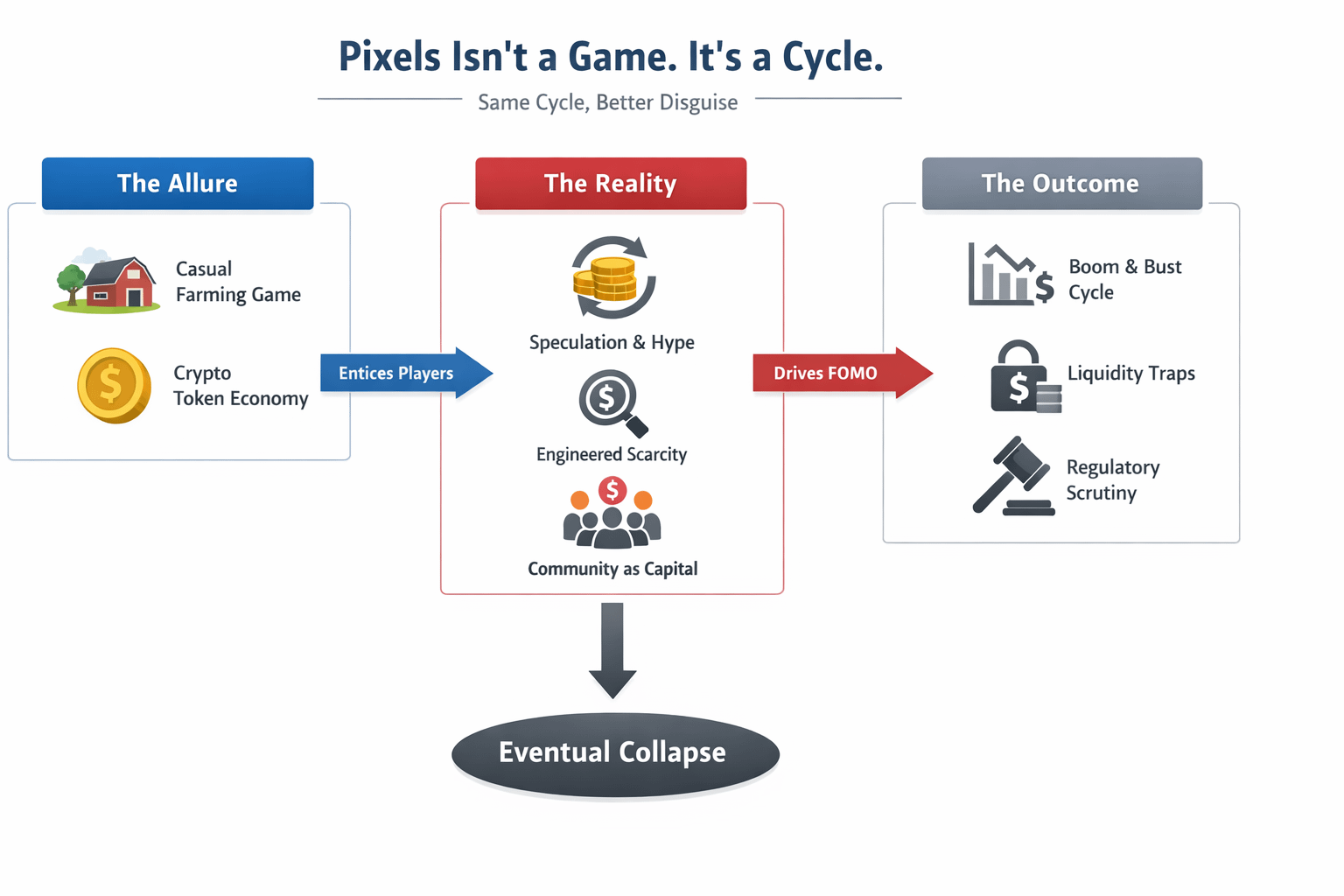
Same Cycle, Better Disguise
None of this is novel. The industry would like you to believe it is. It isn’t.
The cycle is well established. Early excitement. Rapid growth. Expanding narratives. Slowing inflows. Sudden stress. Eventual collapse.
What Pixels offers is not a new model. It offers a more palatable version of an old one.
Cleaner design. Softer language. Lower initial resistance.
But the mechanics are intact. And mechanics, not marketing, determine outcomes.
The system does not need to deceive everyone. It only needs enough people, for long enough.
That has always been the threshold.
And it has never held.
