
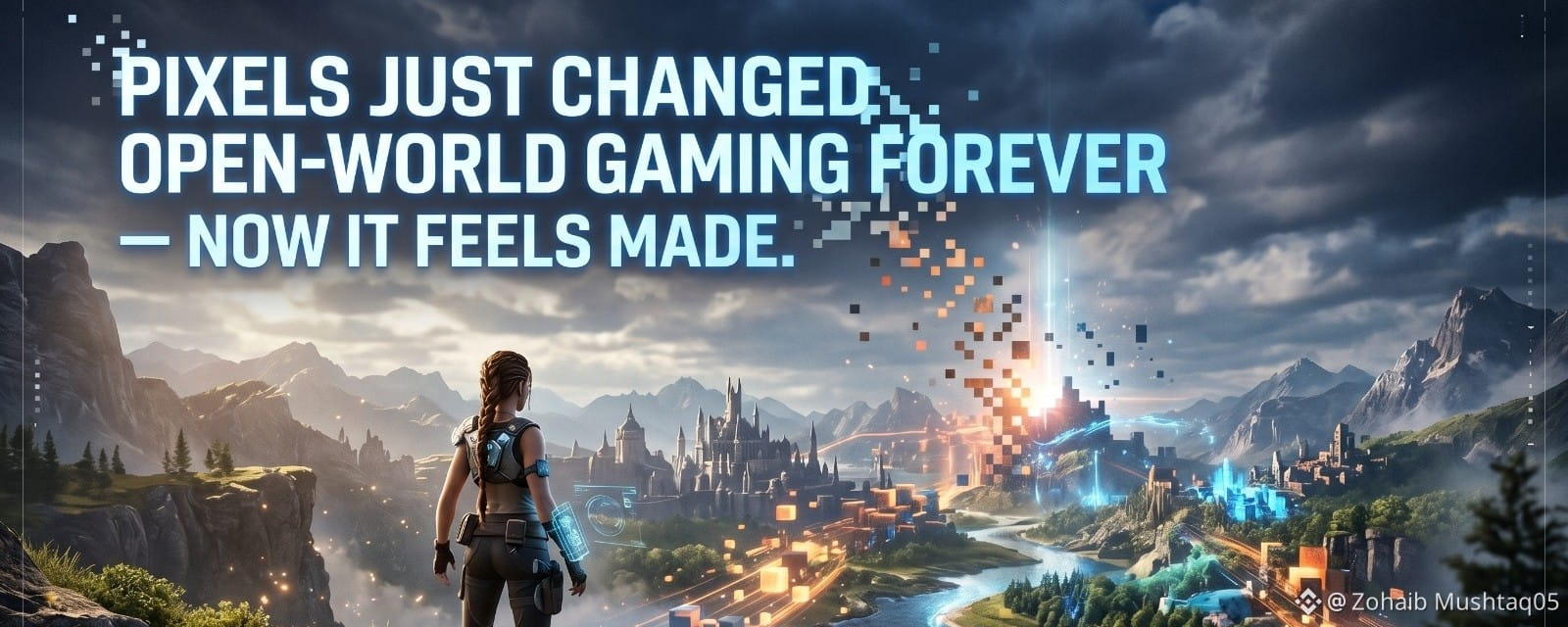
For years, open-world games chased scale the way cities chase skylines. Bigger maps. Longer draw distances. More icons bleeding into the horizon. The promise was freedom, measured in square miles. You could move across them. You could consume them. Rarely could you change them.
What’s shifting now isn’t just size or fidelity. It’s the pixel itself.
In the newest generation of open-world designwhether built from voxels, dense simulation grids, or highly granular physics systemsthe world is no longer a painted backdrop. It’s constructed from units that behave. The change sounds technical. It feels philosophical.
Older open worlds often resembled elaborate stage sets. A mountain looked solid, but it was a mesh wrapped around emptiness. A building might have ten doors, but only one opened. Rivers shimmered, yet never flooded their banks. Developers placed rocks and shrubs by hand or with procedural tools, then locked them in place. Players learned the rules quickly. You could go anywhereso long as “anywhere” had been pre-approved.
The new approach starts smaller. Instead of designing a hill, you define the material that forms hills. Instead of scripting a forest fire, you simulate combustion across every tree, branch, and blade of grass. It’s slower work. It demands more computing power. It introduces risk, because systems interact in ways designers can’t fully predict. But the payoff is subtle and powerful: the world feels made.
You notice it in the margins.None of this needs a cutscene. It simply happens, because the underlying pixelsor voxels, or particlesare treated as matter rather than decoration.
This shift has been building quietly. Minecraft hinted at it more than a decade ago, even with its chunky cubes and simple lighting. Every block could be placed or destroyed. Mountains were not images of mountains; they were stacks of discrete units. Players didn’t just traverse the world. They edited it. Later games layered more complexity onto that idea: more detailed materials, more nuanced physics, more believable ecosystems. No Man’s Sky expanded the scale, generating entire planets from mathematical rules. Teardown made destruction the central mechanic, modeling buildings as fully breakable structures. Each step moved open worlds away from the illusion of solidity toward actual systemic presence.
What’s different now is density. The pixels are smaller. The simulations are deeper. Hardware that once struggled to render static scenery can now track thousands of interacting elements at once. That technical foundation changes creative decisions. Designers no longer need to fake every landslide or pre-script every collapsing bridge. They can set conditions and let the system resolve the outcome. Sometimes that means a mission unfolds differently than intended. Sometimes it means players solve problems in ways no one anticipated.
There are tradeoffs. System-driven worlds can feel messy. A carefully framed vista might be disrupted because a player tunneled through a hillside. A dramatic escape sequence can lose tension if someone simply digs under the wall. Narrative control becomes harder when the environment refuses to stay pristine. Developers must decide where to allow true malleability and where to quietly reinforce boundaries. Total freedom, it turns out, can dilute drama.
Yet when it works, the effect is grounding. You stop seeing the world as a collection of assets and start reading it as a place with properties. Materials matter. Weight matters. Weather matters. Even small interactions—footprints lingering in mud, scorch marks that persist after a fight—accumulate into a sense of consequence. The landscape remembers you.
That memory changes player behavior. In older open worlds, destruction was cosmetic. Smash a crate and it respawns. Fire a rocket and the smoke clears without residue. Now, actions leave marks that shape future decisions. If you level a forest to build a settlement, you feel the absence of those trees later.
It also alters pacing. When terrain can be altered and structures can fail, movement slows. You consider the angle of a climb because the surface might crumble. You think twice before detonating explosives indoors. Travel becomes less about sprinting toward a waypoint and more about reading the environment’s logic. The space between objectives gains texture.
None of this guarantees better games. A meticulously authored world can still be more emotionally resonant than a fully simulated one. Handcrafted detail has its own power. But the granular approach closes a gap that long defined the genre. Open worlds promised immersion while quietly reminding you, at every invisible wall and indestructible fence, that you were inside a controlled exhibit. Now the control is loosening.
The irony is that as pixels become more fundamentalmore literal building blocksthe artifice becomes less visible. The world doesn’t feel procedurally inflated or algorithmically stitched together. It feels assembled from parts that obey shared rules. You can test those rules. You can break them. You can learn them the way you learn how wood splinters or stone fractures in real life.
Open-world gaming once equated freedom with acreage. Today, it’s starting to measure freedom in granularity. Not how far you can go, but how deeply you can affect what’s there. The revolution isn’t in the skyline.