
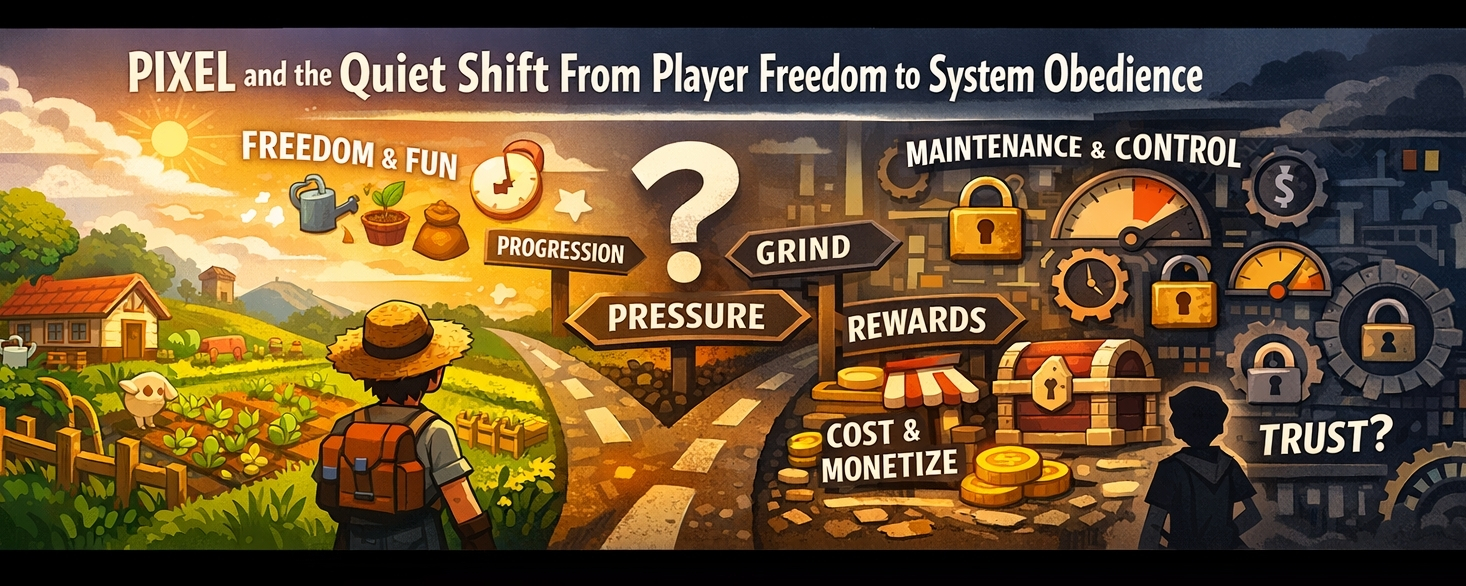
I’m watching PIXEL more closely now, and what keeps standing out to me is how a project can still promise ownership, progression, and freedom while slowly starting to feel less personal from the inside. That is the part I find interesting. Not the branding, not the pitch, but the moment where a project like PIXEL stops feeling like something you are shaping and starts feeling like something that is quietly shaping you.
At first, PIXEL feels simple in a good way. You enter the world, build, farm, collect, progress, and slowly create a place for yourself inside the system. That is why the project works on the surface. It gives players a sense of movement. Your time seems to matter. Your effort seems visible. Your assets seem connected to your progress. It feels like the project is rewarding participation in a direct and understandable way.
But the longer I look at PIXEL, the less I see it as just a game and the more I see it as a managed system. That is not automatically a bad thing. Every live project has rules, balances, and economic pressure points. Still, in PIXEL, those moving parts matter because they shape how people behave over time. The project is not only giving players things to do. It is teaching them what kind of behavior it values most.
That is where the tone changes for me. Once rewards become tied to repeated actions, players naturally become more strategic. They stop asking only what is fun and start asking what is efficient. They begin learning the rhythm of the project, the best routes, the best habits, the most useful assets, the safest way to stay ahead. And when that happens, PIXEL starts feeling less like an open world and more like a system that rewards certain forms of discipline.
I think that is one of the biggest truths inside projects like this. Players do not stay casual for long when real value is involved. The moment a project connects gameplay to assets, tokens, land, or any form of economic position, the player mindset begins to shift. People optimize. They compare. They measure. They stop reading the project emotionally and start reading it operationally. And once enough users do that, the real shape of the project becomes easier to see.
In PIXEL, ownership is part of that story, but it is not the whole story. A project can say players own assets, and that can be true, but the deeper question is what that ownership actually feels like in practice. If staying relevant inside the project requires constant activity, careful timing, system knowledge, or access advantages, then ownership starts to feel less like freedom and more like maintenance. You still hold something, but now you also have to protect its usefulness inside a shifting environment.
That is why progression matters so much here. In a project like PIXEL, progression does more than reward time. It separates users by knowledge, consistency, patience, and access. Some players move through the project casually. Others learn how to squeeze the most value out of every loop. Over time, that difference becomes structural. The project begins rewarding not just participation, but a specific style of participation. And that can slowly narrow who the system feels welcoming to.
I do not think PIXEL is unique in this. A lot of projects run into the same problem once their economy, progression, and retention systems become tightly connected. What starts as a fun loop can slowly become a behavioral filter. The players who understand the system best rise faster, defend their position better, and read changes more clearly. Everyone else can start to feel like they are playing inside rules they technically understand but no longer fully control.
That is also where trust becomes important. I think players can accept a lot from a project if the logic feels clear. They can accept grinding. They can accept imbalance. They can even accept monetization. What becomes harder to accept is the feeling that the project is slowly asking for more while calling it normal progression. Once players begin feeling managed rather than supported, even small adjustments start to feel heavier.
This is why I do not like looking at retention alone as proof of health. A project can keep users coming back for very different reasons. Sometimes they return because they genuinely enjoy the world. Sometimes they return because they have built habits. Sometimes they return because they have already invested too much to leave easily. Those are very different kinds of loyalty. And in PIXEL, I think that difference matters more than people want to admit.
The monetization side adds even more pressure. In a project with real economic weight, every design choice carries extra meaning. Friction is not just pacing anymore. It can feel like control. Rewards are not just motivation anymore. They can feel like distribution policy. Access is not just progression anymore. It can start to feel like a ranking system for who matters most inside the project. That does not mean the design is wrong. It just means players read the project more carefully once value is involved.
I keep coming back to durability because that is the real test for PIXEL as a project. Not whether it can attract attention, and not whether it can create short bursts of activity, but whether it can keep the system believable once users start pushing hard against its edges. Real users always test a project in ways that marketing never does. They optimize every loop. They question every imbalance. They notice every weak spot. And when trust softens, even a stable system can start feeling fragile.
Still, I do not think PIXEL should be dismissed. The project is clearly trying to build something more connected than a simple token layer placed on top of gameplay. That makes it more interesting to watch. But it also makes the trade-offs harder to hide. The closer PIXEL pulls together ownership, progression, economy, and retention, the more pressure each piece puts on the others. What helps the project last may also make it feel heavier. What strengthens the economy may weaken the sense of freedom. What rewards commitment may also make leaving feel more costly.
That is where I end up with PIXEL. I do not see it as a broken project, and I do not see it as a clean success either. I see it as a live system trying to balance play, value, and long-term structure without losing the player in the process. Whether it can really do that over time, I am still not fully sure. But I think that question is more important than anything the project says about itself.