
I didn’t go into Pixels pets expecting to find anything particularly deep.
It looked like the usual setup. Mint an NFT, assign some traits, introduce rarity tiers, and let the market figure out the rest. We’ve seen that model enough times to know how it usually plays out. Unique on the surface, but interchangeable underneath.
But the more I looked at it, the harder it became to keep that assumption.
Not because the structure is radically different.
But because of what the system seems to be trying to connect.
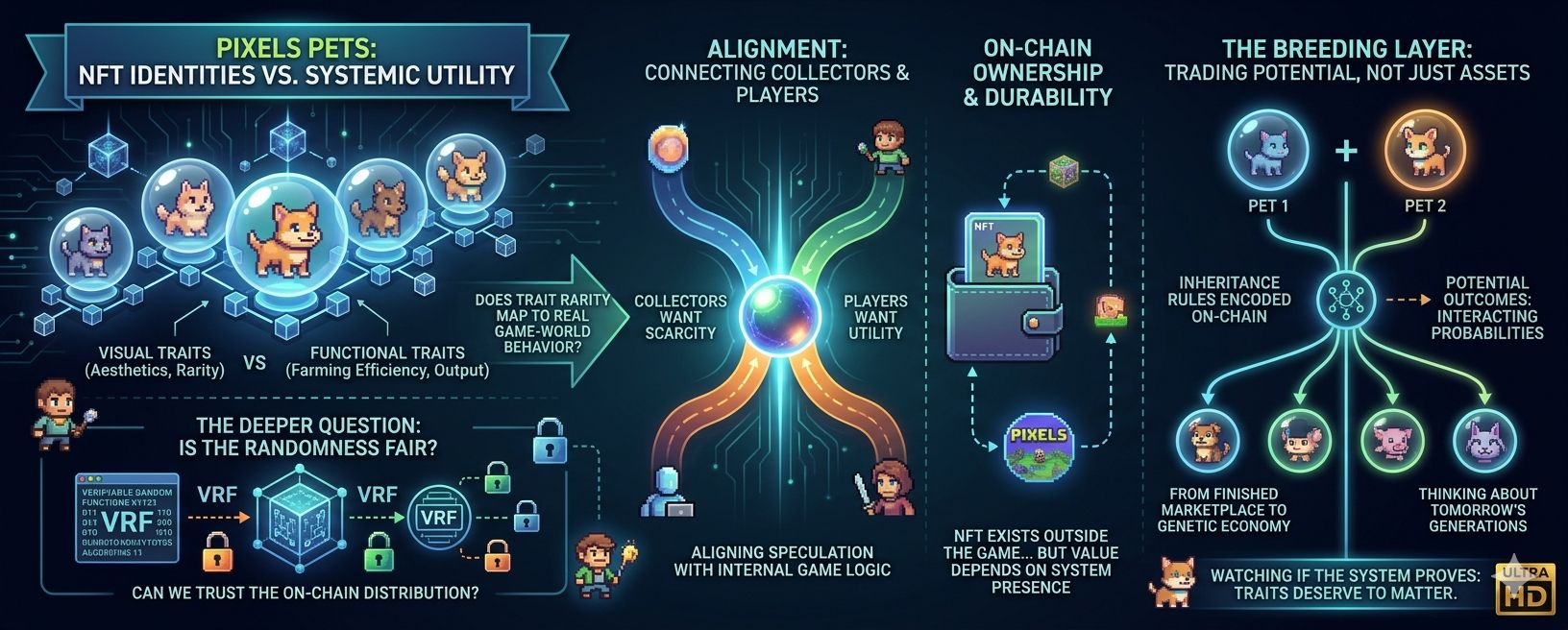
At a basic level, Pixels pets are straightforward. They’re minted on-chain, each with a combination of traits that define how they look and what they do. That second part is where things start to shift.
Most NFT pet systems stop at identity. The pet looks different, maybe rarer, maybe more desirable visually. But functionally, it doesn’t change much. Ownership becomes aesthetic, not operational.
Pixels doesn’t fully follow that path.
Traits here appear to tie directly into farming behavior. What your pet is affects what it does. And that creates a different kind of dependency one where the outcome of minting isn’t just cosmetic, it’s structural.
That’s a meaningful design choice. But it also raises a more complicated question.
How much of that outcome is actually fair?
The system relies on on-chain randomness to assign traits, which sounds clean in theory. Verifiable randomness, provable fairness, no central manipulation. That’s the promise.
In practice, it’s rarely that simple.
Blockchains don’t generate randomness naturally. They simulate it. Most systems rely on mechanisms like verifiable random functions or commit-reveal schemes to approximate unpredictability. And while those methods can be secure, they’re not automatically beyond question.
Without a clear audit of how Pixels handles this layer, it’s difficult to know whether the randomness is truly resistant to influence… or just convincing enough to feel that way.
That uncertainty doesn’t break the system.
But it does shape how much trust you place in the outcome.
Rarity itself is familiar territory. Some traits are common, others are scarce, and that distribution drives perceived value. That part isn’t new, and it doesn’t need to be.
What matters more is what rarity actually does.
If a rare pet only looks better, the system leans toward speculation. If it performs better in meaningful ways, it starts influencing how players operate.
From what’s visible so far, Pixels is trying to push toward the second model.
A rare trait isn’t just a badge. It’s supposed to translate into better efficiency, better output, or better positioning in specific farming loops.
If that relationship holds as more pets enter the system, it creates something most NFT ecosystems struggle with:
Alignment.
Collectors want scarcity.
Players want utility.
When those two start pointing in the same direction, the asset stops being purely speculative. It becomes part of the game’s internal logic.
That’s difficult to get right.
And it doesn’t fully resolve just by designing traits well.
Because ownership in this system exists outside the game.
Your pet sits in your wallet. It’s yours independently of Pixels itself. That’s one of the core promises of on-chain assets.
But it also introduces a less comfortable reality.
If the game disappears, what exactly are you left holding?
The NFT still exists. The traits are still recorded. But without a system that gives those traits meaning, the value becomes uncertain.
That’s not a flaw specific to Pixels.
It’s a property of the entire model.
And it’s something worth acknowledging clearly before treating any in-game asset as inherently durable.
Where things become more interesting is in the breeding layer.
Two pets can produce offspring, with traits that are inherited, combined, and occasionally mutated. On paper, that’s a familiar mechanic.
But the implications are deeper than they first appear.
Because once inheritance rules are encoded on-chain, you’re no longer just trading assets.
You’re trading potential.
Certain combinations don’t just have value because of what they are.
They have value because of what they might produce next.
That’s where the system starts to resemble something closer to a genetic economy.
Not just a marketplace for finished items, but a network of probabilities, where outcomes depend on how traits interact over time.
And that shifts behavior.
Players stop thinking only about what a pet does today.
They start thinking about what it could generate tomorrow.
Which combinations are worth preserving.
Which ones are worth experimenting with.
Which ones might compound into something more valuable later.
That’s a more complex loop than simple mint-and-sell dynamics.
But it also depends heavily on execution.
If inheritance feels too random, players disengage.
If it’s too predictable, it becomes solvable and quickly optimized.
Finding the balance between those two is where most systems struggle.
Right now, it’s still early.
The structure is there. The intent is visible. But whether it holds under scale when more pets exist, more combinations emerge, and more players start optimizing is still an open question.
I’m not dismissing it.
But I’m not fully convinced yet either.
Because systems like this don’t fail in obvious ways.
They fail when the underlying mechanics become too easy to exploit… or too opaque to trust.
And both outcomes tend to appear slowly.
So for now, it’s something I’m watching.
Not just for how unique the pets look.
But for whether the system actually proves that some traits don’t just exist
They deserve to matter.