

I’ve been watching blockchain games for a while now, and honestly, most of them still miss the point. After the whole play-to-earn wave crashed, the same old complaint keeps coming up: these games feel more like investment schemes than actual games. You need a wallet, some crypto upfront, and then you grind for tokens that lose value almost as soon as you earn them. Players get burned out, bots take over, and the casual folks who just want to have fun never stick around. That’s the real problem Pixels is quietly trying to fix.
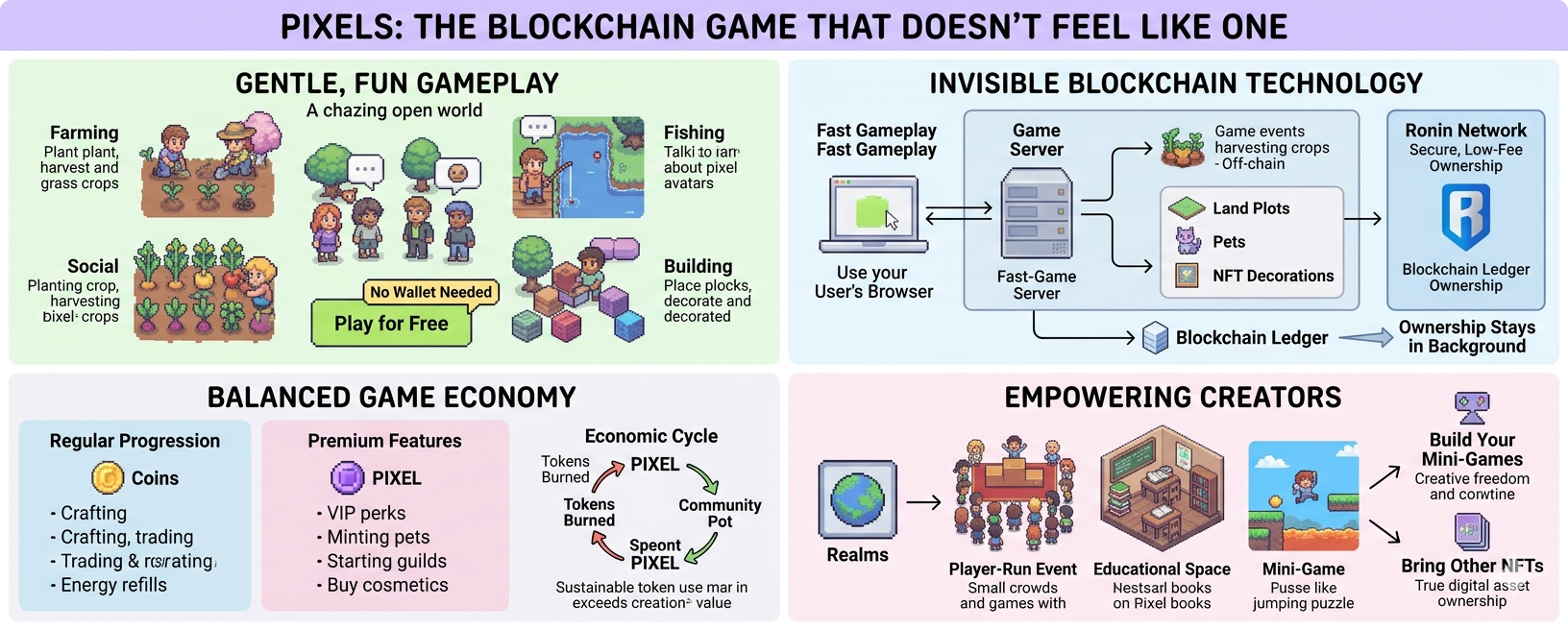
Pixels is a cozy, pixel-art open world built on the Ronin network. Think Stardew Valley meets a bit of Minecraft, but with that gentle social vibe where you farm, explore, craft, and slowly build something with friends. You plant crops, raise animals, level up skills, and shape your little corner of the map. There’s light energy management so you can’t just spam everything, and you can team up in guilds or simply chill with neighbors. What makes it different is how invisible the blockchain part is. You can jump in for free right in your browser—no wallet, no land NFT required. Everything meaningful you create or collect can live on-chain if you want it to, but the game never forces it on you. It feels like the ownership is there in the background, waiting patiently until you’re ready.
Technically, it’s pretty straightforward and smart about it. Ronin is an Ethereum sidechain that Sky Mavis (the Axie Infinity folks) built specifically for games. It gives fast transactions and tiny fees, which is exactly what you need when thousands of people are harvesting crops at the same time. Most of the actual gameplay runs off-chain so everything feels smooth and responsive. The blockchain only steps in for the stuff that really matters long-term: proving you own that plot of land, your pets, or the decorations you placed. There’s even a “Realms” feature where players can start building their own mini-games or spaces and bring in other NFTs. It’s not trying to be a fully decentralized supercomputer running every leaf on every tree—it’s a normal game with blockchain handling the ownership layer cleanly.
The economy feels like they actually learned from past mistakes. Early on they had an off-chain token called BERRY that got farmed to death and crashed. Now in the current version they use two currencies: regular Coins for everyday progression (tasks, crafting, energy refills) and the on-chain PIXEL token for the premium stuff—VIP perks, minting pets, starting guilds, fancy cosmetics. A chunk of every PIXEL spent gets burned or goes into the community pot. Land owners earn a small passive share when people farm on their plots, but the whole system is tuned to reward actual play and cooperation instead of pure grinding. The goal is simple: more PIXEL should get used up inside the game each month than gets handed out. It’s the kind of balanced virtual economy that regular MMOs have been chasing forever, except now it’s transparent and you can actually own what you build.
What interests me most is where this could go beyond just farming pixels. By letting players create their own spaces and bring in outside NFTs, Pixels is quietly testing whether blockchain can become the invisible plumbing for real creator economies—like Roblox or Minecraft, but with built-in royalties and real ownership. Down the line you can imagine small communities running their own events, educational experiences, or even light social economies where the rules are set by the players themselves. It’s not revolutionary on its own, but it’s the kind of practical step that makes blockchain feel useful instead of complicated.
This is where Pixels fits into the bigger story of blockchain growing up. We’ve moved from clunky general-purpose chains that choked under normal traffic to purpose-built gaming networks like Ronin. The real win here isn’t flashy tech—it’s that the blockchain disappears so the fun can stay front and center. Millions of people have already played without ever thinking of themselves as “crypto users.” That quiet, low-friction onboarding is something most Web3 projects have never managed.
Of course, it’s not all smooth sailing. Ronin has come a long way since its early days, but scaling to huge crowds will keep being a test. Getting full features still works best with a wallet, even if social login makes the first step easy. Keeping players and creators around without constant token rewards is tricky, and like every crypto project, price swings can shake people’s confidence. Competition is everywhere—polished traditional games on one side, other blockchain worlds on the other. And the regulatory questions around in-game currencies keep forcing careful design choices.
At the end of the day, Pixels doesn’t feel like another grand promise. It feels like someone sat down, looked at what went wrong before, and tried to build something people might actually keep coming back to—pixel by pixel, day by day. In an industry full of hype cycles and spreadsheets disguised as games, that measured, thoughtful approach is honestly refreshing. Whether it grows into the living world they’re aiming for will depend less on market pumps and more on whether regular players keep choosing to return. And right now, that feels like a bet worth watching.
