
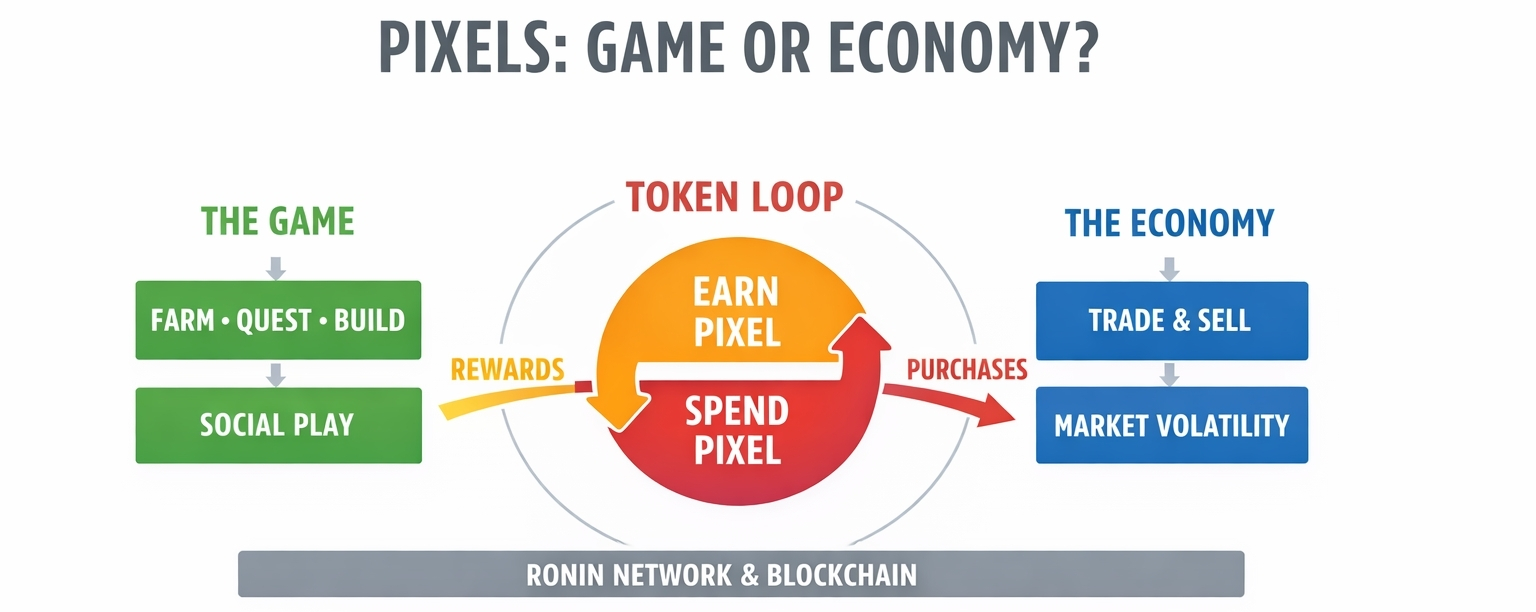
Look, I’ve seen this movie before. It starts with something harmless. A simple game. Farming, crafting, chatting with other players. Low stakes. Nostalgic. Then, quietly, a token shows up. Ownership gets mentioned. Suddenly it’s not just a game anymore. It’s an “economy.”
That’s where Pixels (PIXEL) sits today. A soft, friendly interface wrapped around something much harder underneath.
Let’s be honest. The pitch sounds reasonable. A social game where you can farm, explore, and maybe own a piece of the world. It runs on Ronin Network, which is supposed to make everything smoother, cheaper, easier. No clunky blockchain friction. Just play and participate.
It sounds tidy. On paper, at least.
But once you peel it back, the old questions come rushing in.
First, the core problem they claim to fix. It’s the usual one. Traditional games don’t let players “own” anything. You grind for hours, and when the servers shut down, it’s all gone. Pixels says it fixes that. Your land, your items, your progress—they exist on-chain. You have control.
I get the appeal. I really do.
But here’s the part that never quite holds up. Ownership of what, exactly? You don’t own the game logic. You don’t control the economy. You don’t decide how useful your assets are next month. The developer does. Always has. Always will.
If they tweak drop rates, your assets change value. If they change mechanics, your strategy breaks. If they lose interest, the whole world goes quiet. The blockchain doesn’t save you from that. It just records the aftermath.
So the “problem” is partially real. But the solution doesn’t remove the dependency. It just adds a ledger.
Now let’s talk about the solution itself.
Pixels tries to be clever. It doesn’t go full play-to-earn like the last cycle’s disasters. Instead, it positions the token as a premium currency. Optional. Cosmetic. Convenience-driven. You don’t need it to play. You just… benefit from it.
That sounds more sustainable. And to be fair, it is. Slightly.
But it introduces a different kind of tension. Because once a token exists—and is traded—players stop behaving like players. They start behaving like participants in a market.
I’ve watched this happen over and over.
People optimize. They calculate. They ask: “Is this worth my time?” Not in fun. In money. The game loop gets distorted. Activities become “strategies.” Social interaction becomes coordination for efficiency.
And the developers? They’re no longer just designing a game. They’re managing an economy. Emissions, sinks, inflation, burn rates. It’s basically central banking with pixel art on top.
That’s a hard job. Most teams are not equipped for it.
Now here’s where the complexity creeps in.
Pixels sits on Ronin Network, which is designed to make blockchain gaming feel seamless. Wallets are integrated. Transactions are cheap. Onboarding is easier than it used to be.
But easier doesn’t mean simple.
You still have wallets. You still have tokens. You still have price volatility sitting just outside the game window. Even if the interface hides it, the system depends on it.
And that dependency matters.
Because now your “casual farming game” is tied to external liquidity. Exchanges. Market sentiment. Whale behavior. None of which care about your crops or your quests.
When the token moves, the game feels it. Maybe not immediately. But eventually.
And that’s the layer most people ignore.
Let’s talk about incentives. Who actually benefits here?
Early adopters usually do. People who get in before the system fills up. Before rewards dilute. Before attention shifts. That’s not unique to Pixels. That’s just how token systems behave.
New players? They’re walking into a pre-existing economy. Prices are already set. Land is already distributed. The “opportunity” is no longer the same.
So the question becomes uncomfortable. Are you playing a game, or are you entering someone else’s exit liquidity window?
No one says it that way. But it hangs there.
Now the centralization question.
Pixels uses blockchain. Fine. But control still sits with the developers. They decide reward structures. They manage updates. They shape the economy.
Even parts of the reward distribution system are managed off-chain before being approved on-chain. That tells you everything you need to know.
This is not a decentralized world. It’s a managed system with a blockchain backend.
And maybe that’s necessary. Fully decentralized games are usually chaos. But it also means the “ownership” narrative needs to be taken with a grain of salt.
Because when something breaks—and it will—the players don’t fix it. The team does.
And that brings us to the human reality.
What happens when the numbers stop working?
Because eventually, every token economy hits that moment. Growth slows. New players taper off. Rewards start to feel thinner. The excitement fades.
Then people start leaving.
And when they leave, they don’t just uninstall. They sell.
That’s the part traditional games never had to deal with. A player quitting didn’t create market pressure. Here, it does. It pushes down the very system that remaining players are relying on.
It’s a feedback loop. Not a pleasant one.
Pixels is trying to avoid the worst of this. You can see it in the design. The token isn’t required. The game loop is meant to stand on its own. There’s an effort to shift focus toward social play and creativity.
That’s smart. It shows they’ve learned from the past.
But learning the lesson doesn’t mean you’ve escaped the structure.
You still have a token. You still have a market. You still have incentives pulling behavior away from play and toward optimization.
And once that dynamic exists, it’s very hard to contain.
So when people say Pixels is different, I get what they mean. It is more restrained. More careful.
But I’ve seen careful systems unravel too.
Not because they were poorly designed. But because they were trying to balance two things that don’t really want to coexist: a relaxed, social game… and a live financial asset.
That tension doesn’t go away. It just waits.
