
Pixels did not begin like a giant headline. It began like a careful experiment: a browser-born farming and exploration world, first shown in a demo in late 2021, then pushed into alpha in 2022, built around the idea that a game can feel gentle, social, and still be owned by its players. The project’s own documentation framed it as an open-ended world of farming and exploration where people gather resources, build relationships, and move through quests, while Binance Research later summarized it as a social casual Web3 game centered on farming, exploration, and creation. The real turning point came when Pixels moved onto Ronin in 2023, because Ronin’s own migration write-up said Pixels had already reached about 100K monthly active wallets, 5K daily active users, and roughly 1.5M monthly transactions before the move; in other words, the game had enough gravity that the chain wanted to orbit around it, not the other way around. By February 2024, the token had entered Binance Launchpool, and the project had crossed the line from a niche Web3 experiment into a serious ecosystem story.
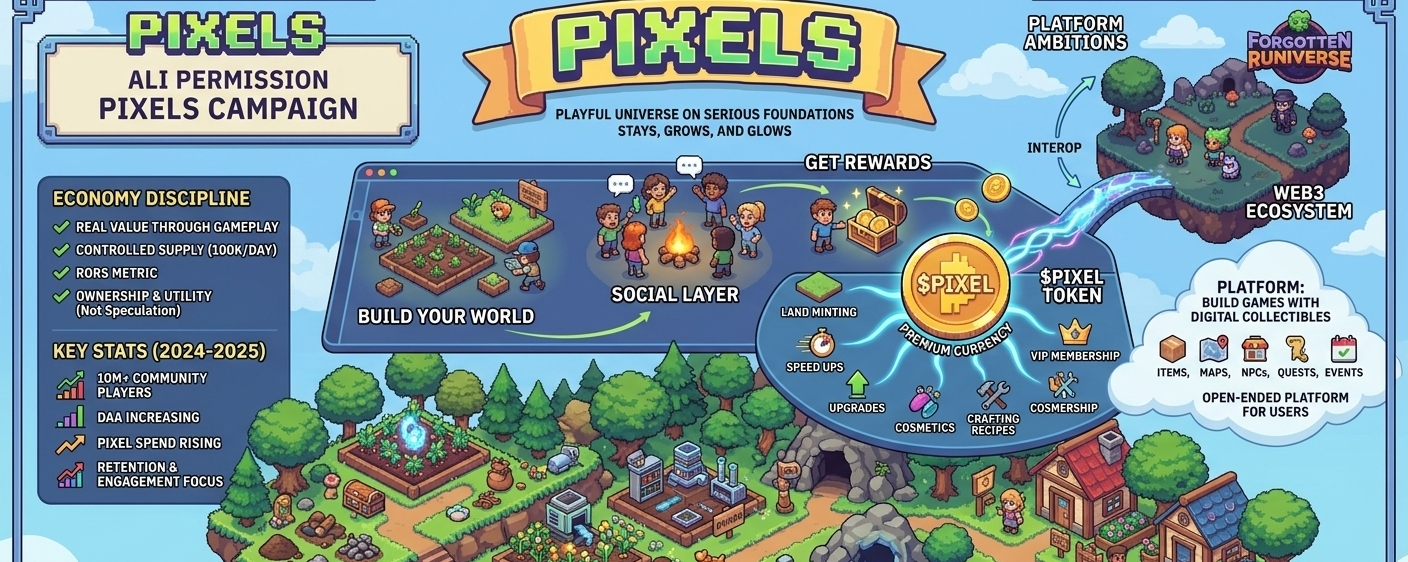
What Pixels looks like today is deceptively simple. The official site speaks in soft, inviting language about making a home in a world of unlimited adventure, playing with friends, managing crops, raising animals, earning rewards, and building your own world; it also says the project is now building a platform where users can build games that natively integrate digital collectibles, and it claims a community of over 10 million players. That combination matters, because Pixels is no longer presenting itself as just one game loop. It is trying to be a social layer, a place where ownership, identity, and play sit next to each other naturally rather than being forced together by hype. The current gameplay docs show the structure behind that feeling: farming, quest narrative, cooking and acquiring recipes, and personalization of spaces are the main mechanics today, while social features, stores, taxes, leaderboards, recipe-book compiling, achievements, and trophies sit beside them as support systems. The project is trying to feel like a familiar game first and a blockchain product second, which is exactly why the pitch has survived longer than many louder projects.
The deeper design is where Pixels becomes interesting. Its economics documentation is unusually direct about one belief: the game must provide real value through gameplay, because the team does not believe blockchain games should monetize at magical levels just because they are blockchain games. That is a quiet but important rejection of the old play-to-earn fantasy. Instead of asking players to chase earnings first, Pixels designs its token and items around enjoyment, time-saving, status, and convenience. The $PIXEL token is described as a premium in-game currency used for items, upgrades, cosmetics, minting new land, speeding up build times, boosting energy, unlocking skins, XP enhancers, crafting recipes, pets, and even merchandise, while the supply is meant to be controlled and predictable, with 100,000 new $PIXEL minted each day and distributed to active players who are doing behaviors the ecosystem wants to reward. In the same design, land is split into free, rented, and owned plots; free land keeps the game accessible, rented land gives more freedom at the cost of yield, and owned land provides the richest interactions, higher yield, automation, and the ability to manage resources more deeply. Resources themselves are tiered, land-sensitive, and varied, ranging from soil and crops to metal and power, which means the game economy is built less like a casino and more like a living production chain. That whole structure is visible in the platform docs too, which say Pixels is building 2D persistent multiplayer virtual spaces where new items, maps, stores, NPCs, quests, random events, and other systems are integrated into the blockchain. The architecture is not accidental; it is trying to make ownership feel useful without making speculation the core purpose of the game.
$PIXEL sits at the center of that design, but Pixels has been careful to define what it is and what it is not. The token is described as a premium in-game currency rather than a prerequisite for progression, and Binance Research and Ronin both note that it is used for NFT minting, VIP membership, guild features, and quality-of-life upgrades, with governance of a community treasury as a longer-term role. That is a strong signal about intent: the token is supposed to capture value from the parts of the game that feel premium, social, or expansionary, rather than from the basic act of playing. Ronin’s launch post also made clear that PIXEL was meant to power a broader loop: it would fuel in-game spending, connect to liquidity on the chain, and eventually participate in governance. In one sense, this makes the token more restrained than many game tokens; in another sense, it makes the token more durable, because the design asks it to do fewer things but to do them repeatedly and consistently. This is why the token story is not just about price or listing day excitement; it is about whether the game can keep converting fun into spending without letting the economy become hollow.
Pixels has undeniably produced meaningful scale. Binance Research said that by February 2024 the project had around 166K DAA and over 1 million unique users, while the official site now says the community has passed 10 million players, which is a sign of how far the project has traveled from its early years. Ronin’s 2023 migration note framed Pixels as already one of the strongest Web3 games by wallet activity, and a later BlockchainGamerBiz review of Pixels CEO Luke Barwikowski’s 2024 financial report showed a more mature and more complicated picture: daily unique active wallets peaked in May 2024 and ended the year at 283,000, but the number of wallets spending PIXEL in-game rose 75% across the year to 109,000, and monthly in-game PIXEL spend reached an all-time high of 10 million tokens in December. That is the kind of metric set that separates a real game economy from a promotional campaign. It says retention, monetization, and behavior are moving in different directions, and that the project is learning to care less about raw wallet churn and more about whether players actually spend inside the world. It also introduces the key internal metric the team itself uses: RORS, or Return on Reward Spend, a measure of whether the game gives out more value than it captures back. In simple terms, Pixels is trying to prove that a Web3 game can become a business, not just a distribution engine.
The biggest risk in Pixels is the same risk that has haunted almost every reward-driven Web3 game: the system can look alive while silently bleeding value. BlockchainGamerBiz reported that Pixels ended 2024 with a reward ratio of 0.5, meaning that for every 100 PIXEL distributed as rewards, only 50 PIXEL were spent in-game, and the same report said net revenue remained negative even after spending improved. That matters because an under-1 ratio means the ecosystem is still paying out more than it is pulling back, which creates constant sell pressure and makes the token harder to defend over time. The broader market does not make this easier. DappRadar’s 2025 reports showed blockchain gaming activity cooling across the sector, with daily unique active wallets falling to 5.8 million in Q1 2025 and then 4.8 million in Q2 2025, while Web3 gaming funding also weakened. In that kind of market, Pixels cannot rely on narrative alone; it has to keep proving that its world is fun, its economy is disciplined, and its community will stay engaged after the first wave of attention fades. This is the real test of the project, because a game can survive hype for a while, but only a sound loop can survive boredom, competition, and time.
The most interesting thing about Pixels is that its future no longer looks like a single game roadmap. The official homepage now talks about a platform where users can build games that integrate digital collectibles, and the old platform docs already described tooling for items, maps, stores, NPCs, quests, and random events that other projects could build on. The gameplay roadmap points to foraging, pets, flower breeding, skills acquisition, expanded customization, competitions, mini-games, relationship building, and narrative sleuthing, which suggests a world that wants to become broader and more human rather than more abstract. The project’s 2025 cross-game event with Forgotten Runiverse is even more revealing, because it showed PIXEL being earned, spent, and claimed in another game, with a 5M PIXEL prize pool tied to that event. That kind of interop matters because it hints at the long-term ambition: not just one farm, but a shared social economy across multiple worlds, where token utility follows players instead of trapping them in a single title. If Pixels succeeds, its legacy may not be that it invented the farm game all over again, but that it helped Web3 gaming learn how to become a network of experiences instead of a single extraction machine.
Pixels still feels like a project in motion, and that is what gives it life. It began as a quiet game about growing, building, and belonging, then turned into a test of token design, user behavior, and ecosystem discipline, and now it stands at a rare point where the story can still bend in more than one direction. Maybe that is the most human part of it. A world like this does not become meaningful because it is perfect; it becomes meaningful because people return to it, leave traces in it, and keep helping it become more than the first idea that created it. If Pixels keeps choosing depth over noise, and patience over empty speed, it may end up proving something bigger than a game can usually prove: that digital worlds can be owned without becoming cold, and that a playful universe can still be built on serious foundations. In the end, that is a hopeful kind of architecture, the kind that does not shout, but stays, grows, and glows.
