
I logged into that day with no plan just a quick farm check, feed a few animals, maybe run a couple loops. But after a while, I noticed something felt… different. Not louder, not more rewarding just tighter. Like the system was quietly forcing me to make better decisions. And that’s when it hit me this wasn’t just a game update. This was a constraint being introduced… and constraints are where real economies begin.
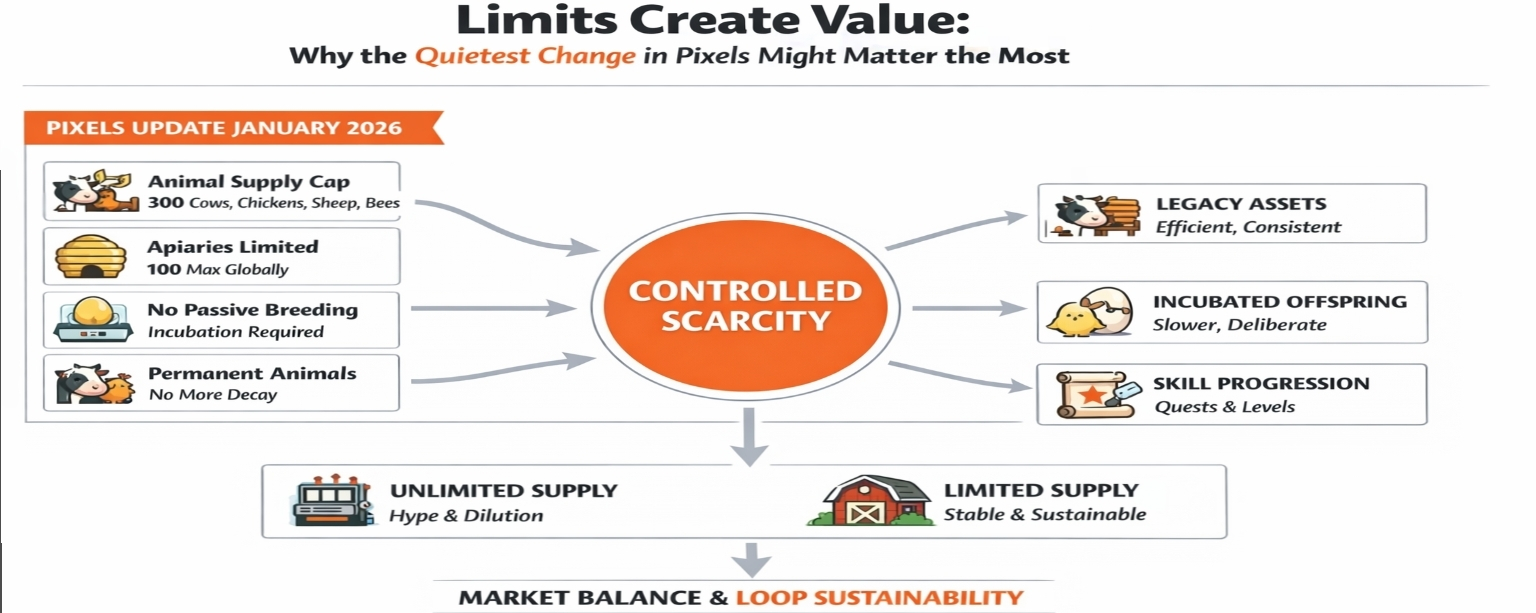
Back in late January 2026, January 22 to be exactthe Pixels team pushed what looked like a routine update through their official channels. But the details told a different story. Legacy animals cows, chickens, sheep, bees and others were locked with a hard supply cap of 300 each globally. Apiaries were capped even tighter at 100. Some systems like sluggeries stayed craftable, and coops tied into NFT land traits. At the same time, animals became permanent. No more running away. No more passive decay.
That alone changes behavior.
But the deeper shift came from how new supply enters the system. Public animals no longer produce offspring. Only Adult or Legacy animals placed on land can generate them. And even then, it’s not passive. You feed, you wait, you maybe get an egg. Then you incubate it using resources and time. Baby animals can be raised on both Specks and NFT lands, but land owners clearly have higher capacity.
So supply is no longer infinite. It’s gated. Controlled. Intentional.
If you’ve been around long enough, this should sound familiar. taught the market what happens when supply is left unchecked. It launched in November 2017 and quickly became the first mainstream blockchain game. At its peak, it reportedly consumed a massive portion of Ethereum’s network activity. But the real lesson wasn’t congestion. It was dilution. Unlimited breeding created short-term hype, then long-term value erosion.
Pixels took the opposite path.
Instead of letting the market correct itself, they designed scarcity from the start. And yeah… that’s a philosophical shift more than a technical one.
I’ve been testing this myself over the past few weeks. Two setups. One with legacy animals. One starting fresh using only incubated offspring. The efficiency gap is obvious. Legacy loops generate more consistent outputs, especially in feed-to-resource conversion. But the interesting part is this starting from scratch isn’t dead. It’s just slower. More deliberate. You feel every decision.
That’s rare in Web3 games.
Most GameFi systems chase accessibility at the cost of value, or scarcity at the cost of growth. Pixels is trying to sit in the middle. And so far, it’s holding. The quest system reflects this progression clearly. Early quests like “A Wild Approach” unlock under Animal Care Level 5. Incubation opens deeper around Level 15+. By Level 20, more specialized loops like bee curing come into play. So it’s not just ownership gating the system it’s skill progression layered on top of scarcity.
That’s important.
Because the real risk here isn’t technical failure. It’s economic stratification. When you cap high-efficiency assets early, you naturally create tiers. Early adopters hold stronger positions. New players enter with constraints. The system tries to balance that through Specks, quests, and incubation access but the tension is still there.
Will that break the economy? Not necessarily.
In fact, this kind of tension is what creates markets.
From a trader’s perspective, I don’t see explosive spikes here. I see something slower. More stable. The kind of system where assets behave less like lottery tickets and more like yield instruments. And that’s probably why it’s trending quietly instead of loudly. There’s no hype wave. No sudden pump. Just consistent engagement and steady system usage.
And honestly… that’s healthier.
If you read between the lines of Pixels’ design docs and official updates, the direction becomes clear. They’re not building for speculation cycles. They’re building for loop sustainability. Feed → drop → incubate → raise → repeat. Every step has cost. Every output has limits. That’s how real economies behave.
We talk a lot in crypto about decentralization, ownership, governance. But we don’t talk enough about constraints. About who decides limits, and why they matter. solved that with a 21 million cap. Pixels is experimenting with the same idea inside a game loop.
Smaller scale. Same principle.
So yeah… three months in, this doesn’t feel like a temporary feature. It feels like an economic stance. A quiet one. The kind you only notice if you’re actually using the system, not just watching charts.
And maybe that’s the real takeaway here.
In a space obsessed with removing limits, the projects that last might be the ones that choose them carefully. Not to restrict players but to give their actions weight. Because without limits, nothing costs anything.
And if nothing costs anything… nothing is worth holding.
