
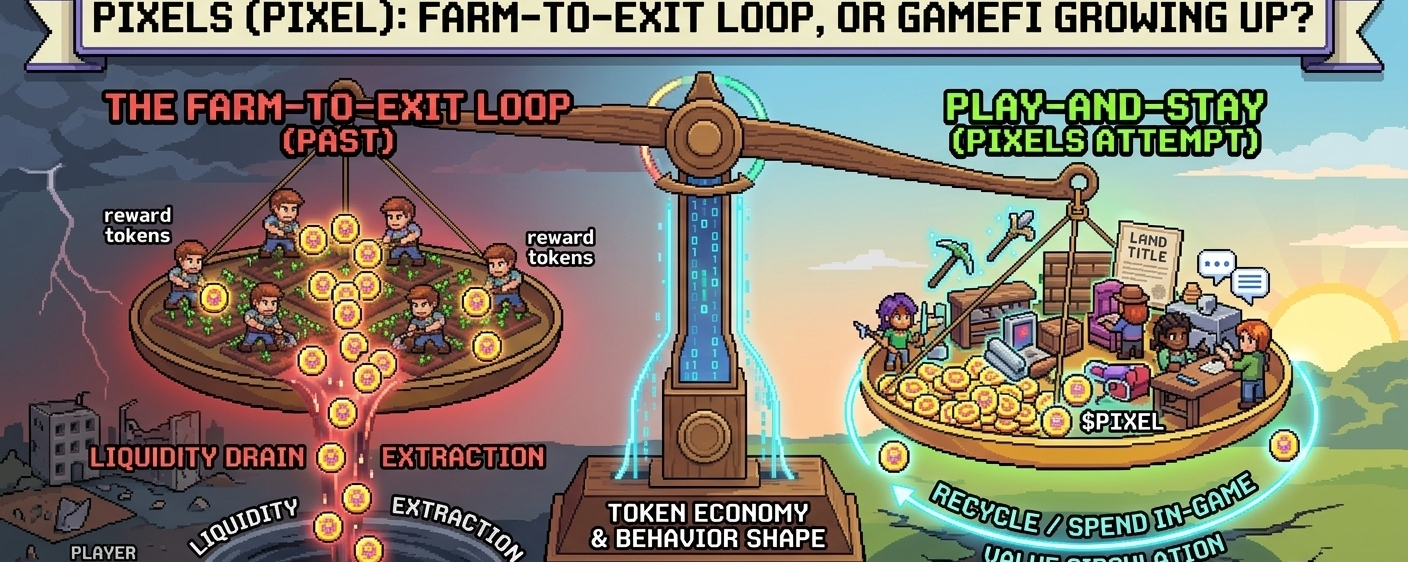
At a distance, Pixels looks dangerously familiar. A soft, pixelated world, a friendly farming loop, a token layered on top—this is the exact aesthetic and structure that has quietly burned through multiple cycles of GameFi already. The pattern is almost predictable now: attention floods in, rewards pull users into repetitive loops, tokens get farmed aggressively, liquidity drains out, and what’s left is a quiet map with fewer players than promises. So it’s hard not to approach something like Pixels with a bit of built-in resistance.
And yet, after sitting with it a little longer, there’s a subtle shift in how it presents itself that makes you pause. It doesn’t scream earnings. It doesn’t lead with APYs or token velocity. Instead, it leans into something most Web3 games only pretend to care about—being an actual game people might play even if the rewards were dialed down. That doesn’t automatically make it good, but it does suggest that the team understands where others went wrong.
The experience itself is simple in a way that feels intentional rather than lazy. You farm, you explore, you craft, you interact with other players, and you slowly build out your presence in the world. The actions are repetitive, but not purely mechanical. There’s a rhythm to it that resembles traditional casual games more than the typical DeFi loop disguised as gameplay. As you move through that loop, you accumulate different forms of value—soft currencies for everyday actions, and PIXEL as the more premium layer sitting on top. What matters more is what the system nudges you to do next. Instead of pushing you straight toward extraction, it keeps redirecting you back into the game—upgrades, land improvements, crafting, participation. It tries, at least, to keep value circulating rather than immediately escaping.
That’s where Pixels begins to separate itself, even if only slightly. It doesn’t position itself as “play-to-earn” in the traditional sense. It leans closer to “play-and-stay,” which sounds like a small semantic shift but actually changes the pressure points of the entire system. The goal isn’t to maximize how much a user can extract in the shortest time. The goal is to keep them engaged long enough that extraction becomes less attractive than progression. Whether that balance holds is another question, but the intent is clearly there.
The token structure reflects that same thinking, though it’s not entirely new. PIXEL sits as the capped, premium asset, while other in-game currencies handle the day-to-day flow. On the surface, it looks like the same dual-token model that’s been reused across dozens of projects. The difference is in how aggressively PIXEL is tied back into the ecosystem. It’s not just a reward—it’s something you’re expected to spend, stake, and recycle through various in-game actions. There are sinks, there are loops, and there is at least an attempt to avoid the one-directional drain that killed earlier projects. Still, none of that guarantees stability. If user behavior tilts toward extraction, even well-designed sinks can get overwhelmed.
What’s more interesting is how the system tries to shape that behavior in the first place. Instead of rewarding pure output, it leans into activity, progression, and participation. Time constraints, energy systems, and social mechanics all play a role in slowing down the kind of hyper-efficient farming that typically destroys these economies. There’s also a visible effort to limit botting and abuse, which is something many projects only react to after the damage is already done. Pixels seems to be designing with that threat in mind from the beginning, which is a sign of experience rather than optimism.
Even with all of that, the economic reality doesn’t magically disappear. The system still leaks value because PIXEL exists outside the game and can be traded freely. That means the entire structure still depends on a steady flow of new or returning users to maintain balance. If that flow weakens, the pressure builds quickly. No matter how well-designed the loops are internally, external liquidity changes the equation. This is where most GameFi projects quietly fail, not because the idea was bad, but because the dependency on growth was underestimated.
So what you’re left with is something that feels more refined, but not necessarily immune. Pixels doesn’t come across as a rushed extraction machine. It feels like a game that’s trying to coexist with a token economy without being completely consumed by it. That alone makes it more interesting than the average Web3 title. But it’s still operating inside the same broader constraints that have taken down others before it.
In the end, Pixels doesn’t read like a finished success story. It reads like a more thoughtful iteration in a category that’s still trying to figure itself out. If it works, it won’t be because of the token or the farming loop—it will be because people genuinely choose to stay. If it fails, it will likely follow the same path as everything before it, just with better design and a slower collapse. Either way, it’s not something to dismiss, but it’s definitely not something to take at face value.
