
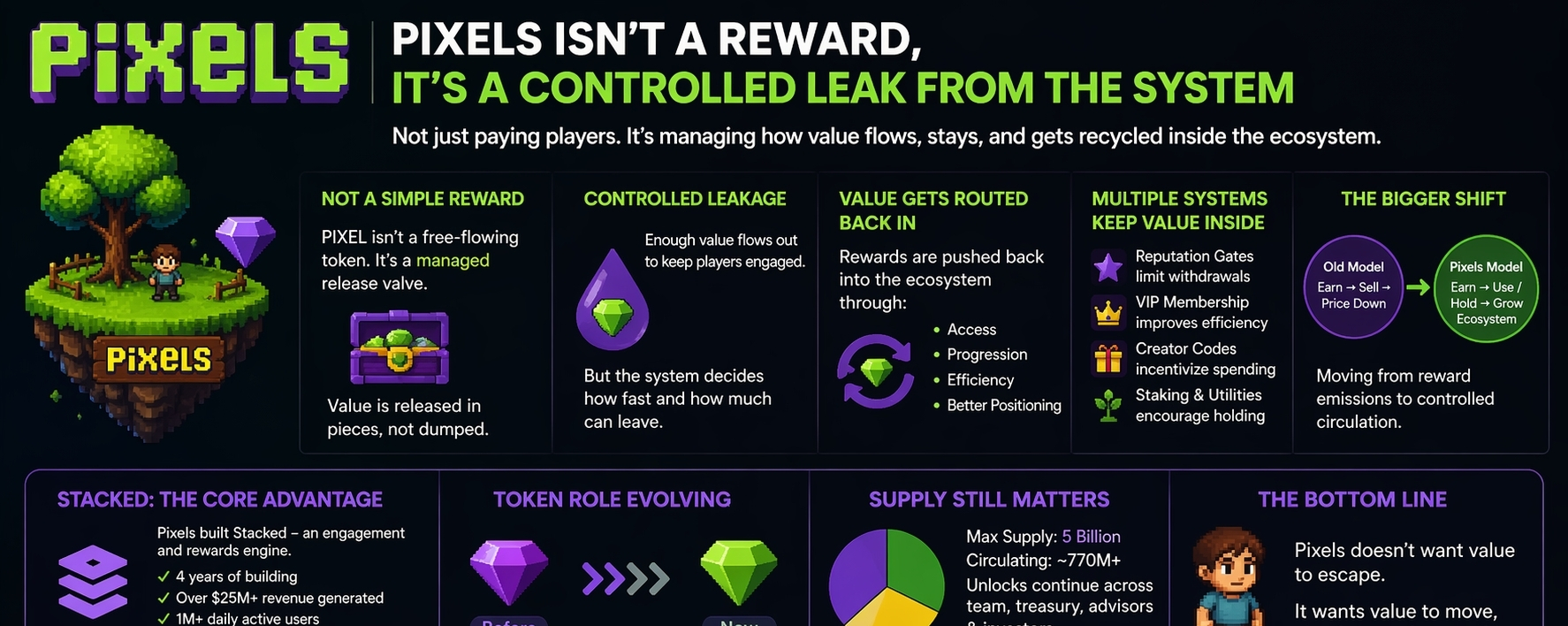
Pixels isn’t just handing out rewards anymore. I don’t even think that frame works now.
I’ve seen too many projects die trying to keep that illusion alive. Same cycle every time. A token gets dressed up as “engagement,” emissions get sold as growth, and eventually the whole thing turns into recycling pressure, exit liquidity, and noise. That usually ends one way.
Pixels looks like it knows that.
Not because it found some magic fix. I don’t think there is one. But when I look at this project now, I’m not looking at a game tossing value at players and hoping the market stays patient. I’m looking at a system trying to control leakage. Trying to slow the bleed. Trying to keep rewards from instantly becoming sell pressure the second they hit someone’s wallet.
That’s a very different thing.
The easy read is to call PIXEL a reward token. I think that misses the point. What matters is not that players earn. Plenty of projects let people earn. What matters is what happens after. Where that value goes. How much friction sits in front of extraction. How much of it gets pulled back into the loop before it ever really leaves.
That’s where Pixels gets more interesting. Also more honest.
Because this project doesn’t feel like it wants value to move freely. It wants value to move usefully. There’s a difference. A big one. You can feel it in the way the whole economy seems built around circulation, not release. You earn, sure. But then the system starts nudging that value somewhere else. Back into access. Back into progression. Back into better positioning inside the same machine.
I’ve watched enough token economies collapse to know what happens when that control disappears. Everything becomes extraction. Nobody says it that cleanly, of course. They hide it under “community incentives” and “player ownership” and whatever else sounds good in a bad market. But under the surface it’s usually the same grind: rewards go out, conviction goes down, price gets weaker, the people left behind start calling dilution “long-term alignment.”
Pixels feels like it’s trying not to end up there.
That doesn’t mean I trust it. It means I can at least see the adjustment.
And honestly, that adjustment matters more than most of the usual talking points. I don’t care about shiny narratives anymore. I care about whether a project understands where its own pressure is coming from. Pixels seems to. It doesn’t look like it’s trying to flood the system and pray demand shows up later. It looks like it’s trying to meter the outflow. Keep players active without letting the economy empty itself every time rewards hit.
That’s the whole fight.
Too much outflow and the token gets chewed up. Too much friction and players stop caring. So the project sits in that ugly middle zone, trying to keep the loop alive without making the controls too obvious. That’s hard. Harder than most teams admit. Because once users start feeling the machinery too clearly, the fantasy breaks. It stops feeling like a world and starts feeling like a managed funnel.
I think Pixels is right on that edge.
And that’s why I don’t read this as a basic reward model anymore. I read it as controlled leakage. Measured release. A system that knows it has to let value out, but only in ways that still serve the system after the fact. That’s colder than the old play-to-earn pitch. Less romantic. Probably more real.
The token isn’t the whole story here. The loop is. The pressure management is. The quiet effort to keep rewards from turning into pure inventory is. That’s what I keep coming back to when I look at Pixels. Not whether people can earn, but whether the project can keep those earnings from becoming the same old death spiral I’ve seen a hundred times before.
Maybe that’s the most honest thing I can say about it.
Pixels doesn’t look like a project trying to reward people. It looks like a project trying to survive its own economy.
And maybe that’s enough for now. Or maybe that’s the first sign the real stress hasn’t even started yet.