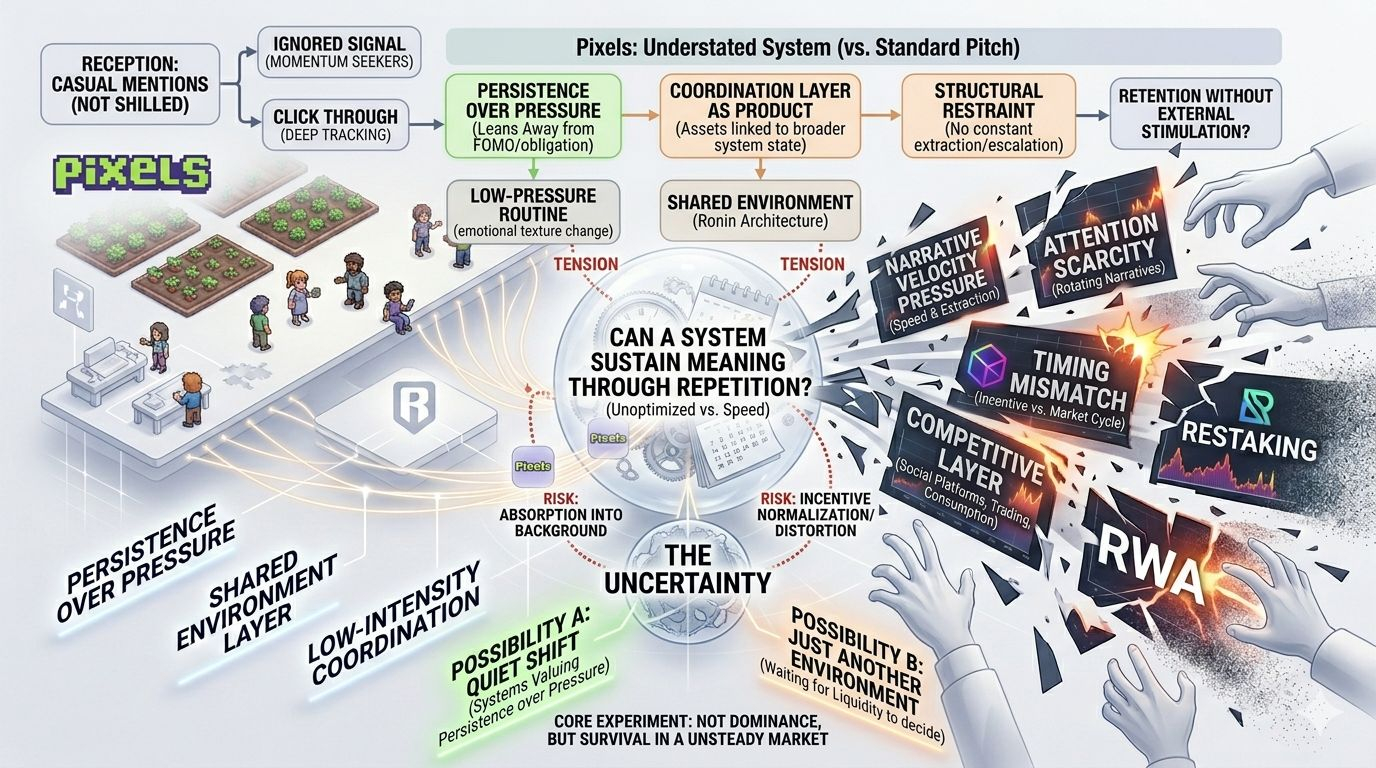
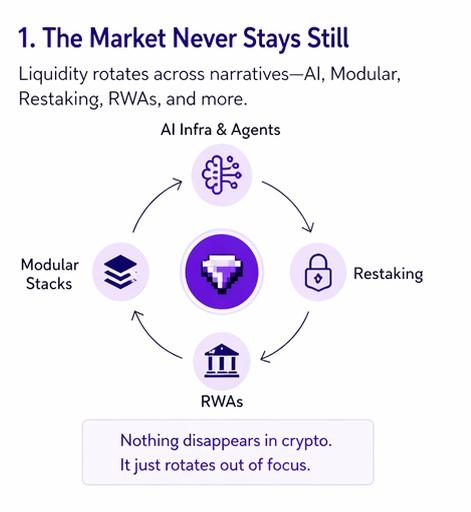
I wasn’t looking for anything new when Pixels showed up again. I was actually deep in one of those late-night scrolls where you’re half tracking charts, half tracking narratives, trying to understand what’s actually holding attention in this market cycle. Liquidity has been restless lately. One week it feels like everything is going toward AI infra and agents, the next week it’s modular stacks and restaking again, then RWAs quietly absorbing institutional curiosity in the background like they always do. Nothing really disappears in crypto anymore it just rotates out of focus for a while.
And in the middle of that noise, I kept seeing Pixels surface in small, almost casual mentions.

Not shilled. Not pushed. Just there. People talking about it like something they log into between other things. That kind of signal is easy to ignore if you’re only looking for momentum. But I’ve learned over time that momentum narratives usually announce themselves loudly, while everything that actually sticks tends to start quieter than you expect.
So I clicked through.
At first, it feels familiar in a way that almost makes you underestimate it. A social casual game on Ronin, farming loops, exploration, light crafting, an open world that doesn’t demand much from you upfront. If you’ve been in crypto gaming long enough, your instinct is already slightly defensive. You’ve seen versions of this pitch before. Worlds that promise persistence, economies that promise depth, incentives that promise alignment.
Most of them don’t survive contact with real user behavior.
But Pixels doesn’t immediately try to convince you it’s different. It just exists.
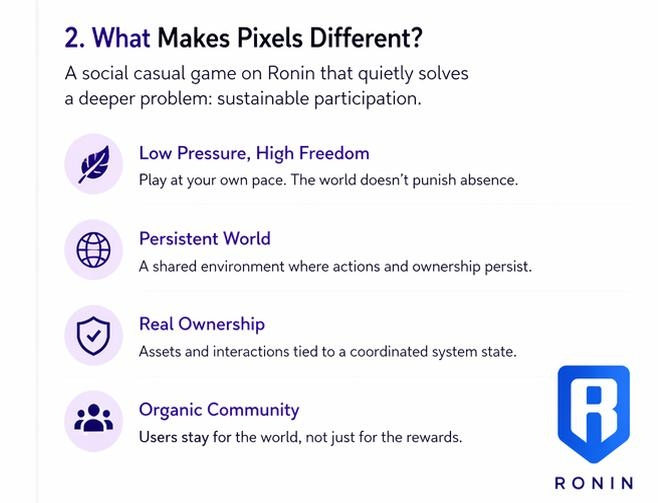
And slowly, what starts to stand out isn’t the gameplay itself, but the structure underneath it. The problem it’s quietly trying to solve isn’t “how do we make a fun blockchain game.” That part is almost secondary. The deeper issue is something more uncomfortable for Web3 gaming: how do you build a system where participation doesn’t collapse the moment incentives fade or attention rotates elsewhere.
In most crypto games, activity is artificially held together by pressure. You log in because you feel like you’re missing something if you don’t. Rewards decay if you step away. Efficiency becomes the whole loop. It turns play into obligation.
Pixels seems to lean away from that. Not completely, but enough that you notice it. The world persists in a way that doesn’t punish absence as aggressively. That alone changes the emotional texture of it.
Under the surface, the Ronin-based architecture matters more than it looks like it should. Assets and interactions exist in a shared environment where ownership isn’t just a UI concept but something tied to a broader system state. You’re not just interacting with a game instance that resets around you. You’re moving through a coordinated environment where other participants’ actions persist alongside yours.
That coordination layer is the real product, even if it doesn’t present itself that way.
And this is where I start thinking less like someone evaluating a game and more like someone watching how systems try to hold attention in a market that refuses to stay still. Because right now, attention is the scarce resource, not capital. Capital is still around, but it moves with hesitation, rotating between narratives that feel increasingly short-lived.
So the question becomes whether something like Pixels can hold even a small pocket of attention without relying on constant external stimulation.
The strength, to me, is in the lack of forced intensity. There’s no constant escalation pressure. It doesn’t feel like it’s trying to extract maximum engagement per session. That sounds small, but in this cycle, where everything competes for immediate retention, that restraint actually stands out.
But restraint can also be a risk.
Because in crypto, attention doesn’t just reward good design. It rewards narrative velocity. If something doesn’t escalate into a story fast enough, it risks being absorbed into the background, no matter how stable its internal loops are.
The incentive layer in Pixels, where it exists, tries to bridge that gap by rewarding participation. But incentives in Web3 gaming always carry this tension. If they’re too strong, they distort behavior. If they’re too weak, they don’t matter. And if they’re just right, they still depend on whether the surrounding market cares at the same time the system needs it to.
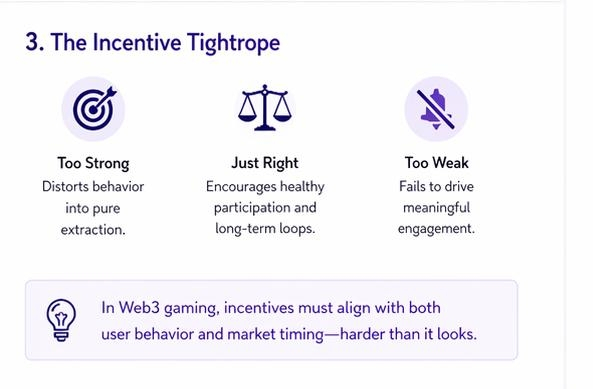
That timing mismatch is where a lot of projects quietly break.
What makes Pixels slightly more interesting is that adoption doesn’t feel aggressively forced. It doesn’t feel like it’s trying to manufacture activity purely through yield or short-term farming behavior. There’s a hint that some users are actually staying because the world itself becomes a low-pressure routine, not just because they’re extracting value from it.
Still, I don’t fully trust early signals in environments like this. I’ve seen too many ecosystems look “organic” in their first phase only to realize later that early retention was just incentive alignment in disguise. Once those incentives normalize, behavior often changes faster than teams expect.
There’s also a broader competitive layer that doesn’t get talked about enough. Web3 gaming isn’t competing only with other Web3 games. It’s competing with everything else that demands attention: social platforms, trading itself, speculation loops, even just passive consumption of narratives. If a system doesn’t win a clear slice of time, it gets diluted into irrelevance, no matter how well-structured it is internally.
And yet, there’s something slightly under-discussed here that I keep coming back to.
Maybe the real experiment isn’t whether Pixels becomes a dominant game or economy. Maybe it’s whether a digital system can sustain meaning through repetition without relying on constant escalation. Whether small, unoptimized actions can remain valuable in an environment that usually rewards speed and extraction.
That’s not a narrative most people in crypto are actively pricing in. We’re still mostly trained to think in terms of acceleration. Faster growth, faster cycles, faster rotations. Even “long-term” strategies often assume eventual compression into some exit event.
But systems like this quietly ask a different question: what if not everything has to accelerate to matter?
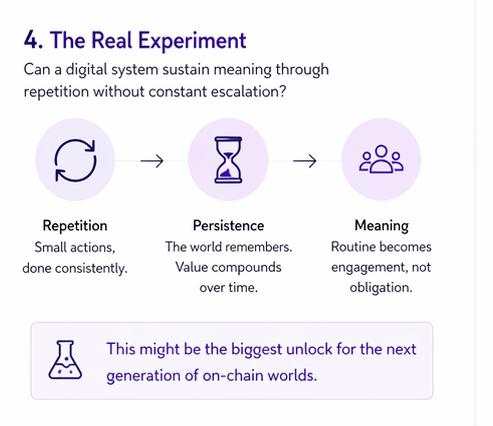
And I don’t have a clean answer for that.
I’ve seen enough cycles to know that most projects don’t fail because they’re misunderstood. They fail because attention moves on before their internal logic has time to compound. Even well-designed systems get caught in timing mismatches with the broader market.
Pixels might be strong enough structurally. Or it might just be slightly out of sync with where attention is headed next.
And that’s the part I can’t stop thinking about not whether it works in isolation, but whether it can survive a market that rarely stays still long enough for anything slow to fully prove itself.
So I keep sitting with the same uncertainty.
Is this a quiet shift toward systems that value persistence over pressure or just another well-built environment waiting for liquidity to decide whether it deserves to matter?