
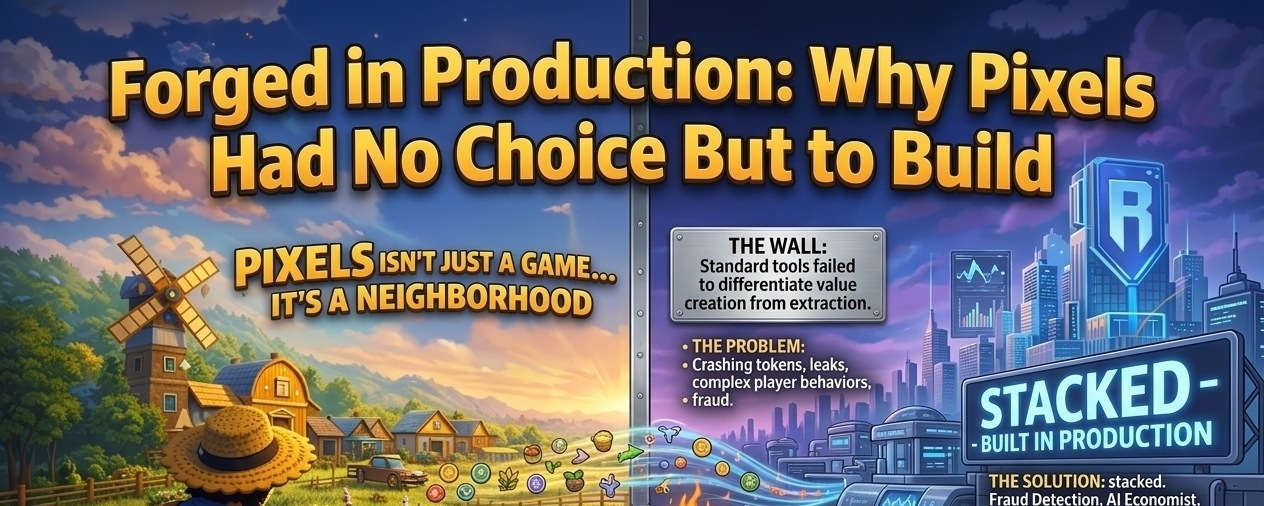
There’s this one line in the Stacked documentation that I keep coming back to—probably more than anything else in the entire Pixels ecosystem: "Built in production, not in a deck."
That’s not just some catchy marketing slogan. It’s a reality check. Having worked closely with startups, you start to notice a very distinct difference in "texture" between products built to check off a roadmap and products built out of pure frustration because nothing on the market was good enough.
The roadmap products? They usually boast a million features and pristine documentation, but completely lack depth where it actually matters. The frustration-built products? Their interfaces might be a bit rougher around the edges, and the docs might be sparse, but they actually solve the core problem. Why? Because the people building them were actively living that problem.
Stacked is 100% the latter.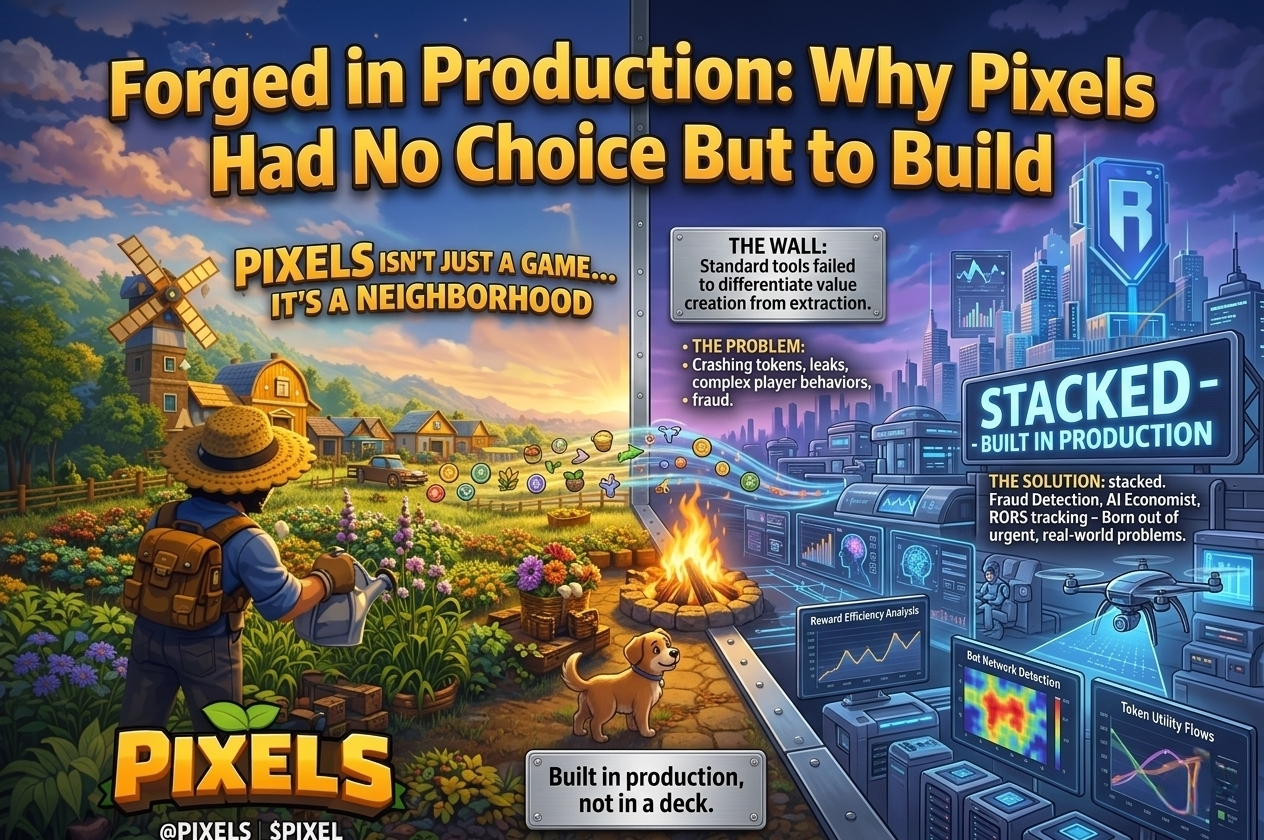
Look at Pixels in 2024: they were running one of the biggest Web3 games globally by daily active users. We’re talking $20 million in revenue and millions of players. But they hit a massive wall that no existing tool could climb: figuring out which rewards actually created real ecosystem value, and which were just being extracted by players giving nothing back.
They looked at standard tools like AppsFlyer. Great for normal mobile attribution, but completely useless for tracking on-chain mechanics or the highly specific behavioral data of Web3 players. Other analytics platforms? None of them could tell the difference between a player farming just to dump tokens and a player farming to reinvest in the game. From the outside, both look identical. Economically, they are polar opposites.
Nothing out there cut it. So, they just built it themselves.
And this is exactly why that "built in production" phrase hits so hard—and why a lot of readers probably gloss right over it.
When you build a product to solve your own massive headache, the incentive alignment is bulletproof. The Pixels team didn’t build Stacked to wow investors with a slick pitch deck. They built it because their tokens were crashing and they desperately needed to understand where the leaks were before it was too late. Every single feature—from fraud detection to RORS tracking to their AI game economist—was born out of an urgent, bleeding-neck problem, not a brainstorming session for a slide deck.
You just can’t fake the battle scars of a product built like this. It has survived actual, adversarial conditions.
We’re talking 200 million rewards processed through this system. Not in a sandbox. Not with simulated users. With real, highly motivated players—some of whom were actively trying to game the system, run bot farms, and extract maximum value without contributing a thing. Stacked’s fraud detection wasn’t trained on theoretical threat models; it was forged in the fire of live attack data. This is something no amount of VC money can buy faster than real time.
But, to be fair, this is also where we have to take a step back and ask the hard reverse question.
Stacked was custom-built by the Pixels team, to solve Pixels' problems, hyper-optimized on Pixels' data. So, when they open this up to outside studios, the question isn’t whether it works. The question is: will it work just as smoothly for a game with completely different genres, demographics, and churn dynamics?
Player behavior in a hardcore dungeon crawler is nothing like a chill farming sim. A competitive PvP game has a totally different spending heartbeat than a casual social game. The models baked into Stacked are heavily trained on Pixels' DNA. They’re going to need time to learn and recalibrate for each new studio. During that awkward adjustment phase, hitting the "right reward to right user" metric might be a bit clunkier than the marketing materials suggest.
Does that make Stacked a bad tool? Absolutely not. It just means it's a product you need to approach with the right expectations.
At the end of the day, after years of watching B2B tech products come and go, I firmly believe this: the most powerful tools in any category are rarely built by teams whose main goal was selling software. They’re built by teams who hit a wall, realized the market had nothing for them, and decided to fix their own mess first.
Pixels never set out with a master plan to build Stacked. They just didn't have another choice.
And honestly? That right there is the origin story of almost every truly great tool I know.
