
Call It a Game If You Like. It’s Still a Financial System.
Let’s not waste time.
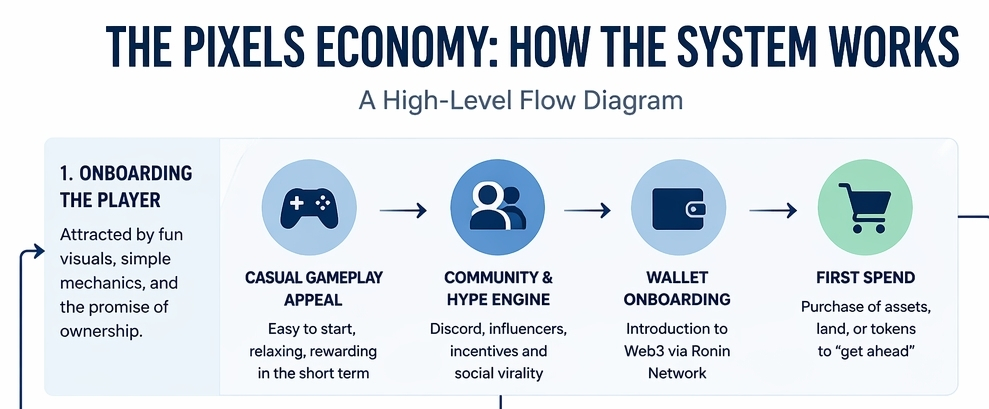
Pixels is not a casual game. It’s a financial product wrapped in a farm.
The moment a game introduces a tradable token and ties progress to it, the nature of participation changes. You are no longer playing for fun. You are playing inside an economy designed to extract value from your time, your attention, and eventually your money.
I’ve seen this structure before. It doesn’t end differently because the graphics are softer.
Pixels sells relaxation. What it delivers is exposure.
“Ownership” Sounds Empowering. It Usually Isn’t.
The sales pitch is predictable. You own your assets. You control your experience.
No, you don’t.
Ownership inside a system controlled by developers is conditional. They set the rules. They adjust supply. They reshape incentives whenever it suits them. Your so-called assets exist within a framework you cannot influence.
And here’s the uncomfortable part. The more you invest, the less free you become. Ownership increases your commitment. It makes leaving harder. That is not empowerment. That is lock-in.
People mistake digital ownership for independence. It’s often just a more sophisticated form of dependence.
A Fragile Backbone Pretending to Be Solid Ground
Pixels sits on Ronin, a network with a history that should make any serious participant pause.
It doesn’t.
This is a chain that has already suffered one of the most damaging breaches in the sector. That isn’t ancient history. That is a warning. Yet the narrative has shifted neatly to recovery and growth, as if resilience cancels risk.
It doesn’t.
If the infrastructure fails, everything built on top of it fails with it. That includes Pixels. There is no insulation here. No real buffer.
You are building value on a system that has already broken once. That should not be a footnote. It should be the headline.
This Economy Doesn’t Create Value. It Redistributes It.
Strip away the language and look at the mechanics.
Where does the value come from?
Not from production. Not from innovation. It comes from new participants entering the system and buying in. The economy functions because fresh demand supports existing prices. Without that, the structure stalls.
This is not a productive economy. It is a circular one.
Circular systems need constant expansion. When growth slows—and it always does—the imbalance becomes visible. Rewards shrink. Prices soften. Engagement drops.
At that point, the game stops feeling like a game.
Call It Farming. It Still Looks Like Work.
The gameplay loop is not subtle.
Repeat tasks. Optimise output. Maximise returns.
That is not leisure. That is labour with better branding.
Players are encouraged to think in terms of efficiency and yield. Time becomes a resource to be deployed. Effort becomes something to be monetised. This is not accidental design. It is deliberate conditioning.
And like any labour market, the distribution of rewards is uneven. Early participants and larger holders extract more. Latecomers work harder for diminishing returns.
The system recreates inequality inside a space people still insist on calling entertainment.
The Community Isn’t Organic. It’s Incentivised Expansion
Watch the tone of the community and you see the mechanism clearly.
Relentless optimism. Constant recruitment. Little tolerance for doubt.
This is not what an organic community looks like. This is what a growth-dependent system produces. When value depends on new entrants, every participant becomes, in effect, a recruiter.
That shifts the entire dynamic.
You are not just playing alongside others. You are part of a network that benefits from bringing more people in. That is not social interaction. That is economic alignment.
And economic alignment rarely rewards skepticism.
Soft Graphics. Hard Economics.
Pixels looks gentle. That is not incidental.
The visual design lowers resistance. It makes the system feel safe, almost trivial. People don’t associate pastel farms with financial risk. That gap in perception is useful.
Because beneath the surface, the mechanics are not gentle at all. They are built on scarcity, reward cycles, and behavioural incentives designed to keep players engaged and spending.
The mismatch works in the system’s favour.
When something looks harmless, people stop asking hard questions.
Growth Masks the Problem. Until It Doesn’t.
Every system like this thrives on momentum.
Early adopters benefit. Activity rises. Prices respond. The narrative reinforces itself. It feels like success because, for a while, it is.
Then growth slows.
That is the moment that matters. Because these systems are not designed for stability. They are designed for expansion. When expansion weakens, the structure is exposed.
Pixels has not faced that test yet. But nothing in its design suggests it will pass it.
The dependence on new inflows is not a flaw. It is the foundation.
This Isn’t Reinventing Gaming. It’s Rewiring It
The real shift here is broader than one game.
Pixels is part of a pattern where entertainment is being quietly turned into a financial layer. Play is no longer an end in itself. It is a means to participate in an economy.
That changes incentives. It changes behaviour. It changes what games are for.
When players start measuring their time in returns rather than enjoyment, something fundamental has already been lost.
And it doesn’t come back.
You Already Know How This Ends
There is a reason this structure feels familiar.
Because it is.
An economy that depends on constant inflow. A reward system that weakens over time. Early gains followed by late-stage pressure. We have seen this cycle repeat across platforms, tokens, and games.
The packaging improves. The outcome doesn’t.
Pixels is not breaking that pattern. It is following it closely.
And when the inflow slows—as it inevitably will—there won’t be a mystery to solve.
Only a result that was obvious from the start.
