
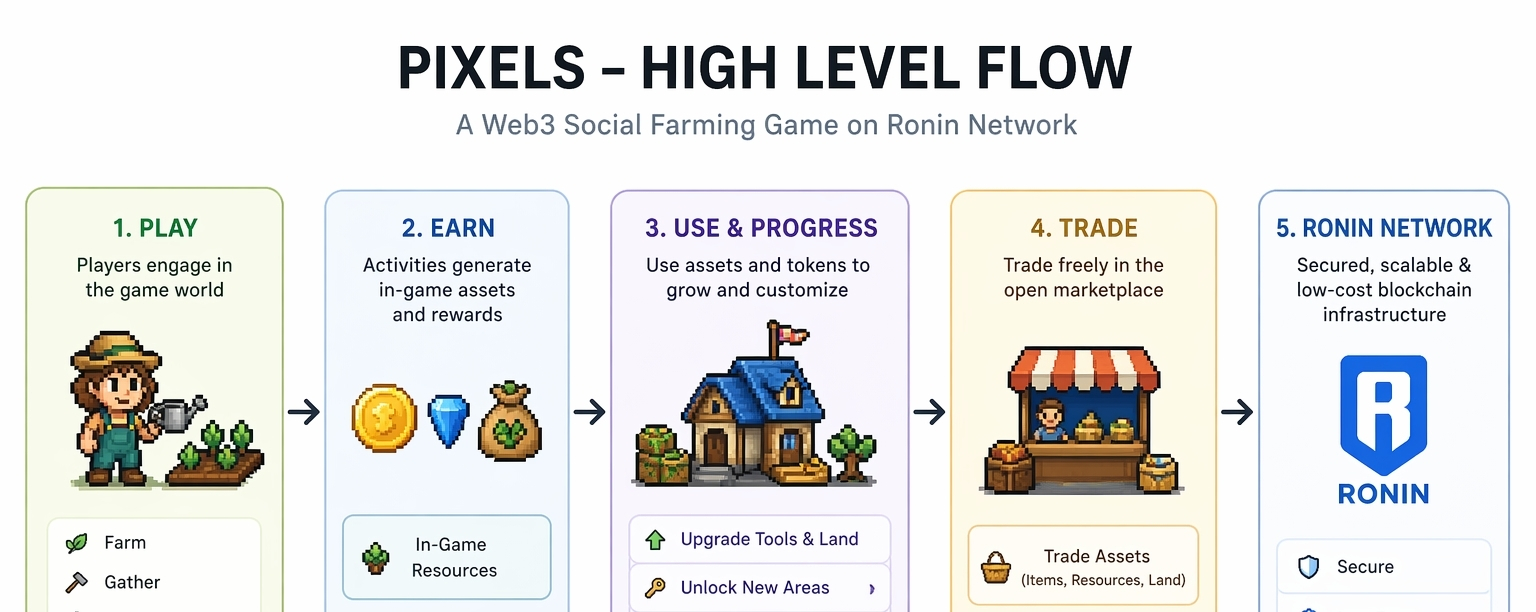
Look, I’ve seen this movie before. New game. Friendly graphics. Big talk about ownership and earning while you play. It sounds tidy. On paper, at least. But once you sit with it for a bit, the familiar cracks start to show.
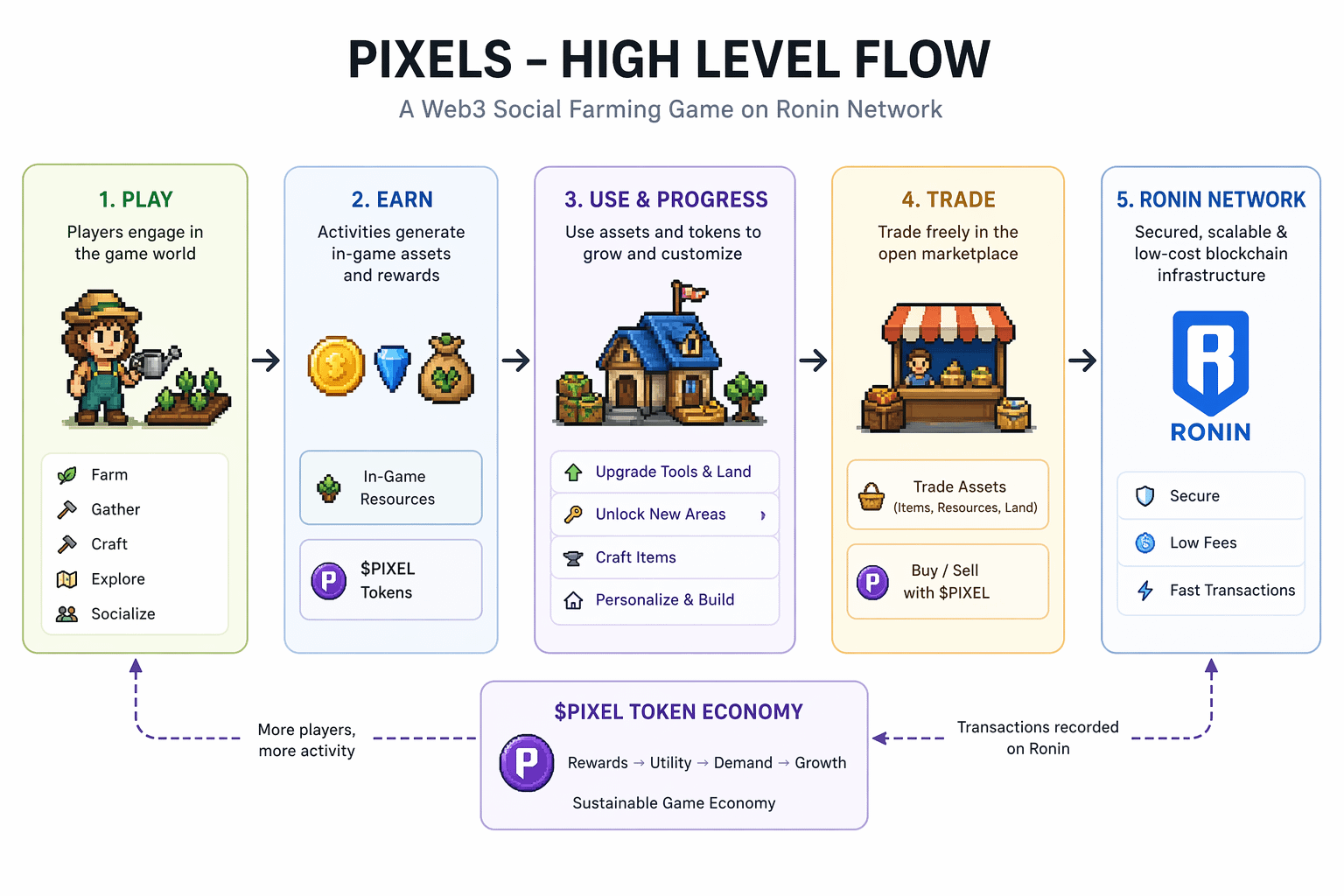
Pixels is the latest attempt to dress a financial system as a game. It runs on the Ronin Network, which already tells you something. This isn’t just about farming crops or chatting with other players. It’s about plugging user activity into a token economy and hoping the numbers hold.
Let’s be honest about the problem they claim to fix. Traditional games are closed systems. You spend time, maybe money, and you get entertainment. That’s it. No resale value. No ownership in the financial sense. Web3 games like Pixels step in and say: what if your time had measurable economic value? What if your in-game work paid you back?
It sounds appealing. Of course it does. But the real issue they’re targeting isn’t player fairness. It’s engagement decay. Games lose users over time. Always have. Pixels is trying to bolt a financial incentive onto that problem and call it a solution.
Here’s the part most people skip over. If players are earning something, that value has to come from somewhere. There’s no magic here. No hidden pool of money. It’s either coming from new players entering the system, or from existing players spending more than they earn. That’s the engine.
And I’ve seen how that engine behaves.
Early users get in cheap. They grind. They accumulate tokens. Then new users arrive, pushing demand up, making everything look healthy. For a while, it works. It even looks sustainable. Until growth slows. It always slows. Then the math flips. Rewards shrink. Selling pressure builds. Prices slip. Quietly at first, then all at once.
Pixels tries to soften this with slower pacing. Farming loops. Social interaction. Daily routines. The idea is to keep players engaged without encouraging rapid extraction. It’s a smarter design than the first wave of play-to-earn games. I’ll give it that.
But it doesn’t remove the core tension. It just stretches it out over time.
Now let’s talk about the “solution.” Because this is where things get messy. Instead of a simple game economy, you now have layers. Blockchain infrastructure. Token emissions. External markets. Wallets. Liquidity flows. Each layer adds complexity. Each one introduces a new point of failure.
If something breaks in a normal game, the developer patches it. End of story. Here, if the token tanks, or liquidity dries up, or users lose confidence, no patch fixes that. The system starts to unwind from the outside in.
And then there’s the question nobody in the marketing deck wants to sit with: who is actually making money here?
It’s not evenly distributed. It never is. The people who benefit most are those who get in early, understand the mechanics, and exit before the system cools. Everyone else is effectively providing liquidity, whether they realize it or not.
That’s not a community. That’s a market with uneven information.
Now, to be fair, Pixels does something slightly different. It leans into social design. Shared spaces. Collaborative play. It’s trying to build stickiness that isn’t purely financial. That’s smart. Maybe even necessary.
But let’s not pretend it solves the underlying issue. If the token loses value, the social layer gets tested. Hard. People say they’re there for the experience. Until the incentives disappear. Then you find out what’s real and what was just tolerated.
There’s also the centralization question. Yes, assets are on-chain. Yes, transactions are verifiable. But control? Still largely in the hands of the developers. They tweak emissions. They design the sinks. They shape the economy. Call it decentralized if you want, but the levers are not evenly distributed.
And when things go wrong—and they do—the burden falls on users, not the system.
I keep coming back to the same point. This isn’t really about gaming. It’s about turning player activity into a financial loop and hoping it holds together longer than the last attempt.
Maybe it will. For a while.
But strip away the art style, the farming mechanics, the social features, and you’re left with a familiar structure. Value in. Value out. Dependent on growth. Sensitive to sentiment. Vulnerable when attention moves on.
And attention always moves on.
