
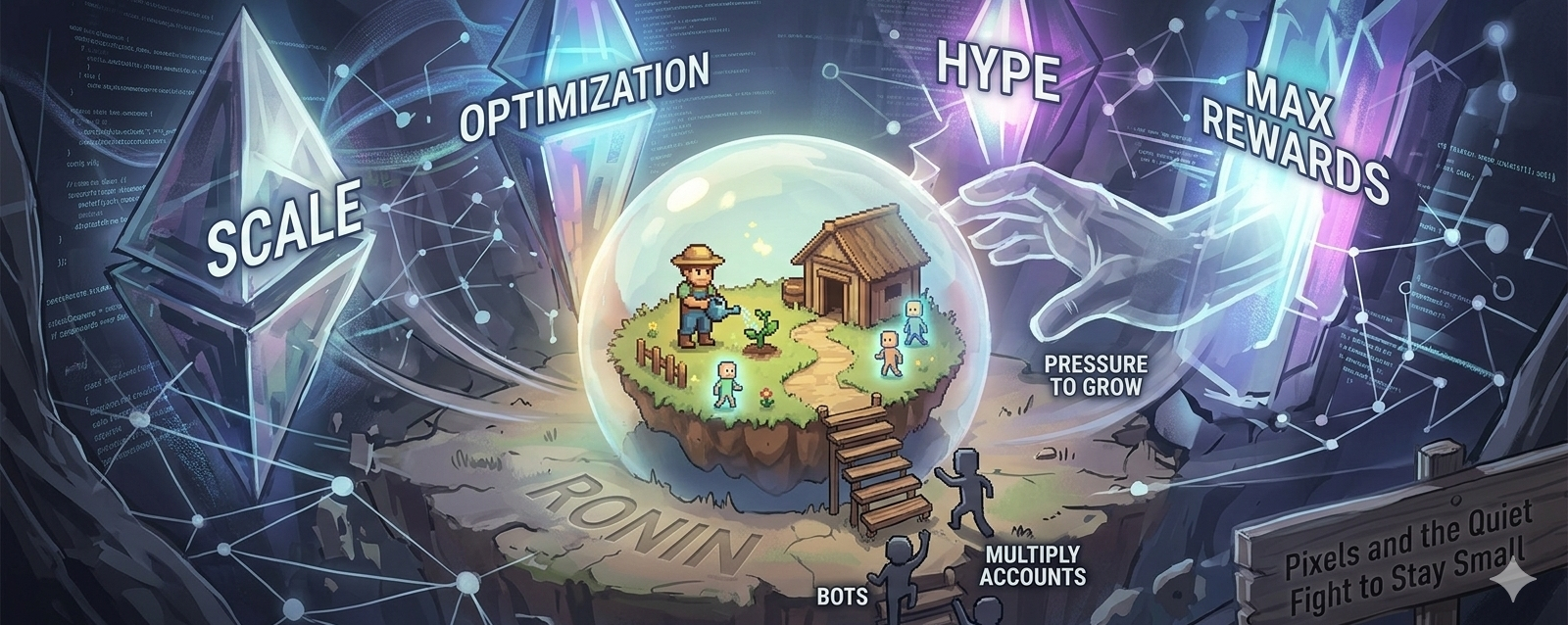
@Pixels #pixel $PIXEL
I’ll be honest—I almost ignored it.
The moment I hear “Web3 game,” something in my head just switches off. Not even out of frustration anymore. It’s just habit. I’ve seen too many of these cycles play out the same way: something that looks simple and fun on the surface, but underneath it’s all about optimization, rewards, and squeezing the loop until it stops feeling like a game.
So when Pixels showed up—farming, crafting, walking around, talking to people—it felt predictable. Like I already knew where it was going.
But then it didn’t go away.
Not in a loud way. No constant hype, no aggressive push. Just… there. Someone mentioning they checked in. Another person saying they spent more time than planned. It started to feel less like a “project” and more like something people casually returned to.
That’s rare.
In most crypto spaces, attention is fast and noisy. Things explode, trend, and disappear just as quickly. But Pixels doesn’t move like that. It sits in the background. And weirdly, that made me pay more attention.
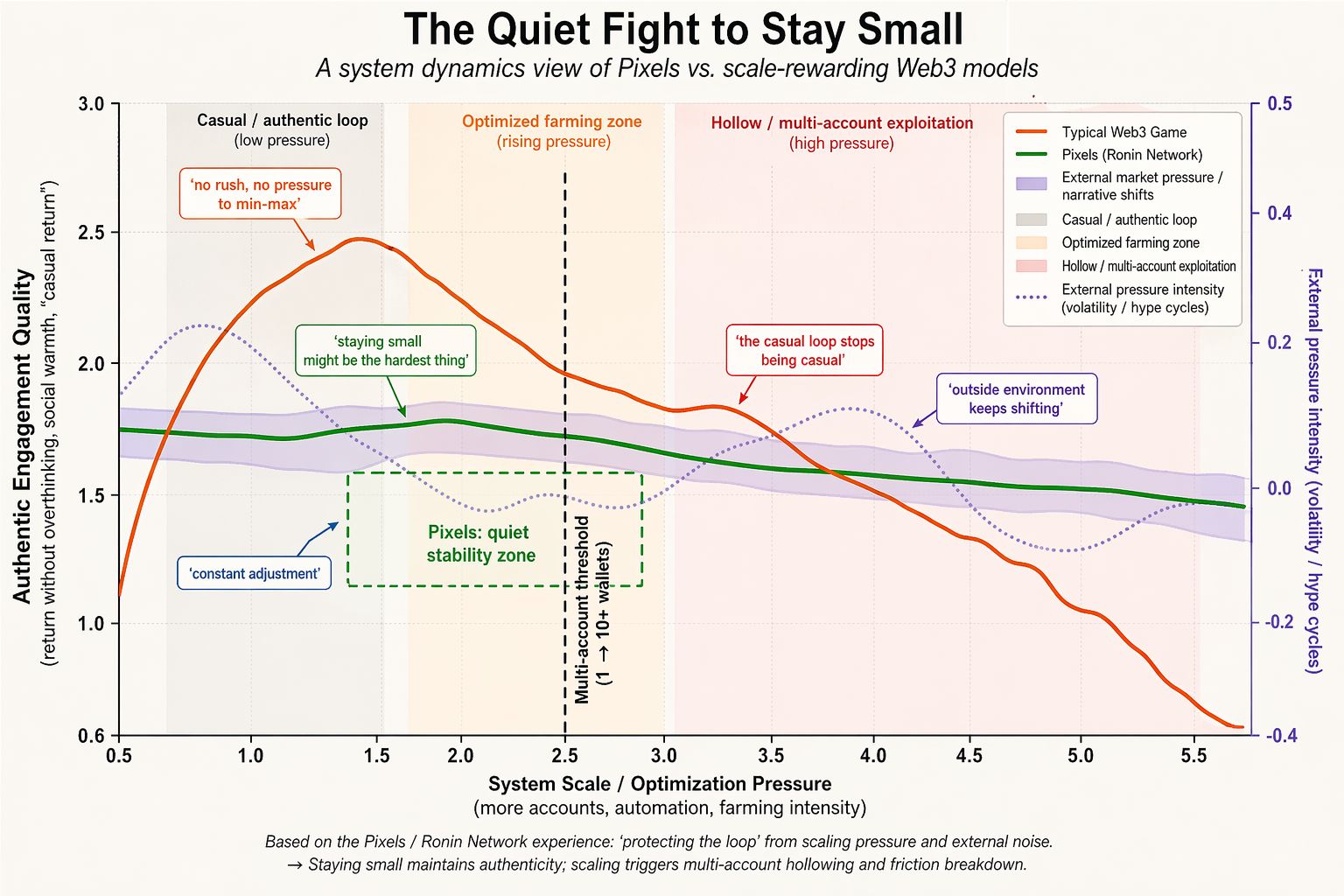
The game itself is easy to understand. You log in, take care of your land, craft a few things, maybe wander around and see who’s nearby. There’s no rush. No pressure to min-max every action. It feels… slower. And that’s intentional.
But the part that sticks with me isn’t what you see—it’s what you don’t.
Because Pixels runs on the Ronin Network, and that changes the whole picture. Not in an obvious way, but in all the small, invisible moments.
When things work, you don’t think about it. You plant, harvest, move on. But if something breaks—if an action stalls, if a wallet interaction fails—that calm routine disappears instantly. And people don’t stick around for that kind of friction. Not in a game that’s supposed to feel easy.
That’s where most projects quietly fall apart. Not during launch, not during hype—but later, when real usage starts testing all the parts no one talks about.
What makes Pixels interesting is that it seems aware of that. It doesn’t try to impress you with complexity. It just tries to keep things working, consistently, without making you think about the system underneath.
And honestly, that’s harder than it sounds.
Then there’s the whole identity side of things.
On paper, wallets are supposed to make everything simple. One address, one player. Clean and straightforward. But games aren’t spreadsheets. They’re social spaces. People expect some level of authenticity, even if it’s informal.
And that’s where things get messy.
If everything is too open, people find ways to scale behavior. One account becomes ten, ten becomes fifty. The “casual” loop stops being casual. It turns into something optimized, repetitive, and a little bit hollow.
But if you try to control that too much, you risk pushing away the very people who made the space feel alive in the first place.
There’s no perfect balance. Just constant adjustment.
And all of this happens while the outside environment keeps shifting. Prices move. Narratives change. New trends show up out of nowhere. Even if the game itself stays calm, the ecosystem around it doesn’t.
That pressure leaks in.
So the real challenge for Pixels isn’t just building a good loop—it’s protecting that loop from everything around it. Keeping the experience steady even when the context isn’t.
That’s what I keep coming back to.
It’s not about whether the game is “fun” in the traditional sense. It’s about whether it can remain a place people return to without overthinking it. Something that fits into a routine instead of demanding attention.
Right now, it feels like that’s what it’s trying to be.
Not bigger. Not louder. Just… stable.
And in a system that constantly pushes everything to scale, staying small might actually be the hardest thing to pull off.
I still don’t fully trust it. Maybe that instinct never really goes away.
But I’ve stopped ignoring it.
And that, on its own, says something.