
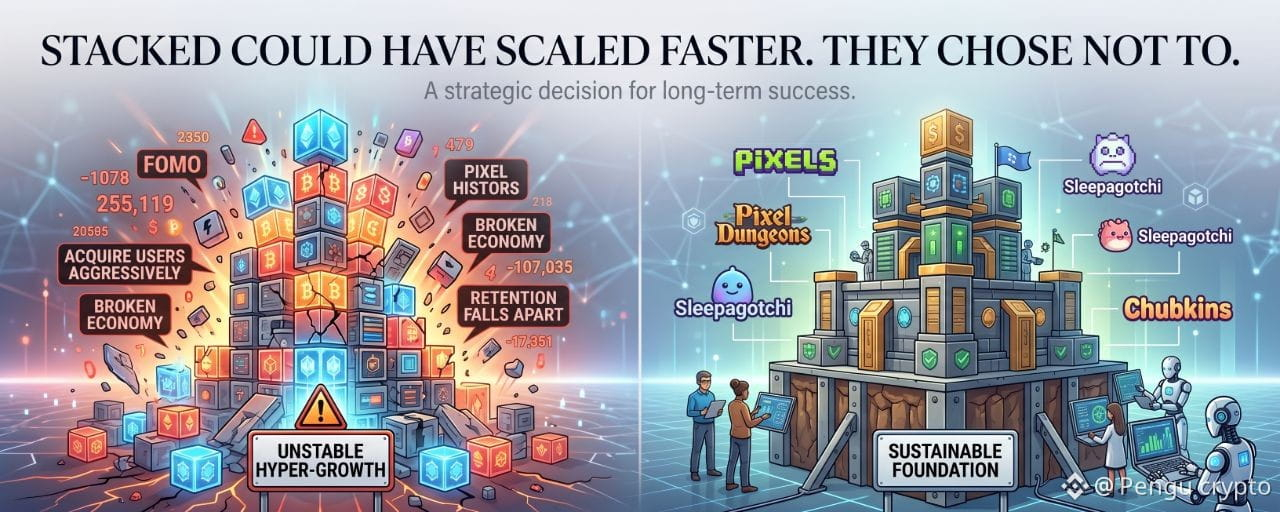
That decision is more interesting than it sounds.
Most crypto projects do the opposite. Launch loud, acquire users aggressively, hit the headline numbers before the product is ready to support them. The growth looks real for a few months. Then retention falls apart, the economy breaks under pressure, and the team spends the next year trying to fix something that was never designed to work at scale in the first place.
Stacked announced a soft launch and was explicit about what that means. The rewards feed is focused on the internal ecosystem for now. Pixels, Pixel Dungeons, Sleepagotchi, Chubkins. No aggressive external push yet. No flood of studios onboarding before the system has been stress tested in its new form.
Luke was direct about the reasoning. The first chapter is focused. The latter ones get much bigger.
I've been in this space long enough to know how rare that sentence is. Most founders say something like it and don't mean it. The pressure to show growth, to justify valuations, to keep community momentum alive pushes teams to scale before they're ready almost every time. Saying no to that pressure is genuinely difficult.
But there's a specific reason this restraint makes sense for Stacked in a way it wouldn't for most products.
The entire value proposition is that the reward system works. Not that it works in a demo. Not that it works with a small curated user base. That it works under adversarial conditions at scale, with real players, real extraction attempts, real edge cases the team didn't anticipate. The RoRS sitting at 3:1 inside Pixels right now is the proof point that @Pixels brings to every external studio conversation. That number only means something if it holds.
If Stacked onboards fifty studios before the system is calibrated for that volume and something breaks, the proof point breaks with it. The entire B2B pitch depends on the infrastructure being as reliable as the team claims. Scaling before that confidence is earned doesn't just risk the product. It risks the thing that makes the product worth buying.
There's also something quieter happening during the soft launch period that doesn't get talked about. Every game that runs inside Stacked right now is generating behavioral data that makes the AI Game Economist sharper. More games means more player profiles, more reward experiments, more signal about what works across different genres and audiences. The system that external studios will eventually plug into will be meaningfully better than the one running today because of the time spent here.
Slow is how you build something that survives contact with scale.
Most projects in this space have proven that moving fast breaks things in ways that are very hard to repair. Stacked seems to have looked at that pattern and decided the headline growth number wasn't worth the risk.
That's not a weakness. That's probably the most important decision they've made.
