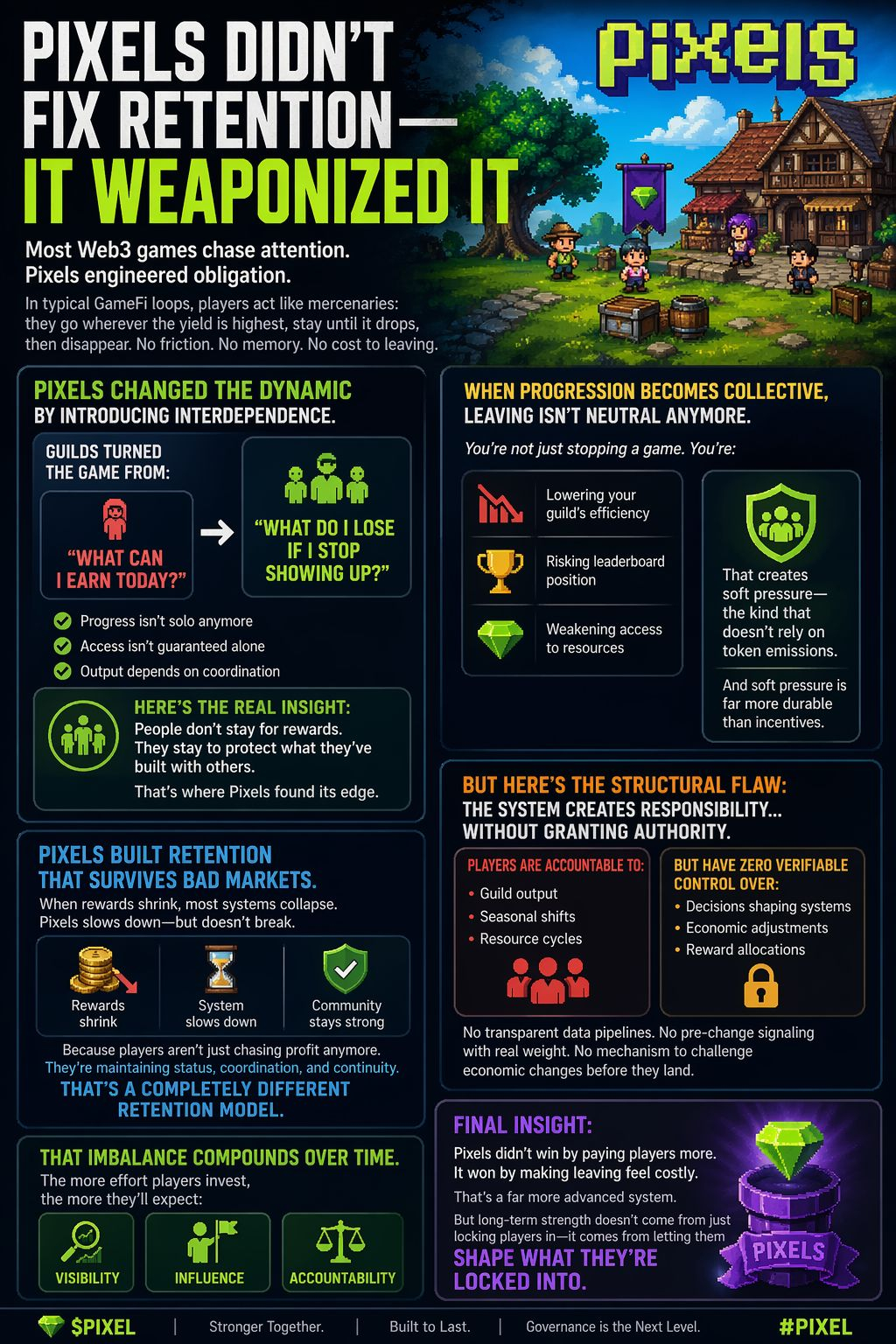
Pixels engineered obligation.
That’s the difference.
In typical GameFi loops, players act like mercenaries:
they go wherever the yield is highest, stay until it drops, then disappear. No friction. No memory. No cost to leaving.
Pixels changed that dynamic by introducing interdependence.
Guilds didn’t just add a social layer —
they made other players part of your production function.
Now your output isn’t isolated.
Your access isn’t guaranteed.
Your progression isn’t purely yours.
It’s shared. And that changes behavior.
This is where it gets interesting:
When progression becomes collective, leaving isn’t neutral anymore.
You’re not just stopping a game.
You’re:
lowering your guild’s efficiency
risking leaderboard position
weakening access to resources
That creates soft pressure the kind that doesn’t rely on token emissions.
And soft pressure is far more durable than incentives.
Pixels built retention that survives bad markets.
When rewards shrink, most systems collapse.
Pixels slows down but doesn’t break.
Because players aren’t just chasing profit anymore.
They’re maintaining status, coordination, and continuity.
That’s a completely different retention model.
But here’s the structural flaw:
The system creates responsibility…
without granting authority.
Players are accountable to:
guild output
seasonal shifts
resource cycles
But they have zero verifiable control over the decisions shaping those systems.
No transparent data pipelines.
No pre-change signaling with real weight.
No mechanism to challenge economic adjustments before they land.
That imbalance compounds over time.
Because the more effort players invest,
the more they’ll expect visibility.
And eventually influence.
Right now, Pixels captures: time
coordination
commitment
But it doesn’t yet distribute: power
oversight
accountability upward
Final Insight:
Pixels didn’t win by paying players more.
It won by making leaving feel costly.
That’s a far more advanced system.
But long-term strength doesn’t come from just locking players in
it comes from letting them shape what they’re locked into.
Until that layer exists,
Pixels will have one of the strongest communities in Web3…
but not one of the most empowered.