
Something about Web3 games doesn’t sit right with me. Not in an obvious way, more like a quiet mismatch you only notice after spending time inside them. You play, you earn, you repeat but the system never really reacts back. It just keeps going, like it doesn’t care how or why you’re playing. And after a while, that starts to feel less like a game and more like a routine you’ve already solved.
I started noticing this after jumping between a few GameFi titles. The structure barely changes. Do tasks, earn tokens, optimize the loop. At first, it feels rewarding. Then it becomes mechanical. You’re not reacting anymore, you’re executing. And what’s strange is that the system doesn’t push back. It doesn’t adapt. It just keeps paying, even when the behavior clearly isn’t real.
At first, I thought @Pixels was just another version of that. A farming loop with better design, maybe more polish. Plant, harvest, craft, repeat. I assumed it would eventually flatten into the same pattern, players figuring out the most efficient path, extracting value, and slowly drifting away. That’s how it usually ends.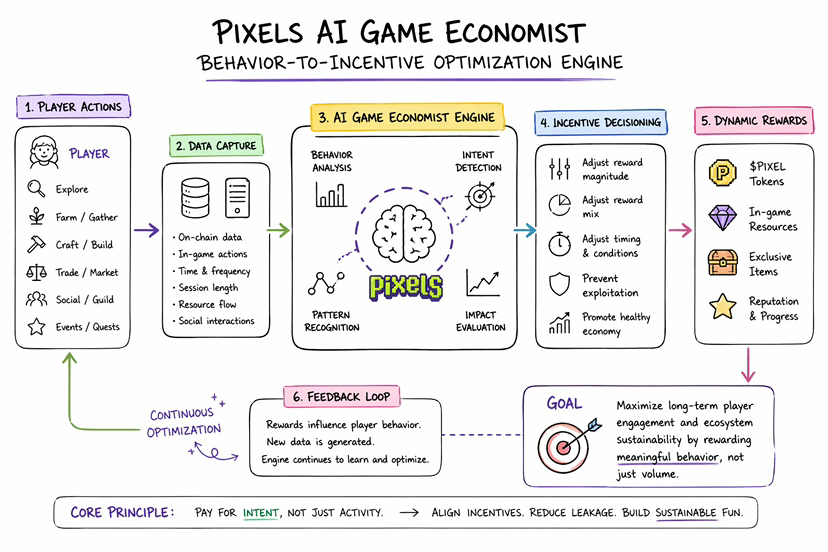
But something didn’t quite fit. The longer I stayed, the harder it was to fully “solve” the system. Not in a frustrating way, just less predictable. I couldn’t tell if doing more would always give me more. Sometimes it did, sometimes it didn’t. And that’s when it started to feel like the system wasn’t just tracking what I was doing, it was trying to interpret it.
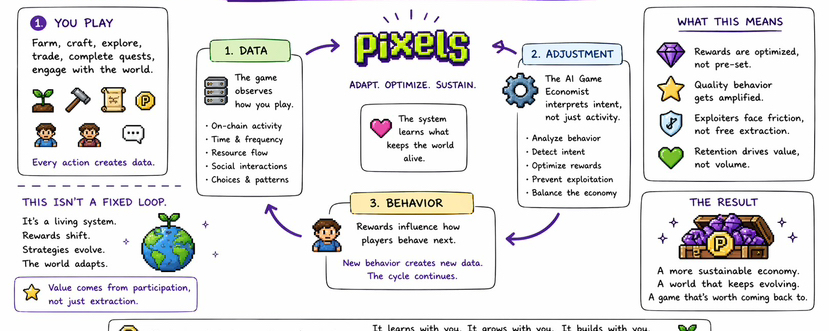
That’s a subtle difference, but it changes everything. Most Web3 games measure activity. Pixels feels like it’s trying to measure intent. Not perfectly, but enough to create friction for pure optimization. It didn’t feel like rewards were fixed. It felt like they were being optimized based on how different types of player behavior actually impacted the system. Not static, not linear. More like a loop behavior feeds data, data adjusts rewards, and those rewards shape the next behavior.
And that’s where it gets interesting. Because if rewards are fixed, behavior converges. Everyone finds the same optimal path. But if rewards are optimized, behavior starts to diverge. It felt like the system wasn’t just tracking activity, it was trying to interpret intent. Almost like every action was feeding back into the system, shaping what gets rewarded next.
I wouldn’t call it “AI” in the literal sense, but it behaves like one. Not predicting perfectly but constantly updating what “good behavior” looks like. A system that observes, adjusts, and recalibrates based on outcomes. Over time, it feels less like a reward engine and more like something trying to learn what kind of activity actually sustains the game.
And that leads to a different way of thinking about incentives. Most GameFi pays for activity. This feels like it’s trying to pay for alignment. Most systems focus on how much they distribute. This one feels like it’s focused on how efficiently those rewards translate into real activity.
When I started thinking about the token side, it reframed things again. $PIXEL isn’t just a reward layer, it’s part of this feedback loop. Its value depends on whether activity is meaningful, not just high volume. Even with a market cap in the hundreds of millions, the real question isn’t valuation, it’s whether the activity behind it is actually sustainable.
That’s where most GameFi economies break. They reward volume, not value. So players farm, sell, and leave. The system doesn’t learn, it drains. But Pixels feels like it’s trying to close that gap. Not by removing incentives, but by shaping them. Making them more precise. Less about how much you do, more about how you do it.
Still, I keep coming back to the same doubt. Can a system like this actually hold? The moment real money is involved, behavior shifts. People optimize. They always do. Even if the system adapts, players adapt too. It becomes a loop of adjustment on both sides. I’m not sure where that stabilizes, or if it ever does.
It reminds me of recommendation systems on social platforms. At first, they respond to users. Then users start responding to the system. Then both evolve together. Sometimes that improves things. Sometimes it just creates a different kind of noise. I can see a similar feedback loop forming here.
If rewards are too loose, the system drains. If they’re too strict, players stop engaging. Somewhere in between, it has to balance and that balance isn’t static. That’s probably the hardest part. Not designing the system, but keeping it stable as behavior keeps changing.
What Pixels might be doing differently is slowing that cycle down. Introducing friction. Making it harder to immediately exploit the system. And in that space, something interesting happens. Over time, it felt like the system was quietly separating players not by access, but by how they interacted with it. Small advantages compound. No hard barrier, but real divergence.
And that brings everything back to retention. Because none of this matters if players don’t stay. You can’t optimize a system that people abandon. Utility only works if someone comes back tomorrow. Without that, even the most sophisticated reward system becomes irrelevant.
So the loop starts to look different. Not farm and sell, but play and return. Not extract and leave, but engage and evolve with the system. Value becomes something that emerges from participation, not something you chase directly. It’s slower, less obvious but potentially more resilient.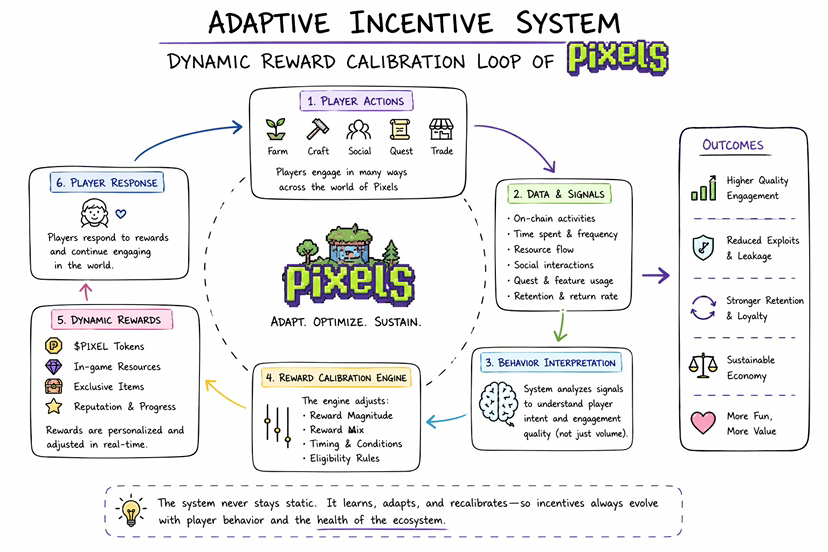
I don’t think #pixel is just a game, and it’s not just a token either. It feels more like an adaptive economy. One that learns from behavior instead of being exploited by it. Whether that actually works at scale is still uncertain.
Because systems like this need time. They need data, volume, and a wide range of behaviors to stabilize. Early on, everything is noisy. Signals are weak. And sometimes, getting enough players matters more than designing the perfect system.
So I’m still watching it. Not fully convinced, but definitely paying attention. The idea makes sense, now it’s a question of whether the system can keep learning faster than players can break it.