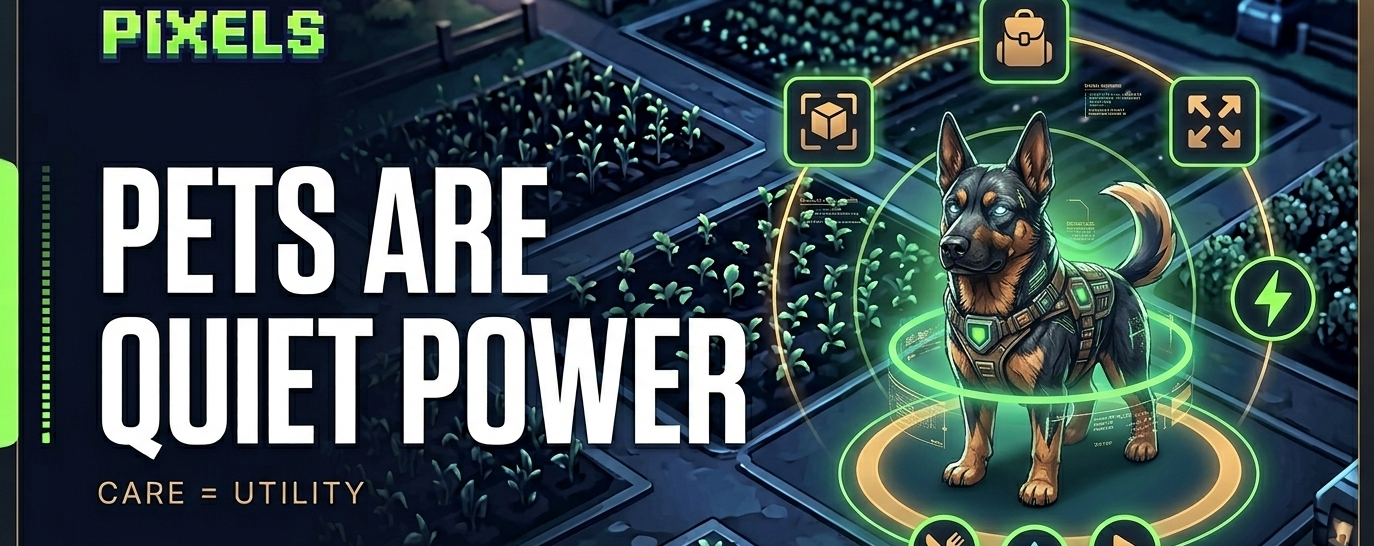
I did not expect pets to be one of the parts of @Pixels that would stay in my mind for this long.
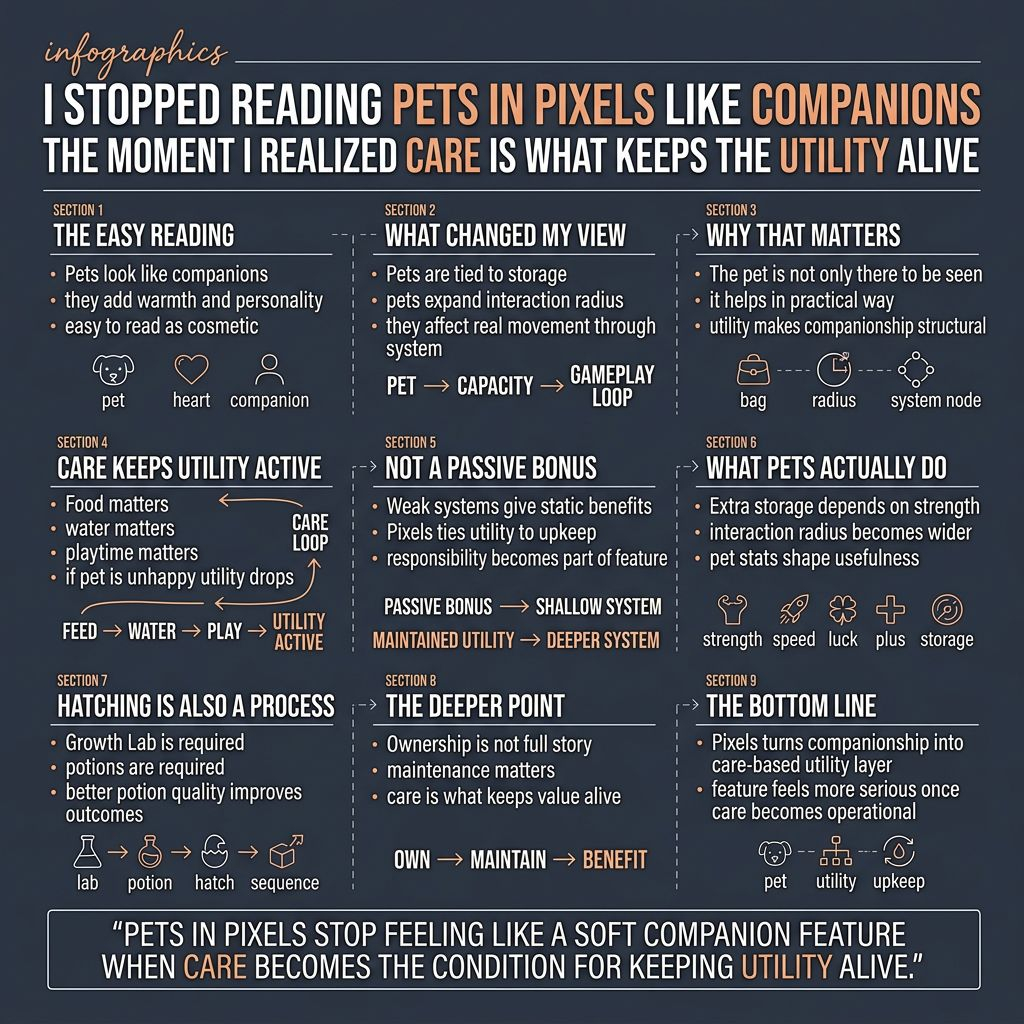
At first, I read them in the most obvious way possible. A pet follows you around. It gives the world a little more personality. It makes the game feel warmer, more alive, more personal. That is the easy reading. And honestly, that is where I thought the whole thing would end too. But the more I sat with the official structure, the less pets felt like a soft cosmetic layer and the more they started feeling like one of the clearest examples of how Pixels thinks about systems.
That is where my view changed.
Because Pixels does not really treat pets like passive companions. It treats them more like utility that has to be maintained. That difference matters to me more than it looks on the surface. A lot of games are happy to give players companions that mostly exist for attachment, status, or visual charm. Pixels goes somewhere more interesting than that. Here, pets are tied to storage. They are tied to interaction range. They are tied to stats. And most importantly, they are tied to upkeep. The pet is not just there with you. It is helping you in a practical way, and whether that help stays active depends on how you treat it.
That is the part that caught my attention.
The moment a companion starts affecting carrying capacity, movement efficiency, or the way you interact with the world around you, it stops feeling secondary. It becomes part of the real loop. And once the system says that happiness affects whether that utility remains available, care stops feeling decorative too. It becomes operational. Food, water, playtime — those things are not there just to make the pet feel alive. They are there because the game wants the benefit to stay connected to responsibility. I think that is a much smarter design choice than people give it credit for.
And honestly, this is where weaker systems usually lose me.
A weaker system loves the look of companionship, but not the discipline behind it. It gives you something cute, maybe throws in a passive bonus, and then leaves the relationship mechanically empty. You own it, so you benefit from it. End of story. Pixels reads differently because ownership is not the full story here. Maintenance matters. Condition matters. The system does not only ask whether you have the pet. It quietly asks whether you are keeping the relationship with that utility alive. To me, that makes the whole thing feel more intentional.
That difference matters to me.
Because once care starts controlling access to utility, the emotional layer and the system layer stop sitting apart from each other. They start reinforcing each other. A pet is still a companion, yes. But it is also a managed layer of value. And I think that is why this part feels more serious than it looks at first. The game is not only asking the player to like the pet. It is asking the player to sustain what the pet provides.
That is where pets started reading differently to me.
And the hatching process pushes that idea even further. Pets are not framed like something you casually click and receive. There is process behind them. There is setup behind them. There is preparation behind them. You need the Growth Lab. You need potions. You need the potions to be made well if you want stronger outcomes. That stayed with me because it means the system is not only building maintenance after the pet exists. It is building intentionality before the pet exists too. The companion layer begins with process, then continues through upkeep. That is not accidental design.
I think that part says a lot about how Pixels thinks.
Because the deeper pattern here is not really about pets alone. It is about how the game keeps refusing to make useful things fully passive. It keeps pulling value back toward participation, upkeep, and player discipline. The same logic shows up here very clearly. The pet can help you. The pet can expand your capacity. The pet can make the world easier to move through. But the benefit is not supposed to feel detached from your behavior. It is supposed to stay connected to how you play, how you maintain, and how seriously you treat the system around you.
That is where the feature started feeling stronger to me.
A lot of people will still look at pets and mostly see charm. I understand that. Charm is part of the design. But I think that is still the surface reading. The deeper reading is that Pixels has turned companionship into a care-based utility layer. Strength matters. Speed matters. Luck matters. Happiness matters. Process matters. None of that feels random to me. It feels like the game is taking something that could have stayed cosmetic and making it structurally relevant instead.
And that difference matters to me more than people admit.
Because the easiest version of a pet system is always the same: collect it, show it, enjoy it. The harder version is: collect it, build it, maintain it, and keep earning the right to benefit from it. Pixels feels closer to the second one. That is why I do not really read pets here as a light side feature anymore. I read them as a quiet example of how the game tries to connect usefulness to care rather than letting utility sit there for free once unlocked.
That is the part that stayed with me.
I do not think pets in Pixels become interesting when they simply make the world feel more alive. I think they become interesting when care stops looking sentimental and starts looking structural. Once I saw that, the whole feature changed for me.
For me, that is where Pixels starts feeling more thoughtful.
Not when a pet looks like a companion.
When care becomes the condition for keeping utility alive.