
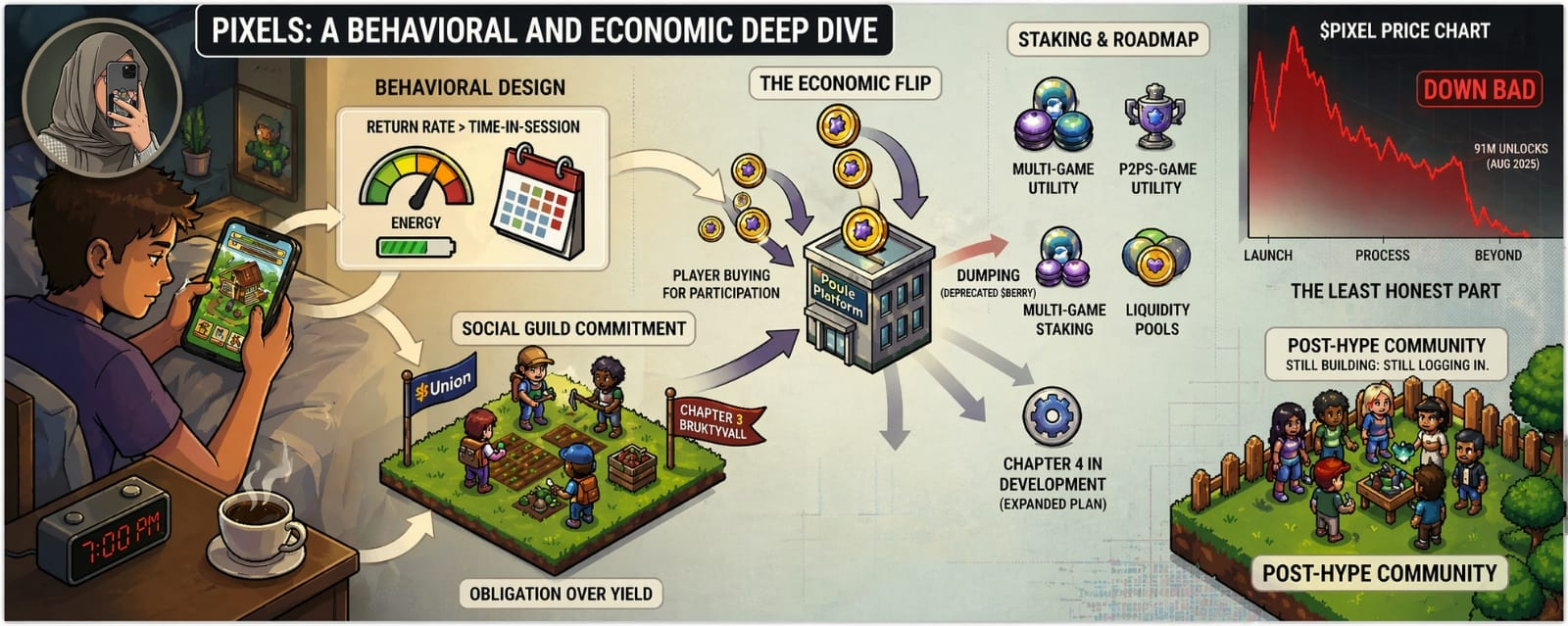

There's a version of this piece where I lead with a price chart.
This isn't that.
Partly because I'm not a technical analyst. Mostly because the price chart is the least honest part of this story.
If you want to understand what's actually happening with Pixels underneath the token volatility, underneath the GameFi noise you have to look somewhere else.
You have to look at behavior.
Specifically, mine.
Which is uncomfortable to admit. But here it is: $PIXEL became part of my morning routine sometime in the last few months, and I didn't notice until it was already set. Before the news. Before email. In that half-awake window between the alarm and actually starting the day.
I didn't decide to make it a habit.
It decided for me.
That's the part I keep returning to. Because it didn't happen with other games. Didn't happen with other tokens I've held or followed or believed in for a while. Something about Pixels specifically built a loop I never consciously agreed to enter and by the time I noticed, I was already deep inside it.
The Energy System is Not What It Looks Like
My first reaction to hitting the energy cap was frustration.
You're playing. Making progress. Then the game tells you that's enough. Come back later.
In a medium that's spent thirty years conditioning players toward unlimited sessions, that feels like friction. A leash. Bad design.
It isn't.
What the cap actually does is end the session before boredom does. You don't grind until the enjoyment hollows out. You do what you can, the game cuts you off cleanly, you leave while it still felt worthwhile.
Then you come back tomorrow and the day after.
And somewhere in that cycle without urgency, without FOMO, without a single notification demanding your attention the behavior sets.
That's more sophisticated session design than most Web3 games attempt. Most traditional games too, honestly. The industry spent decades optimizing for time-in-session. Pixels optimized for return rate instead.
Those are not the same thing. Almost nobody treats them as different.
The Tokenomics Move Nobody Talked About Enough
The old dual-token model was quietly dying.
$PIXEL as the primary asset. A structure the sector has run before and the arc is always the same. Farming scales. Supply outpaces demand. The in-game currency devalues. Veterans exit. New players inherit a broken economy while the UI stays identical.
The health deteriorates underneath. The screenshots still look fine.
The team deprecated BERRY entirely.
One token. Consolidated incentives. Dramatically less surface area for the spiral to find.
Boring decision. Correct decision. The kind of call that doesn't trend on CT but separates projects that survive from projects that don't.
Then May 2025.
Quietly. No announcement thread. No viral post about it.
For the first time, more $PIXEL flowed into the game than out. Net positive. In a sector where net outflow is essentially the permanent default where farming pressure and mercenary capital create constant sell-side gravity that almost nothing escapes the economy flipped direction.
Players were buying PIXEL to participate.
Not farming it to dump.
I sat with that for a while. It's the kind of signal that doesn't make headlines.
It probably should.
What Bountyfall Actually Changed
Chapter 3 wasn't a content update.
It was a different game.
Earlier chapters were deliberately casual. Low friction, accessible, patient with players still learning Web3 mechanics. Smart onboarding strategy. But casual has a ceiling once you know the systems, individual motivation to keep showing up quietly weakens. The loop gets thinner. You start skipping days.
Bountyfall introduced Unions. Team competition. Yieldstones. Sabotage mechanics.
Suddenly you weren't farming alone.
You had teammates. Obligations. People who noticed when you went quiet.
That's when I realized I was already inside something I hadn't fully understood.
Because it's not yield holding those players. It's something older and less rational than yield. The mild social guilt of letting people down. The same force that kept people raiding in World of Warcraft at midnight. The same thing that makes you show up to things you'd otherwise skip.
Web3 games almost never get this right. The sector is so fixated on individual token rewards it forgets players are social animals first, yield optimizers second.
Pixels remembered.
The Honest Part
The token is down significantly from peak.
91 million tokens unlocked in August 2025. Real supply pressure. A broader market that has been skeptical of GameFi for legitimate reasons. YouTube's crackdown on Web3 gaming content cut organic discovery across the whole sector quietly, without drama, and it hurt.
These aren't footnotes.
But here's the tension I can't resolve cleanly: the people still in Pixels aren't waiting for the price to recover before they log in. They're just logging in. Building farms. Running guild strategy. Debating task optimization like it's a part-time job they actually want.
Post-hype. Post-pump. Post every green candle that might have justified the attention.
Still here.
That community composition is rarer than any metric I know how to cite. Hype brings people in. Structure real structure, behavioral structure keeps them. And the only way you build that is by not optimizing for the launch.
The team is still shipping. Chapter 4 in development. Multi-game staking extending PIXEL utility beyond a single title. A founder who has been clear that the vision is a platform, not a game a user acquisition engine for Web3 gaming broadly, not one title competing on novelty until the narrative moves on.
That's the kind of architectural thinking that's easy to dismiss when the chart is red.
It's also the only kind that matters.
What I Actually Think
I stopped calling it a game at some point.
I don't remember when exactly.
It's down bad. I open it every morning. Those two facts sit next to each other without resolving, and I've stopped trying to make them resolve.
The people still here aren't here because the numbers are good. They are here because the routine formed before they thought to question it. Before the price gave them a reason to stay or a reason to leave. The habit was already set.
In a market that runs entirely on attention where the average project's community has a half-life measured in months that's the hardest thing to build.
Pixels built it.
Whether PIXEL reflects that over the next six months, I genuinely don't know.
But I'll open it tomorrow morning. Before the news. Before I've fully decided to be awake.
Before I've had the chance to ask myself why.
And maybe that's the most unsettling thing I can say about it.
I'm not sure I want to know the answer.
