
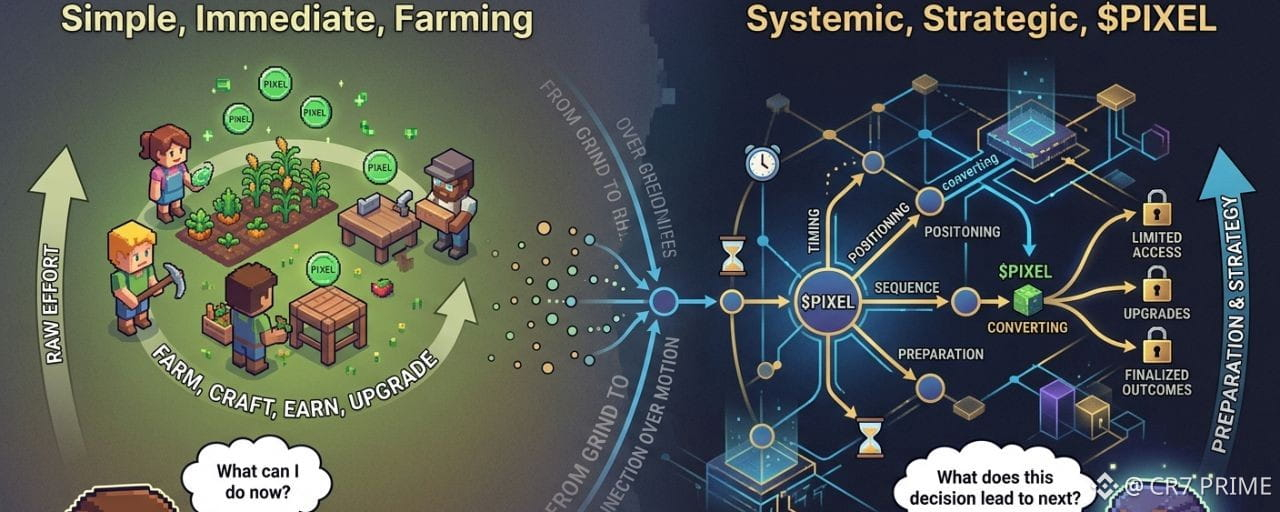
I did not notice the shift immediately. At first, Pixels felt straightforward. You farm, craft, earn, upgrade, repeat. The world stays busy, rewards keep moving, and everything feels like progress. On the surface, it looks like a smooth loop where effort naturally turns into value.
But after spending more time inside the system, that feeling changed.
I started noticing that activity alone was not enough. Two players could spend similar time, follow similar loops, and still end up with very different outcomes. Some actions felt productive, while others felt strangely empty. Nothing looked broken, yet the results were uneven enough to make me stop and think.
That was the moment Pixels started becoming more interesting to me.
I slowed down and began watching more carefully. Not just what an action gives in the moment, but what it unlocks next. That changed everything. I realized the system is not simply rewarding movement. It is rewarding connection. Timing, sequence, positioning, and readiness matter more than they first appear. A resource does not hold the same value in every situation. Sometimes using it early weakens your position later. Sometimes waiting creates more value than acting immediately.
That is also where the difference between newer players and experienced players becomes very clear.
New players usually respond to what is visible. If an action gives rewards, they take it. If something is available, they use it. That feels natural. But veteran players often behave differently. They hesitate. They wait. They skip things that look useful on the surface. At first that seems irrational, but over time it becomes obvious that they are not reacting to the game. They are reading the system behind it.
And that deeper layer is what Pixels rarely explains directly.
You are not told to optimize timing. You are not told which decisions matter most. Instead, the game lets you experience patterns until you begin to recognize them yourself. That design is subtle, but powerful. It slowly moves your thinking away from “What can I do right now?” and toward “What does this decision lead to next?”
That same shift changed how I started thinking about $PIXEL too.
At first, it is easy to see PIXEL just another reward token inside a growing game economy. But the more I watched, the less that explanation felt complete. Most of the gameplay is fluid and low-friction. Players farm, craft, trade, and keep the world moving. But when a meaningful opportunity appears, a valuable upgrade, limited access, or something that needs to be finalized, the system tightens. Suddenly it is no longer about who stayed busy. It is about who is ready to act when that moment arrives.
That is where PIXEL feels different.
It does not just reward participation. It often acts more like a layer of conversion between effort and outcome. If you have it ready when the right moment comes, you move forward. If you do not, you wait, or you miss the chance entirely. Over time, that difference compounds. The same players keep appearing where value gets locked in, not always because they did more work in that instant, but because they were positioned in advance.
That dynamic reminds me less of a simple game loop and more of how real systems work. In markets, in business, even in personal finance, activity is not always the same as progress. Access, timing, and decision quality usually matter more than raw motion. Pixels quietly reflects that idea. It still looks open on the surface, and in many ways it is. Anyone can enter, play, and participate. But not every action carries the same economic weight. Some actions stay in the background. Others pass through the system and become something final.
That is why Pixels stopped feeling confusing to me.
The confusion disappeared when I realized the game was not built only around doing things. It was built around understanding how things connect. Once that clicked, the uneven outcomes started making sense. The economy is not just rewarding grind. It is recognizing preparation, sequencing, and the ability to see one step ahead.
And that is what makes Pixels more interesting than it first appears.
It starts like a casual system built around farming, crafting, and earning. But over time, it begins to train a different mindset. You stop reacting to isolated rewards and start thinking in patterns. You stop asking what is available now and start asking what matters later. The mechanics stay the same, but your relationship with them changes.
So now I keep coming back to the same question.
If a system rewards thinking ahead more than acting immediately, if understanding matters more than activity, then what exactly is Pixels becoming for the player?
A game?
Or a system that quietly teaches how better decisions are made over time?
