
There’s a small tea stall a few minutes from where I live. Nothing special about it really. A metal counter, a few plastic chairs, and a television that’s usually showing the news or a cricket match. In the evenings people gather there, not always to talk about anything important, mostly just to sit and watch the street settle down.
A few nights ago I was there after dinner, scrolling through my phone while waiting for tea. Out of habit more than intention, I opened Pixels.
The screen looked exactly like it always does. Crops ready to harvest. Energy to spend. Tasks lined up in the familiar order. If you’ve played long enough, you know the rhythm without thinking. Tap here, move there, collect the reward, start the next loop.
It’s almost automatic.
But that night, sitting there with the noise of traffic and conversations drifting around me, I caught myself slowing down. Not because something was wrong in the game. Everything was functioning exactly as expected.
What caught my attention was something else entirely.
I realized I wasn’t really thinking about the farming or the tasks anymore. I was thinking about the structure underneath them.
Because once you spend enough time around crypto ecosystems, you start recognizing that many of them are trying to answer the same question, just in different ways.
Who deserves the rewards?
And how do you decide that fairly?
For a long time, the answers in this space were messy. Early token distributions often felt chaotic. Bots moved faster than humans. Airdrops landed in the wrong places. Participation was hard to measure and even harder to reward properly.
So newer systems began experimenting with credentials and participation tracking. The idea is simple enough. Instead of guessing who contributed, you try to observe behavior directly.
You see who shows up.
You see what they do.
You see how consistently they engage.
Then you translate those actions into eligibility.
At first glance, it feels like a step forward. There’s logic behind it. A sense that effort might actually count for something. Compared to the randomness many people experienced before, that structure brings a certain comfort.
But fairness in crypto rarely stays simple.
The moment a system connects behavior to rewards, people start studying that connection carefully. Not necessarily to break it. Most of the time, they’re just trying to understand it.
Players notice which actions matter.
They notice which ones don’t.
And before long, patterns start spreading.
Someone discovers a more efficient way to move through the tasks. Another player shares it in a community chat. Within a few days, what started as a small trick becomes common knowledge.
The atmosphere changes slowly.
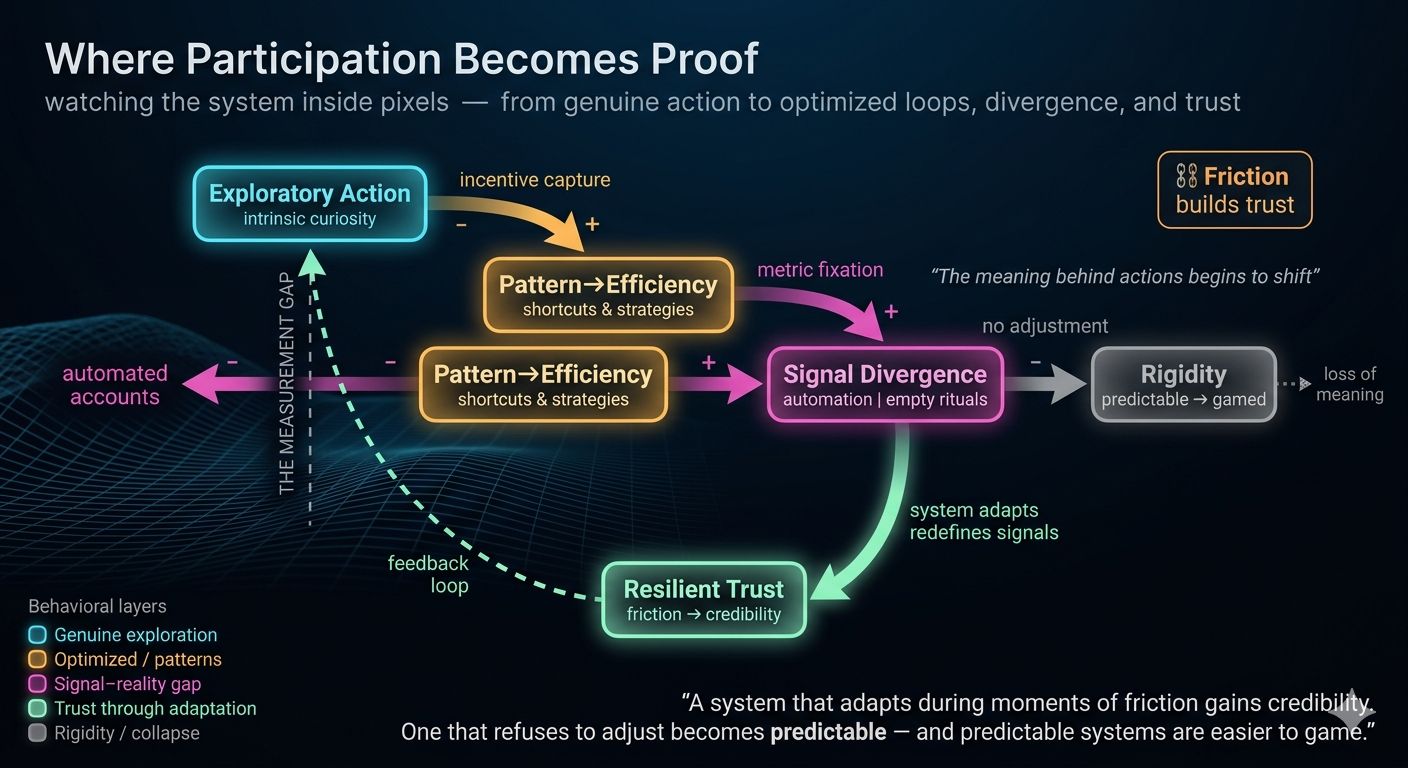
Instead of wandering through the game, people follow familiar routes. Instead of experimenting with different activities, they repeat the ones that produce reliable results.
Participation becomes structured.
And eventually, optimized.
None of this is unusual. In fact, it’s exactly how players behave in most games. If there’s a faster way forward, people will find it. If there’s a loop that produces rewards consistently, it will be repeated again and again.
That’s just human nature interacting with incentives.
Still, after enough time passes, something interesting begins to happen. The system continues working exactly as designed. Activity remains high. Tasks are completed efficiently. Metrics look healthy.
But the meaning behind those actions begins to shift.
What the system measures may no longer represent the same thing it once did.
Credential systems rely on signals. They assume that if someone performs certain actions repeatedly, those actions reflect genuine engagement. For a while, that assumption works well enough.
Then the unusual cases start appearing.
A player who technically qualifies for every reward but barely interacts with anyone else.
An automated account that performs tasks perfectly, simply because it never gets distracted.
A longtime participant who contributes in ways that don’t show up clearly in the system’s measurements.
Situations like these slowly raise questions that aren’t easy to answer.
What counts as participation?
Which actions actually create value for a community?
And who decides which signals deserve the most weight?
These aren’t purely technical problems. They’re social questions, even though they’re expressed through code and mechanics.
That’s part of what makes Pixels an interesting place to observe these dynamics. Games tend to reveal incentive structures faster than most platforms because players interact with them directly. They test boundaries. They experiment with strategies. They push systems in ways designers didn’t always expect.
When credentials and token distribution are layered on top of that environment, the game becomes something more complex.
It becomes a behavioral experiment.
Players adapt to incentives.
Designers watch those adaptations.
And over time, both sides influence how the system evolves.
Lately I’ve found myself paying attention to those changes more closely. Not the obvious signals like token discussions or growth charts. Those things are easy to track.
What interests me more are the smaller shifts.
The way strategies circulate through communities.
The habits players form after spending months inside the same environment.
The subtle moments when conversations move from excitement to quiet curiosity.
Because those moments often reveal something deeper about trust.
Trust rarely comes from perfect design. It develops through friction. A system that works smoothly when conditions are ideal doesn’t prove much on its own. The real test begins when things become complicated.
When unexpected situations appear.
When users start discovering edges the designers never anticipated.
When people begin asking questions that don’t have immediate answers.
A system that can adapt during those moments tends to gain credibility over time. One that refuses to adjust often becomes predictable. And predictable systems are easier for people to work around.
Time matters here as well.
Many projects in this space try to establish legitimacy quickly. They want proof that participation has meaning right away. But trust usually forms more slowly than that.
It grows through observation.
Through repeated interactions.
Through the gradual realization that the system can handle pressure without collapsing.
Credentials, in that sense, might work best when they’re not treated as permanent labels. Instead of fixed badges that last forever, they could function as evolving records of behavior. Something that reflects not just what someone did once, but how they continue to participate over time.
Designing systems like that isn’t easy. It requires patience and a willingness to revisit earlier assumptions. But without that flexibility, credential structures risk becoming rigid.
And rigid systems rarely stay fair for long.
From where I’m sitting, Pixels still feels like a system in motion rather than a finished model. Player strategies continue to evolve. Participation patterns shift. Designers observe and adjust where they can.
Some outcomes will strengthen the ecosystem.
Others will expose weaknesses that need to be addressed.
That’s normal for any system that’s still learning about the people inside it.
So these days I approach it with a different mindset. I still log in. I still play. But I also pay attention to the quieter signals.
The habits forming.
The strategies repeating.
The moments when something small feels slightly different than before.
Because systems like this rarely prove themselves during their most successful periods. Their real character shows later, when uncertainty appears and the community begins asking harder questions.
And in crypto, those questions always arrive eventually.