
At first, it was normal stuff. Just logging in, doing the usual things, not really thinking too much about it.
That’s probably when my attention shifted.
Not toward what I was earning… but toward why I was earning it.
And once that shift happens, you can’t really unsee it.
Pixels right now is moving fast. Maybe faster than most people realize when they’re just playing day to day.
All of this didn’t take long. And honestly, I still can’t fully shake that feeling. It feels like systems being built properly. Still… speed changes how people absorb things. Not everyone is keeping up with the same layer of understanding.
That part still sits with me.
One thing I keep coming back to is this, staking isn’t just staking here.
It kind of is governance, even if it isn’t always labeled that way.
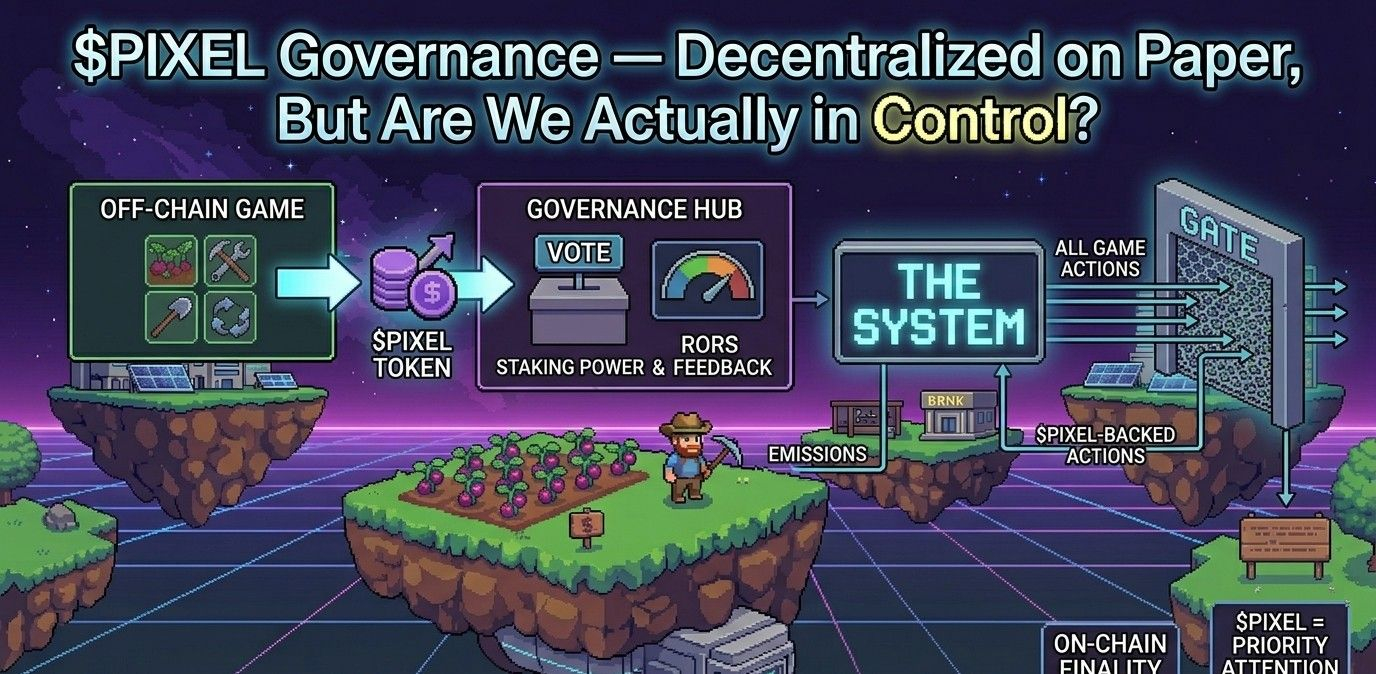
When you stake $PIXEL into Pixels Core, Pixel Dungeons, or Forgotten Runiverse, you’re indirectly deciding where emissions go. And in Phase Two, that becomes even clearer, more staking into a game means more reward allocation for that game.
So basically, community behavior starts shaping which games grow and which ones slow down.
We went from BERRY → Coins → $PIXEL becoming the main token. Then Chapter 2.5 came in and inflation got cut pretty heavily. Then staking launched, vPIXEL showed up, Farmer Fees were introduced, reward feedback system became something everyone suddenly had to understand, and now community voting system governance is somewhere ahead in the roadmap.
That realization sits differently once it clicks. I keep thinking about that.
This part took me a bit longer to understand properly.
Because it’s not just about how much $PIXEL you have staked, it’s also about how long and how consistently you stay staked.
That sounds simple, but it actually changes the whole idea of influence. It rewards stability more than constant switching.
And I’ll be honest here, I used to move allocations around a lot. Pixel Dungeons one week, Core the next, chasing better emissions without really thinking deeper about what that behavior signals.
Looking back, it makes sense individually.
But in reality, it’s tracking whether emissions going into a game are actually being supported by real activity inside that game.
And this is where it gets interesting.
Because even players who don’t touch staking at all are still part of it.
Every time someone farms, spends, converts resources, they’re indirectly affecting that balance.
Most people don’t realize that though. They just see gameplay. Which is fair.
But underneath, that behavior is feeding into how emissions might get adjusted later.
It’s kind of invisible unless you intentionally look for it.
The land NFT system adds another layer that’s hard to ignore once you notice it.
But when you scale it, it creates a noticeable difference in governance weight between players.
And that naturally connects influence to early entry and capital strength.
I don’t think it’s necessarily wrong. It just feels like that’s how it’s set up. It just quietly shapes the system over time.
What sticks with me though is this:
The players most affected by changes daily farmers, people adjusting to fees, drops, conversions often aren’t the ones with the most governance weight.
That doesn’t break anything. But it definitely bends the direction slightly.
That part still sits with me.
I understand why it’s built like this.
The team has been transparent. Updates are detailed. Docs exist. Nothing is hidden.
But there’s still a gap between information existing and information being fully understood in a usable way.
Most people aren’t breaking down reward feedback system or thinking about how emission shifts affect long-term supply pressure.
And again, that’s not criticism. It’s just reality.
Most people are here to play, not model an economy.
But governance doesn’t really separate those two roles cleanly.
The community voting system part is where things start to feel more serious.
Because once decisions go fully on-chain, there won’t really be a buffer anymore between understanding and action.
At that point, the vote becomes the decision.
And that raises a question I keep coming back to maybe more than anything else:
How many people voting will actually understand what they’re shaping?
Not just on the surface… but structurally.
I don’t think @Pixels is doing anything wrong here.

If anything, the system feels intentionally designed. The staking model, emission routing, how rewards reflect real activity loop , it all connects in a way that suggests real system thinking, not random feature building.
But even well-designed systems can have gaps.
And I think the biggest one here isn’t technical.
It’s understanding.
How many people actually see what their participation is shaping… and how many are just participating without fully realizing it?
Because at some point, governance stops being something separate from the game.
And just becomes part of how the game is played, whether you’re thinking about it or not.