
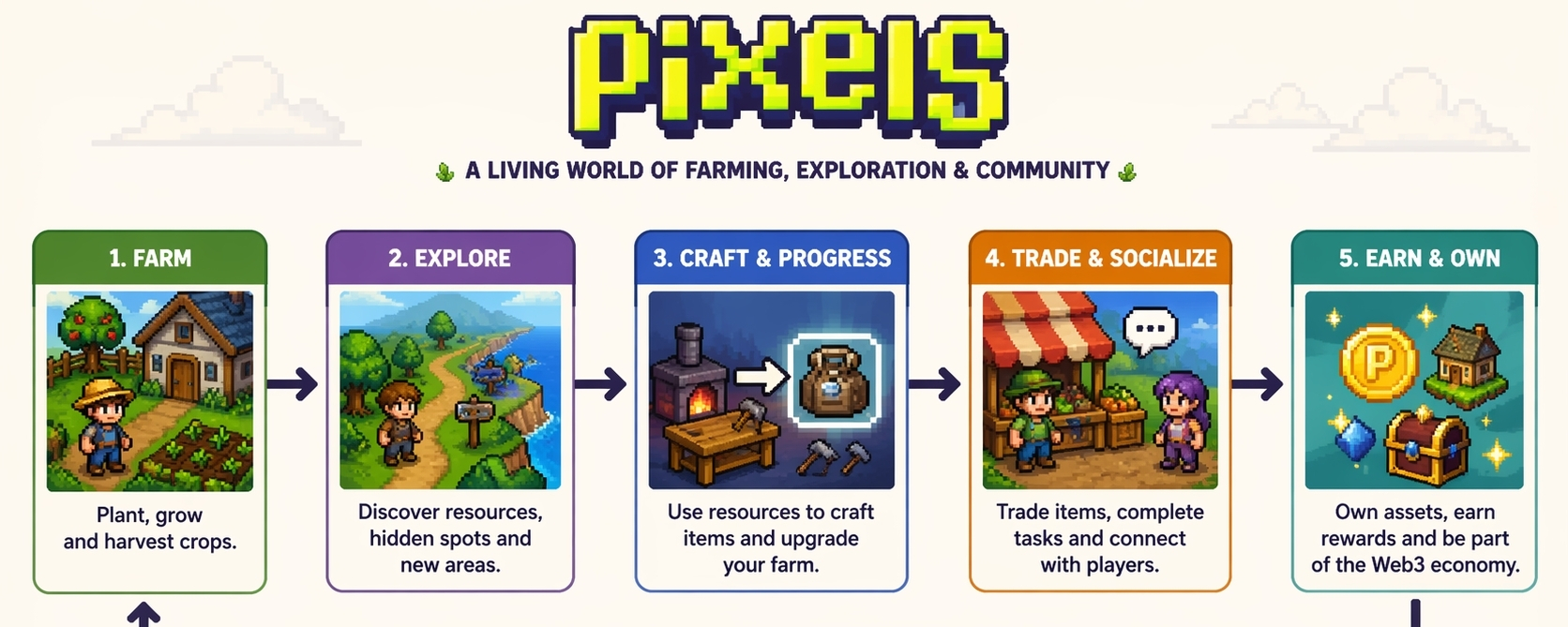
There’s something quietly satisfying about games that don’t rush you. No countdown timers breathing down your neck, no constant pressure to win. Just you, a bit of land, and the freedom to decide what comes next. That’s the kind of experience you step into with — a game that looks simple at first glance but slowly opens up into something much bigger.
Built on the , Pixels mixes familiar farming mechanics with the ideas behind Web3. But instead of throwing technical jargon at players, it eases you in. You don’t need to understand blockchain to enjoy planting crops or exploring the map. That part comes naturally.
A World That Feels Alive
The first thing most players notice is how open everything feels. You’re not locked into a strict path. You can farm, sure—but you can also wander around, meet other players, trade items, or just stand there watching the world move.
It’s not trying to overwhelm you with objectives. Instead, it gives you space. That space is what makes it feel more like a world than just a game.
Imagine logging in after a long day. Instead of intense action, you water your crops, maybe expand your land a little, and then take a walk across the map. Along the way, you bump into someone building something, another player harvesting resources, or a group chatting near a marketplace. It feels… casual, in a good way.
Farming, But Not the Boring Kind
At its core, Pixels is still a farming game. You plant seeds, wait, harvest, and repeat. But it doesn’t stay repetitive for long.
As you progress, farming connects to other parts of the game. Crops can be used for crafting, trading, or completing tasks. You start to realize your little farm is part of a bigger system.
There’s also a small but important detail—progress feels earned. You don’t suddenly jump from beginner to expert overnight. It builds slowly, which makes upgrades and expansions feel more meaningful.
Exploration That Actually Matters
A lot of games say they have “exploration,” but it usually means empty areas with little purpose. Pixels handles this differently.
When you explore, you find resources, hidden spots, and sometimes opportunities you weren’t expecting. The map isn’t just decoration—it’s part of the gameplay.
You might head out looking for one thing and end up discovering something completely different. That unpredictability keeps things interesting without forcing it.
The Social Side Feels Natural
Some games try too hard to push social interaction. Pixels doesn’t. It just lets it happen.
Players gather naturally around shared goals—trading, farming, crafting. There’s no pressure to talk, but the option is always there. Over time, you start recognizing familiar names, which adds a sense of community without making it feel like a chore.
It’s closer to a digital neighborhood than a competitive arena.
Where Web3 Actually Makes Sense
Let’s be honest—“Web3 gaming” can sometimes feel confusing or overhyped. Pixels takes a more grounded approach.
Instead of making everything about tokens and ownership, it uses blockchain in the background. Items, land, and in-game assets can have real value, but the game doesn’t shove that in your face.
You can just play it like a normal game.
But if you do want to go deeper, that option is there. You can trade assets, earn rewards, and participate in the economy. It’s flexible, which is probably why it appeals to both casual players and more serious ones.
A Game That Grows With You
One of the more interesting things about Pixels is how it changes over time—not just through updates, but through the players themselves.
The more people play, the more the world evolves. Markets shift, popular areas change, and new strategies emerge. It doesn’t feel static.
That kind of growth gives the game longevity. You’re not just finishing levels—you’re part of something that keeps moving.
Not Perfect, But That’s Part of the Charm
Pixels isn’t trying to be flawless, and that’s actually part of why it works. It has rough edges, moments where things feel slow, or systems that take time to understand.
But those imperfections make it feel real. Like a place still being built rather than something polished to the point of feeling artificial.
Why It Stands Out
There are plenty of farming games. There are plenty of blockchain games. But not many manage to combine both without losing their identity.
Pixels stands out because it doesn’t try too hard.
It doesn’t overload you with mechanics.
It doesn’t rush your progress.
It doesn’t force you into a specific playstyle.
Instead, it gives you a simple starting point—and lets you figure out the rest at your own pace.
Final Thoughts
Pixels isn’t just about farming or earning tokens. It’s about spending time in a space that feels relaxed, flexible, and quietly engaging.
Some days you’ll log in with a plan.
Other days you’ll just wander around and see what happens.
And oddly enough, both feel equally rewarding.
That balance is hard to get right but Pixels manages it in a way that feels natural, not forced.
