

I don’t think people outside crypto really understand how tired some of us are.
Not the dramatic kind of tired. Not the “bear market blues” tired. Just… worn down. The kind that comes from watching the same patterns play out over and over again with slightly different branding. New coins show up every week, AI gets slapped onto everything whether it belongs or not, influencers recycle conviction like it’s a template, and somehow we all pretend this cycle is more “mature” than the last one.
Honestly, it doesn’t feel more mature. It just feels more crowded.
You scroll through timelines and it’s a blur of charts, threads, “next big thing” takes, and ecosystems that all start to sound interchangeable if you read enough of them. Even the excitement feels rehearsed now. Like everyone knows the script.
So when something like Pixels shows up, it doesn’t hit you like a revelation. It hits you more like… a pause.
Because Pixels isn’t loud. It’s not trying to convince you it’s the future of civilization. It’s a farming game. Pixel art, simple loops, wandering around planting crops and collecting resources. If you strip away the crypto layer, it’s the kind of thing you’d play half-asleep just to relax your brain.
And maybe that’s exactly why it stands out a little.
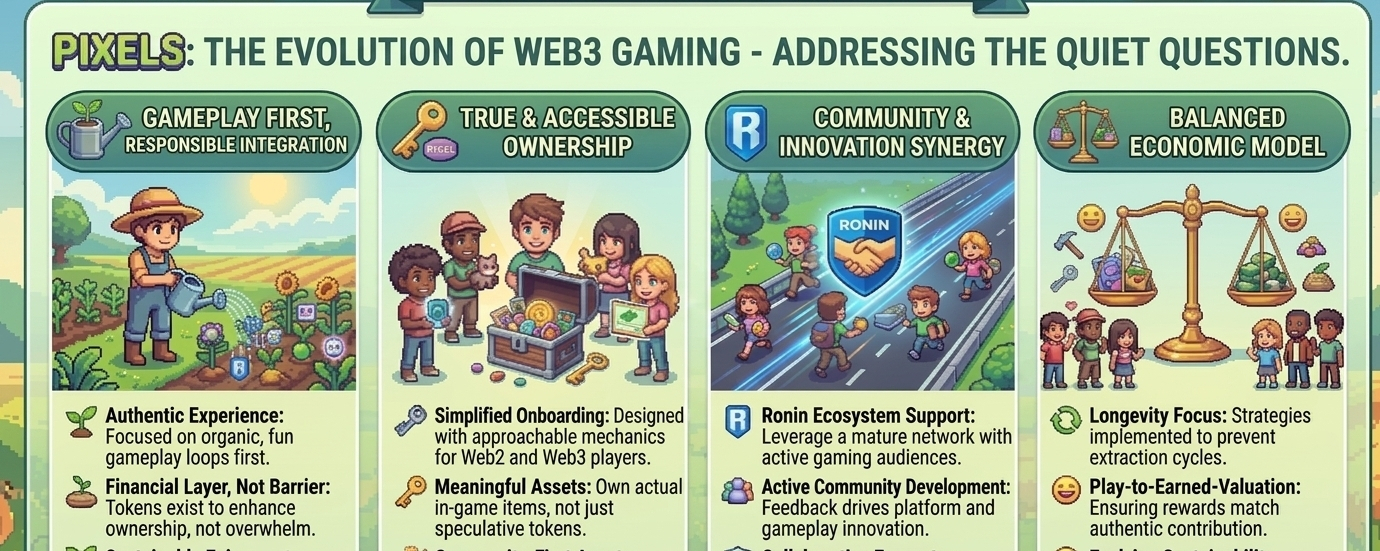
Let’s be real, most Web3 games feel like financial products pretending to be games. You can feel the economy before you feel the gameplay. Pixels, at least on the surface, tries to reverse that. You log in and you’re not immediately thinking about APRs or token emissions. You’re just… farming.
For a few minutes, it almost feels normal.
But of course, this is still crypto. That layer is always there, even if it’s not screaming at you right away.
There’s a token, PIXEL, tied to the ecosystem. There’s in-game currency, progression tied to ownership, a whole structure sitting underneath what looks like a casual experience. And that’s where the familiar tension creeps back in.
Because we’ve seen what happens when games and tokens start leaning too hard on each other.
At first, everything feels balanced. Players are exploring, earning, trading. There’s a sense of momentum. Then slowly, almost quietly, behavior changes. People optimize. They min-max. They stop playing for fun and start playing for output. The community shifts from players to participants, then from participants to extractors.
And that shift is subtle, but it’s everything.
That’s the part that worries me with Pixels.
Not because it’s doing anything particularly wrong, but because it’s walking a path that has historically been very hard to get right. A calm farming game is supposed to feel slow, even a little pointless in a comforting way. You log in, do small tasks, log out. There’s no pressure.
But once there’s value attached to your time, pressure sneaks in whether you want it or not.
Even if the game doesn’t force it, the players will.
And once that happens, the entire vibe changes.
To be fair, Pixels does have something a lot of projects don’t: actual users. Being on the Ronin Network isn’t just a technical detail, it’s a distribution advantage. That ecosystem already has people who are used to Web3 gaming, wallets, transactions. You’re not trying to explain everything from scratch.
That matters more than most people admit.
But it also creates a weird expectation. Because if you’re building in a place known for gaming economies, people aren’t just going to play. They’re going to analyze, compare, and eventually, test the limits of whatever system you’ve built.
And crypto players are very, very good at breaking systems.
Another thing I keep circling back to is onboarding. Pixels is often described as accessible, and yeah, compared to most Web3 projects, it probably is. It runs in a browser. It doesn’t hit you with complexity immediately.
But “more accessible than crypto” is still not the same as “accessible.”
At some point, the wallet becomes unavoidable. Tokens become relevant. Decisions carry financial weight. And that’s usually the moment where casual players—real casual players—start drifting away.
We’ve seen that gap before. It doesn’t always show up on charts right away, but you can feel it in the community over time. The tone shifts. The conversations change. The game starts speaking more to insiders than to newcomers.
And then there’s the token itself.
I’m not going to pretend I have a clean answer on whether PIXEL is necessary or just expected. That’s always the question, isn’t it? Every project has a token, but not every token has a reason to exist beyond funding and speculation.
Maybe PIXEL works as a coordination layer. Maybe it aligns incentives. Or maybe it just becomes another asset people trade while the game continues quietly in the background.
Honestly, I don’t know.
And I think it’s okay to admit that.
Because if there’s one thing crypto history has taught us, it’s that elegant token models on paper don’t always survive contact with real users. Economies inflate. Rewards get diluted. Early participants benefit more than late ones. And eventually, someone is left holding something that doesn’t behave the way they expected.
That doesn’t mean Pixels is destined for that outcome. But pretending the risk isn’t there would be dishonest.
Still, I keep coming back to one thing that feels… different, or at least less exhausting.
Pixels isn’t trying to solve everything.
It’s not positioning itself as infrastructure for the entire industry. It’s not layering AI on top just to stay relevant. It’s not promising to redefine ownership in some grand, abstract way.
It’s just taking a very simple idea—owning what you earn in a game—and applying it to something small and understandable.
And that problem is actually real.
For decades, players have spent time and money in games where nothing truly belongs to them. Servers shut down, accounts get banned, items disappear. All that effort just… vanishes. The idea that you could actually keep something, even something as small as a virtual plot of land or a resource you farmed, isn’t crazy.
It’s just been poorly executed in the past.
So maybe Pixels is another attempt at getting that balance right. Not perfectly, not permanently, but incrementally.
Or maybe it ends up following the same trajectory as everything else. Early traction, growing attention, increasing financialization, and then a slow drift away from the original experience.
Maybe it works, maybe it doesn’t.
At this point, I’ve stopped trying to force certainty where it doesn’t exist.
What I can say is this: Pixels feels like one of the few projects that isn’t shouting at me. And after years in this space, that alone is noticeable.
But quiet doesn’t mean safe. Simple doesn’t mean sustainable. And fun—real fun—is still the hardest thing to build when money is involved.
So I’m watching it, not with excitement, but with cautious curiosity.
Which, honestly, might be the most realistic stance left in crypto right now.